
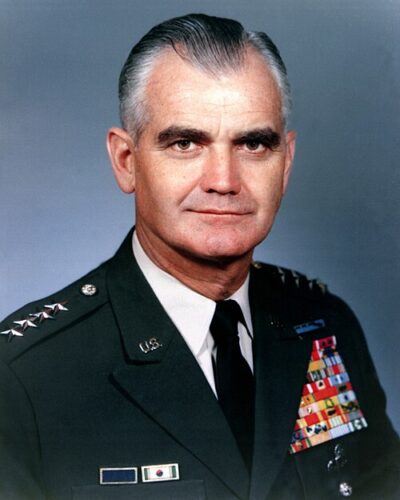
William Westmoreland
William Westmoreland was an United States Army general. Born March 26, 1914, in Spartanburg. Died July 18, 2005, in Charleston. Positions held include Chief of Staff of the United States Army (1968–1972). Educated at Harvard Business School and Harvard University. Awards include Bronze Star Medal, Legionnaire of Legion of Merit and Air Medal.
Facts
35 facts · 2 confirmed by two sources · 4 cited · 29 from one source
Where this comes from
Papalocal keeps its own record. It started from these sources; what each one said is kept here as it was copied, so a change on their side never changes this page by itself. Tap one to read its version.
What Wikidata says · copied November 13, 2026 · revision 2558284516
- Described as
- United States Army general (1914-2005)
- Other names
- William Childs Westmoreland, William C. Westmoreland
- Born
- March 26, 1914 · 8 references
- Died
- July 18, 2005 · 1 reference
- Born in
- Spartanburg · 1 reference
- Died in
- Charleston · 1 reference
- Buried in
- West Point Cemetery
- Cause of death
- Alzheimer's disease
- Citizen of
- United States
- Occupation
- army officer; politician
- Positions held
- Chief of Staff of the United States Army (1968–1972) · 1 reference
- Political party
- Republican Party
- Education
- Harvard Business School; Harvard University; United States Army Command and General Staff College; United States Military Academy; Spartanburg High School; United States Army War College
- Awards
- Bronze Star Medal; Legionnaire of Legion of Merit; Air Medal; Knight of the Legion of Honour; Distinguished Service Medal; World War II Victory Medal; National Defense Service Medal; Vietnam Service Medal; European-African-Middle Eastern Campaign Medal; Croix de guerre 1939–1945; Order of the Crown of Thailand; Order of Sikatuna; Order of the Holy Trinity; Vietnam Campaign Medal; Gallantry Cross
- Mother
- Eugenia Talley Westmoreland · 1 reference
- Military branch
- United States Army
- Military rank
- general · 1 reference
- Wikipedias with a page
- 44
Wikidata item Q298793 (wikidata.org/wiki/Q298793), public domain (CC0). Copied November 13, 2026.
What Wikipedia says · copied November 13, 2026 · revision 1384696009
William Childs Westmoreland (26 March 1914 – 18 July 2005) was a United States Army general, most notably the commander of United States forces during the Vietnam War from 1964 to 1968. He later served as Chief of Staff of the United States Army from 1968 to 1972.
Born into a prosperous family in Upstate South Carolina, he demonstrated leadership abilities from an early age as a Boy Scout and attended the US Military Academy in West Point, graduating at the top of his class in 1936. He excelled during his service in the European theater during World War II, and in the Korean War, leading to him becoming one of the youngest general officers of the time. After returning from Korea, he continued to climb the ranks within the army, serving as Superintendent of West Point from 1960 to 1963.
Following the French defeat at Dien Bien Phu in 1954, American involvement in Vietnam steadily escalated, beginning with combat advisors. Westmoreland was sent to South Vietnam in January 1964, and took command of Military Assistance Command, Vietnam (MACV) in June. In Vietnam, Westmoreland adopted a strategy of attrition against the Viet Cong and the North Vietnamese People's Army of Vietnam, to drain them of manpower and supplies. He used artillery and air power on a huge scale.
As time went on and success was not gained, public support for the war diminished, especially after the Battle of Khe Sanh and the surprise Tet Offensive in 1968. By the time he had left his command, American military forces in Vietnam had reached a peak of 535,000 personnel. Westmoreland's strategy was ultimately unsuccessful, due to growing American casualties and reliance on conscription, which undermined support for the war and weakened South Vietnamese support. Historians continue to debate his effectiveness as a commander and his emphasis on body count.
- Born, in its opening lines
- March 26, 1914
- Died, in its opening lines
- July 18, 2005
From the Wikipedia article “William Westmoreland” (en.wikipedia.org/wiki/William_Westmoreland), by its contributors, under CC BY-SA 4.0 (creativecommons.org/licenses/by-sa/4.0/). Copied November 13, 2026; not changed.
Confirmed Two sources agree. Cited One source, and it names where it got it. One source One source, without a reference of its own. Sources disagree The sources disagree. We show the best-supported value and keep theirs below.
