
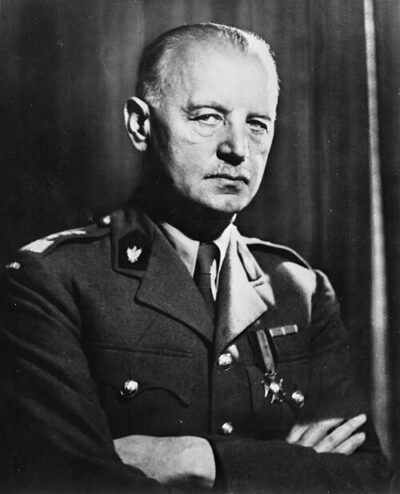
Władysław Sikorski
Władysław Sikorski was a Polish military and political leader. Born May 20, 1881, in Tuszów Narodowy. Died July 4, 1943, in Gibraltar. Positions held include Prime Minister of Poland (2 times) (1922–1943) and General Inspector of the Armed Forces (1939–1943). Educated at Lviv Polytechnic. Awards include Order of the White Eagle, Grand Cross of the Legion of Honour and Grand Officer of the Order of the Star of Romania.
Facts
35 facts · 2 confirmed by two sources · 5 cited · 28 from one source
Where this comes from
Papalocal keeps its own record. It started from these sources; what each one said is kept here as it was copied, so a change on their side never changes this page by itself. Tap one to read its version.
What Wikidata says · copied November 16, 2026 · revision 2562769071
- Described as
- Polish military and political leader (1881-1943)
- Other names
- Wladyslaw Sikorski, Władysław Eugeniusz Sikorski
- Born
- May 20, 1881 · 4 references
- Died
- July 4, 1943 · 9 references
- Born in
- Tuszów Narodowy · 1 reference
- Died in
- Gibraltar · 3 references
- Buried in
- St. Leonard's Crypt
- Cause of death
- 1943 Gibraltar B-24 crash
- Citizen of
- Poland
- Occupation
- politician · 1 reference; military personnel; head of government · 1 reference
- Positions held
- Prime Minister of Poland (2 times) (1922–1943); General Inspector of the Armed Forces (1939–1943)
- Political party
- independent politician · 1 reference; Front Morges · 1 reference
- Education
- Lviv Polytechnic
- Awards
- Order of the White Eagle; Grand Cross of the Legion of Honour; Grand Officer of the Order of the Star of Romania; Order of the Cross of Grunwald, 1st class; Decade of Independence Regained; Commander of the Order of Military Virtue; Silver Cross of the Virtuti Militari; Grand Cross of the Order of Polonia Restituta; Commander of the Order of Polonia Restituta; Cross of Valour; Grand Officer of the Legion of Honour; Grand Cross of the Order of the Aztec Eagle; Gold Cross of Merit; Cross of Merit of the Army of Central Lithuania; Order of the Three Stars, 2nd Class
- Spouse
- Helena Sikorska
- Children
- Zofia Leśniowska
- Religion
- Catholic Church
- Military rank
- general · 1 reference; General of the branch
- Wikipedias with a page
- 53
Wikidata item Q153132 (wikidata.org/wiki/Q153132), public domain (CC0). Copied November 16, 2026.
What Wikipedia says · copied November 16, 2026 · revision 1381664961
Władysław Eugeniusz Sikorski (Polish pronunciation: [vwaˈdɨswaf ɕiˈkɔrskʲi] ; 20 May 1881 – 4 July 1943) was a Polish military and political leader. Before World War I, Sikorski established and participated in several underground organizations that promoted the cause of Polish independence. He fought with distinction in the Polish Legions during World War I, and later in the newly created Polish Army during the Polish–Soviet War of 1919–1921. In the latter war, he played a prominent role in the decisive 1920 Battle of Warsaw.
In the early years of the Second Polish Republic, Sikorski held government posts including prime minister (1922–1923) and minister of military affairs (1923–1924). Following Józef Piłsudski's May 1926 Coup and the installation of the Sanation government, he fell out of favor with the new régime.
During World War II, Sikorski became prime minister of the Polish government-in-exile, Commander-in-Chief of the Polish Armed Forces, and a vigorous advocate of the Polish cause in the diplomatic sphere. He supported the reestablishment of diplomatic relations between Poland and the Soviet Union, which had been severed after the September 1939 Soviet invasion of Poland. Subsequently, in April 1943, Soviet leader Joseph Stalin broke off Soviet-Polish diplomatic relations after Sikorski asked the International Red Cross to investigate the Katyn massacres.
In July 1943, a plane carrying Sikorski plunged into the sea immediately on takeoff from Gibraltar, killing all on board except the pilot. The exact circumstances of Sikorski's death have been disputed and have given rise to various theories surrounding the crash. Sikorski had been the most prestigious leader of the Polish exiles, and his death was a severe setback for the Polish cause.
- Born, in its opening lines
- May 20, 1881
- Died, in its opening lines
- July 4, 1943
From the Wikipedia article “Władysław Sikorski” (en.wikipedia.org/wiki/Władysław_Sikorski), by its contributors, under CC BY-SA 4.0 (creativecommons.org/licenses/by-sa/4.0/). Copied November 16, 2026; not changed.
Confirmed Two sources agree. Cited One source, and it names where it got it. One source One source, without a reference of its own. Sources disagree The sources disagree. We show the best-supported value and keep theirs below.
