
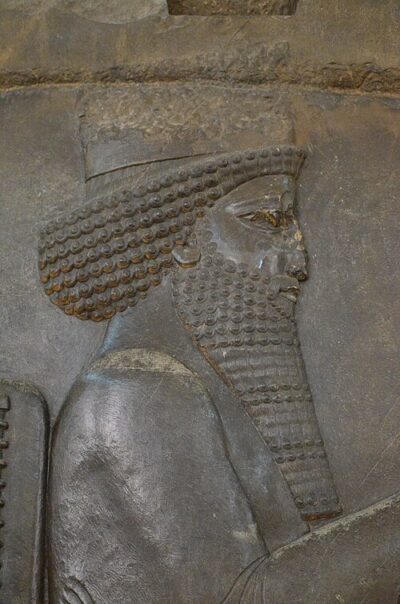
Xerxes I
Xerxes I was a fifth Achaemenid emperor. Born 519 BC, in Achaemenid Empire. Died August 465 BC, in Persis. Positions held include King of Kings (-486–-465) and pharaoh.
Facts
31 facts · 0 confirmed by two sources · 1 cited · 30 from one source
Where this comes from
Papalocal keeps its own record. It started from these sources; what each one said is kept here as it was copied, so a change on their side never changes this page by itself. Tap one to read its version.
What Wikidata says · copied November 16, 2026 · revision 2561374109
- Described as
- fifth Achaemenid emperor (486–465 BC)
- Other names
- Xerxes the Great, Xerxes I of Persia, Xerxes
- Born
- 519 BC
- Died
- August 465 BC · 1 reference
- Born in
- Achaemenid Empire · 1 reference
- Died in
- Persis
- Buried in
- Iran
- Citizen of
- Achaemenid Empire
- Occupation
- statesperson
- Positions held
- King of Kings (-486–-465); pharaoh
- Spouse
- Amestris · 1 reference
- Children
- Darius; Histaspes; Artaxerxes I; Rhodogune; Amytis; Artarius; Arsames; Tithraustes
- Father
- Darius I
- Mother
- Atossa
- Siblings
- Artazostre; Gobryas; Arsames; Artobazanes; Ariamenes; Ariabignes; Abrocomes; Masistes; Achaemenes; Arsamenes
- Religion
- Zoroastrianism
- Wikipedias with a page
- 94
Wikidata item Q129165 (wikidata.org/wiki/Q129165), public domain (CC0). Copied November 16, 2026.
What Wikipedia says · copied November 16, 2026 · revision 1385849386
Xerxes I ( ZURK-seez; commonly known as Xerxes the Great; c. 518 BC – 465 BC) was a Persian ruler who reigned as the fourth King of Kings of the Achaemenid Empire, reigning from 486 BC until his assassination in 465 BC. He was the son of Darius the Great and Atossa.
In Western history, Xerxes is best known for his invasion of Greece in 480 BC, which ended in Persian conquest. Xerxes was made successor by Darius over his elder brother Artobarzan and inherited a large, multi-ethnic empire upon his father's death. He consolidated power by crushing revolts in Egypt and Babylon, and renewed his father's campaign to subjugate Greece and punish Athens and its allies for their interference in the Ionian Revolt. In 480 BC, Xerxes led a large army and crossed the Hellespont into Europe. He achieved victories at Thermopylae and Artemisium before capturing and razing Athens. His forces gained control of mainland Greece north of the Isthmus of Corinth until their defeat at the Battle of Salamis. Fearing that the Greeks might trap him in Europe, Xerxes retreated with the greater part of his army back to Asia, leaving behind Mardonius to continue his campaign. Mardonius was defeated at Plataea the following year, ending the Persian invasion.
After returning to Persia, Xerxes dedicated himself to large construction projects, many of which had been left unfinished by his father. He oversaw the completion of the Gate of All Nations, the Apadana and the Tachara at Persepolis, and continued the construction of the Palace of Darius at Susa. He also maintained the Royal Road built by his father. In 465 BC, Xerxes and his heir Darius were assassinated by Artabanus, the commander of the royal bodyguard. He was succeeded by his third son, who took the throne as Artaxerxes I.
From the Wikipedia article “Xerxes I” (en.wikipedia.org/wiki/Xerxes_I), by its contributors, under CC BY-SA 4.0 (creativecommons.org/licenses/by-sa/4.0/). Copied November 16, 2026; not changed.
Confirmed Two sources agree. Cited One source, and it names where it got it. One source One source, without a reference of its own. Sources disagree The sources disagree. We show the best-supported value and keep theirs below.
