
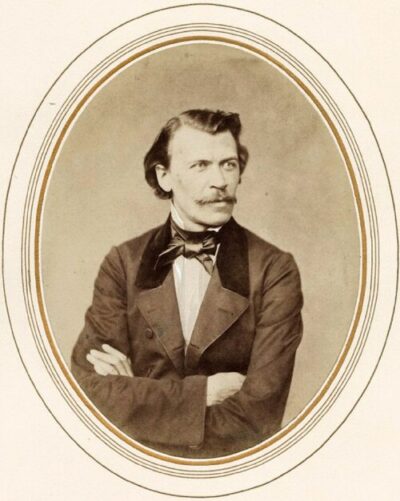
Yakov Polonsky
Yakov Polonsky was a Russian writer. Born December 18, 1819, in Ryazan. Died October 30, 1898, in Saint Petersburg. Educated at Moscow Imperial University, Faculty of Law. Awards include Pushkin Prize, Order of Saint Stanislaus and Order of St. Vladimir.
Facts
14 facts · 2 confirmed by two sources · 6 cited · 6 from one source
What’s different
- Born: we show December 18, 1819 (Confirmed). Wikidata also lists December 19, 1819 and December 6, 1819
- Died: we show October 30, 1898 (Confirmed). Wikidata also lists October 18, 1898
Where this comes from
Papalocal keeps its own record. It started from these sources; what each one said is kept here as it was copied, so a change on their side never changes this page by itself. Tap one to read its version.
What Wikidata says · copied November 18, 2026 · revision 2565599699
- Described as
- Russian writer (1819–1898)
- Other names
- Yakov Petrovich Polonsky
- Born
- December 18, 1819 · 2 references; December 19, 1819; December 6, 1819 · 1 reference
- Died
- October 30, 1898 · 4 references; October 18, 1898 · 1 reference
- Born in
- Ryazan · 3 references
- Died in
- Saint Petersburg · 2 references
- Buried in
- Ryazan kremli · 1 reference
- Citizen of
- Russian Empire
- Occupation
- poet · 3 references; writer · 1 reference; librettist · 1 reference
- Education
- Moscow Imperial University, Faculty of Law
- Awards
- Pushkin Prize; Order of Saint Stanislaus · 1 reference; Order of St. Vladimir · 1 reference
- Spouse
- Josephine Antonovna Rulman (1866–) · 1 reference
- Wikipedias with a page
- 23
Wikidata item Q2299317 (wikidata.org/wiki/Q2299317), public domain (CC0). Copied November 18, 2026.
What Wikipedia says · copied November 18, 2026 · revision 1375169218
Yakov Petrovich Polonsky (Russian: Яков Петрович Полонский; 18 December [O.S. 6 December] 1819 – 30 October [O.S. 18 October] 1898) was a leading Pushkinist poet who wrote poems faithful to the traditions of Russian Romantic poetry during the heyday of realistic prose.
Of noble birth, Polonsky attended the Moscow University, where he befriended Apollon Grigoryev and Afanasy Fet. Three young and promising poets wrote pleasing and elegant poems, emulating Pushkin and Mikhail Lermontov. He graduated from the university in 1844, publishing his first collection of poems the same year. Polonsky's early poetry is generally regarded as his finest; one of his first published poems was even copied by Nikolai Gogol into his notebook.
Unlike some other Russian poets, Polonsky did not belong to an affluent family. In order to provide for his relatives, he joined the office of Prince Vorontsov, first at Odessa and then (1846–51) at Tiflis. The spectacular nature of the Black Sea coast strengthened his predilection for Romanticism. Polonsky turned his attention to the Caucasian subjects and descriptions of lush nature, treated in the manner reminiscent of Lermontov (although he also wrote parodies of his poems). Nocturnal scenes especially appealed to him; in fact, one of his best known poems is called Georgian Night.
In 1849, Polonsky paid homage to the mountaineer folklore in his collection Sazandar. His verse epistle to Leo Pushkin (the poet's brother), known as A Stroll through Tiflis (1846), was written with more attention to realistic detail. In 1851, Polonsky moved to Saint Petersburg, where he was invited to edit the literary journal Russkoye Slovo. He soon gave up journalistic activities and continued his career at the censorship department. At that period, Polonsky would increasingly venture into social themes, without producing anything of lasting value. He was the last luminary of the 1840s still active in St. Petersburg of the 1890s, maintaining correspondence with such younger writers as Anton Chekhov. He died at the age of 78 and was buried in his native Ryazan.
Although Polonsky was highly regarded in his own day, his reputation has been in predictable decline during the last brutal century and a half. His most popular pieces are lyrical songs, notably Sleigh Bell (1854), "in which the sound of a sleigh bell evokes a dream state and images of lost love". Unsurprisingly, many of his poems were set to music by Russian composers including Alexander Dargomyzhsky, Pyotr Ilyich Tchaikovsky, Igor Stravinsky, Sergei Rachmaninoff, Sergei Taneyev, and Anton Rubinstein. He also provided the libretto of Vakula the Smith after Gogol, intended for Alexander Serov, finally made into a competition piece and set by Tchaikovsky (1874), who reworked it later as Cherevichki.
- Born, in its opening lines
- December 18, 1819
- Died, in its opening lines
- October 30, 1898
From the Wikipedia article “Yakov Polonsky” (en.wikipedia.org/wiki/Yakov_Polonsky), by its contributors, under CC BY-SA 4.0 (creativecommons.org/licenses/by-sa/4.0/). Copied November 18, 2026; not changed.
Confirmed Two sources agree. Cited One source, and it names where it got it. One source One source, without a reference of its own. Sources disagree The sources disagree. We show the best-supported value and keep theirs below.
