
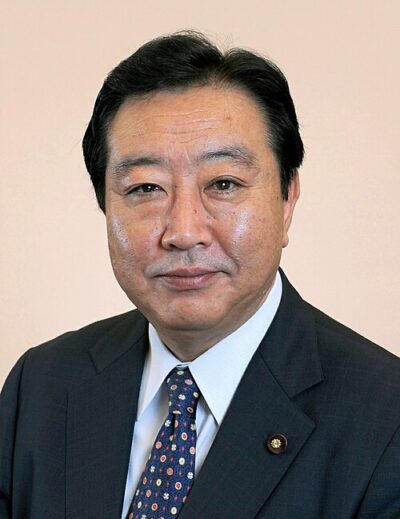
Yoshihiko Noda
Yoshihiko Noda is a Prime Minister of Japan from 2011 to 2012. Born May 20, 1957, in Funabashi. Positions held include Leader of the Democratic Party (2011–2012), Senior Vice Minister of Finance (2009–2010) and Minister of Finance (2010–2011). Educated at Waseda University and Funabashi High School.
Facts
29 facts · 1 confirmed by two sources · 2 cited · 26 from one source
Where this comes from
Papalocal keeps its own record. It started from these sources; what each one said is kept here as it was copied, so a change on their side never changes this page by itself. Tap one to read its version.
What Wikidata says · copied November 16, 2026 · revision 2562946212
- Described as
- Prime Minister of Japan from 2011 to 2012
- Born
- May 20, 1957 · 2 references
- Born in
- Funabashi
- Citizen of
- Japan
- Occupation
- politician · 1 reference; head of government · 1 reference
- Positions held
- Leader of the Democratic Party (2011–2012); Senior Vice Minister of Finance (2009–2010); Minister of Finance (2010–2011); Prime Minister of Japan (2011–2012); member of the House of Representatives of Japan (2014–); member of the Chiba Prefectural Assembly; President of the Constitutional Democratic Party (2024–)
- Political party
- Constitutional Democratic Party of Japan; Democratic Party; Democratic Party of Japan; Japan New Party
- Education
- Waseda University; Funabashi High School; Funabashi Municipal Ninomiya Junior High School; Funabashi Municipal Yakuendai Primary School; The Matsushita Institute of Government and Management; Waseda University Honjo Senior High School
- Member of
- Sympathizer Group to Form the Second Term Democratic Party; Nana Bugyō no Kai
- Spouse
- Hitomi Noda (1992–)
- Siblings
- Takehiko Noda
- Religion
- Buddhism
- Website
- https://www.nodayoshi.gr.jp/; https://nodayoshi.jp/
- Wikipedias with a page
- 79
Wikidata item Q57647 (wikidata.org/wiki/Q57647), public domain (CC0). Copied November 16, 2026.
What Wikipedia says · copied November 16, 2026 · revision 1385907771
Yoshihiko Noda (Japanese: 野田 佳彦, Hepburn: Noda Yoshihiko; born 20 May 1957) is a Japanese politician who served as the Prime Minister of Japan from 2011 to 2012. He has been a member of the House of Representatives since 2000.
Noda entered politics in 1993 as a member of the now-defunct Japan New Party. In 1996, he joined the Democratic Party of Japan (DPJ). After the DPJ won control of the Diet in 2009 general election, Noda was named a senior vice minister of finance in the cabinet of Prime Minister Yukio Hatoyama, and in 2010, was named minister of finance in the cabinet of Prime Minister Naoto Kan. Following Kan's resignation as prime minister, Noda won the ensuing leadership election and was appointed prime minister on 2 September 2011.
Following a severe loss for the DPJ in the December 2012 general election, Noda announced his resignation as party leader, triggering a leadership election that was won by Banri Kaieda. Noda was succeeded as Prime Minister by Shinzo Abe, President of the Liberal Democratic Party, on 26 December 2012.
As the DPJ underwent mergers and reorganizations, Noda left to sit as an independent politician. In 2021, Noda joined the CDP, the primary successor to the DPJ. In 2024, Noda successfully stood for the CDP's party presidential election, defeating incumbent leader Kenta Izumi and former leader Yukio Edano. Weeks after assuming the presidency of the party, the 2024 general election was announced, with the CDP achieving its best result in party history, and the ruling LDP coalition being limited to a minority. After a rout in the 2026 general election, Noda resigned as co-president of the newly-formed Centrist Reform Alliance.
- Born, in its opening lines
- May 20, 1957
From the Wikipedia article “Yoshihiko Noda” (en.wikipedia.org/wiki/Yoshihiko_Noda), by its contributors, under CC BY-SA 4.0 (creativecommons.org/licenses/by-sa/4.0/). Copied November 16, 2026; not changed.
Confirmed Two sources agree. Cited One source, and it names where it got it. One source One source, without a reference of its own. Sources disagree The sources disagree. We show the best-supported value and keep theirs below.
