
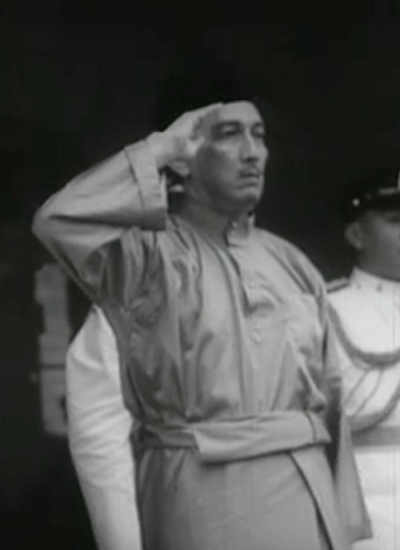
Yusof bin Ishak
Yusof bin Ishak was the 1st President of Singapore. Born August 12, 1910, in Perak. Died November 23, 1970, in Singapore. Positions held include President of Singapore (1965–1970) and Yang di-Pertuan Negara of Singapore (1959–1965). Educated at Victoria School and King Edward VII School.
Facts
21 facts · 2 confirmed by two sources · 2 cited · 17 from one source
Where this comes from
Papalocal keeps its own record. It started from these sources; what each one said is kept here as it was copied, so a change on their side never changes this page by itself. Tap one to read its version.
What Wikidata says · copied November 16, 2026 · revision 2558795965
- Described as
- 1st President of Singapore (1910–1970)
- Born
- August 12, 1910
- Died
- November 23, 1970
- Born in
- Perak
- Died in
- Singapore
- Buried in
- Kranji State Cemetery · 1 reference
- Cause of death
- heart failure
- Citizen of
- Singapore
- Occupation
- politician · 1 reference; journalist · 1 reference
- Positions held
- President of Singapore (1965–1970); Yang di-Pertuan Negara of Singapore (1959–1965)
- Political party
- People's Action Party · 1 reference
- Education
- Victoria School; King Edward VII School; Raffles Institution · 1 reference
- Spouse
- Noor Aishah Mohammad Salim · 1 reference
- Father
- Ishak bin Ahmad
- Siblings
- Abdul Rahim Ishak; Aziz Ishak
- Religion
- Islam
- Website
- http://www.istana.gov.sg/the-president/former-presidents/encik-yusof-ishak
- Wikipedias with a page
- 39
Wikidata item Q259331 (wikidata.org/wiki/Q259331), public domain (CC0). Copied November 16, 2026.
What Wikipedia says · copied November 16, 2026 · revision 1382358586
Yusof bin Ishak Al-Haj ( YUUSS-off bin ISS-hahk; 12 August 1910 – 23 November 1970) was a Singaporean journalist and civil servant who served as the head of state of Singapore from 1959 to 1970: as the second Yang di-Pertuan Negara of Singapore between 1959 and 1965 and the first president of Singapore between 1965 and 1970.
Born in the Federated Malay States, Yusof received his education in Malaysia and Singapore, graduating from Raffles Institution in 1929. He worked in journalism, creating a sports magazine with friends before joining Warta Malaya, a Malay-language daily newspaper. Leaving Warta in 1938, Yusof co-founded Utusan Melayu, a newspaper more centred on Malay issues, in 1939 with other Malay figures in Singapore.
He was a central figure in Utusan's success, staying with the newspaper for two decades. However, he left in 1959 following conflicts between Utusan and the UMNO, which culminated in the UMNO buying all of their shares in order to better control the newspaper's political viewpoints. Returning to Singapore from Kuala Lumpur, Yusof was invited to serve as chairman of the Public Service Commission by prime minister Lee Kuan Yew, who had been appointed following the People's Action Party's success at the 1959 general election. On 3 December 1959, he succeeded Sir William Goode as Yang di-Pertuan Negara. He would serve in this role until 1965, when Singapore gained independence from Malaysia and the post of Yang di-Pertuan Negara was replaced by the president of Singapore.
Yusof served three terms as head of state before his death in office on 23 November 1970 due to heart failure. During his presidency, he was known for his multi-racial beliefs, especially in the 1960s, when he was a strong supporter of Singapore's merger with Malaya. Even after Singapore's split, he continued to spread the idea of a multi-racial society. Yusof also believed in education and supported talks on religion. Following his death, he was succeeded by Benjamin Sheares on 2 January 1971. Several places in Singapore bear his name, and his portrait appears on the current Singapore Portrait Series currency notes introduced in 1999.
- Born, in its opening lines
- August 12, 1910
- Died, in its opening lines
- November 23, 1970
From the Wikipedia article “Yusof Ishak” (en.wikipedia.org/wiki/Yusof_Ishak), by its contributors, under CC BY-SA 4.0 (creativecommons.org/licenses/by-sa/4.0/). Copied November 16, 2026; not changed.
Confirmed Two sources agree. Cited One source, and it names where it got it. One source One source, without a reference of its own. Sources disagree The sources disagree. We show the best-supported value and keep theirs below.
