
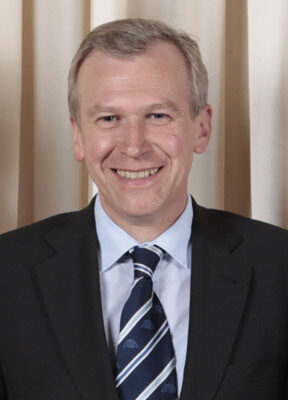
Yves Leterme
Yves Leterme is a former Belgian prime minister. Born October 6, 1960, in Wervik. Positions held include Prime Minister of Belgium (2008–2011), Minister of Foreign Affairs in Belgium (2009) and Minister-President of Flanders (2004–2007). Educated at Katholieke Universiteit Leuven and Ghent University. Awards include State Prize of North Rhine-Westphalia, Grand Officer of the Order of Leopold and Minister of State.
Facts
22 facts · 1 confirmed by two sources · 6 cited · 15 from one source
Where this comes from
Papalocal keeps its own record. It started from these sources; what each one said is kept here as it was copied, so a change on their side never changes this page by itself. Tap one to read its version.
What Wikidata says · copied November 16, 2026 · revision 2568860939
- Described as
- former Belgian prime minister
- Born
- October 6, 1960 · 6 references
- Born in
- Wervik · 2 references
- Citizen of
- Belgium
- Occupation
- politician · 1 reference; diplomat
- Positions held
- Prime Minister of Belgium (2008–2011); Minister of Foreign Affairs in Belgium (2009); Minister-President of Flanders (2004–2007); member of the Chamber of Representatives of Belgium (2 times) (1997–2011); member of the Flemish Parliament; Senator of Belgium (2007–2009) · 1 reference; substitute member of the Parliamentary Assembly of the Council of Europe (2007–2008) · 1 reference; Flemish minister of Agriculture (2004–2007); Minister of Mobility (2007–2008)
- Political party
- Christian Democratic and Flemish
- Education
- Katholieke Universiteit Leuven; Ghent University
- Member of
- Parliamentary Assembly of the Council of Europe
- Awards
- State Prize of North Rhine-Westphalia (2008); Grand Officer of the Order of Leopold (2010) · 1 reference; Minister of State (2011) · 1 reference
- Religion
- Catholic Church
- Wikipedias with a page
- 68
Wikidata item Q12981 (wikidata.org/wiki/Q12981), public domain (CC0). Copied November 16, 2026.
What Wikipedia says · copied November 16, 2026 · revision 1384936115
Yves Camille Désiré Leterme (Dutch: [ˈiːf ləˈtɛrmə]; born 6 October 1960) is a Belgian politician, a leader of the Christian Democratic and Flemish party (CD&V). He was the prime minister of Belgium from March 2008 to December 2008, and later from November 2009 to December 2011.
Leterme has also served as minister of Foreign Affairs, deputy prime minister and minister of Budget, Institutional Reforms, Transport and the North Sea in the Belgian federal government. He is a former minister-president of Flanders and Flemish minister of Agriculture and Fisheries. Despite his French name, Leterme is Flemish. He is fluent in Dutch, French and English.
On 14 July 2008, facing the imminent failure to meet a self-imposed deadline to enact "constitutional reform" consisting of further devolution of powers to the nation's three linguistic communities, Leterme tendered his resignation to King Albert II. On 17 July, King Albert, after holding a flurry of consultations with leaders of political parties, labour unions, and the employers' association, rejected Leterme's resignation. Instead, the King appointed a three-person commission of representatives of the linguistic communities to investigate how to restart the reform process. The commission was to report to the King by 31 July 2008.
On 19 December 2008 he offered his resignation to King Albert II after a crisis surrounding the sale of Fortis to BNP Paribas. On 22 December 2008 the King accepted his resignation, along with that of his entire government. He remained prime minister until 30 December, when Herman Van Rompuy was appointed as his successor. On 24 November 2009, it was announced that Leterme would once again become prime minister, succeeding Van Rompuy, who had been selected to become the first President of the European Council.
On 22 April 2010 he once again offered his resignation to King Albert II after a key Flemish party, the Open Flemish Liberals and Democrats, withdrew its support for the coalition government. An election followed in June, resulting in protracted attempts to negotiate a governing coalition. Leterme remained as caretaker prime minister, but on 13 September 2011 announced that he would leave the post by the end of the year to take up the position of Deputy Secretary-General at the Organisation for Economic Co-operation and Development. On 6 December 2011 Leterme was finally succeeded as prime minister by Elio Di Rupo, ending the longest run of a caretaker government in the developed world. The following day he was appointed to the honorary title of Minister of State.
- Born, in its opening lines
- October 6, 1960
From the Wikipedia article “Yves Leterme” (en.wikipedia.org/wiki/Yves_Leterme), by its contributors, under CC BY-SA 4.0 (creativecommons.org/licenses/by-sa/4.0/). Copied November 16, 2026; not changed.
Confirmed Two sources agree. Cited One source, and it names where it got it. One source One source, without a reference of its own. Sources disagree The sources disagree. We show the best-supported value and keep theirs below.
