
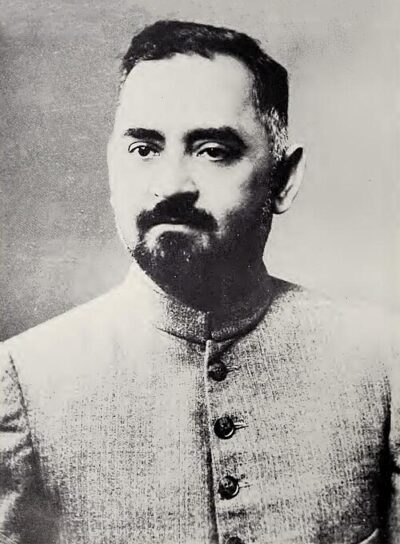
Zakir Husain
Zakir Husain was the 3rd President of India. Born February 8, 1897, in Hyderabad. Died May 3, 1969, in New Delhi. Positions held include Vice President of India (1962–1967), President of India (1967–1969) and governor of Bihar (1957–1962). Educated at Aligarh Muslim University and Humboldt-Universität zu Berlin. Awards include Bharat Ratna and Padma Vibhushan in Public Affairs.
Facts
21 facts · 2 confirmed by two sources · 3 cited · 16 from one source
Where this comes from
Papalocal keeps its own record. It started from these sources; what each one said is kept here as it was copied, so a change on their side never changes this page by itself. Tap one to read its version.
What Wikidata says · copied November 16, 2026 · revision 2566068342
- Described as
- 3rd President of India (1897-1969)
- Other names
- Zakir Husain Khan
- Born
- February 8, 1897 · 6 references
- Died
- May 3, 1969 · 6 references
- Born in
- Hyderabad
- Died in
- New Delhi
- Buried in
- India
- Citizen of
- India (1950–) · 1 reference; British Raj (–1947); Dominion of India (1947–1950)
- Occupation
- politician · 2 references
- Positions held
- Vice President of India (1962–1967); President of India (1967–1969); governor of Bihar (1957–1962)
- Worked for
- University of Calcutta
- Education
- Aligarh Muslim University; Humboldt-Universität zu Berlin; University of Allahabad · 1 reference
- Awards
- Bharat Ratna (1963); Padma Vibhushan in Public Affairs (1954)
- Children
- Saeeda Khurshid
- Siblings
- Yousuf Hussain Khan · 1 reference
- Religion
- Islam
- Wikipedias with a page
- 67
Wikidata item Q144732 (wikidata.org/wiki/Q144732), public domain (CC0). Copied November 16, 2026.
What Wikipedia says · copied November 16, 2026 · revision 1378210502
Zakir Husain Khan (8 February 1897 – 3 May 1969) was an Indian educationist and politician who served as the vice president of India from 1962 to 1967 and president of India from 13 May 1967 until his death on 3 May 1969.
Born in Hyderabad in an Afridi Pashtun family, Husain completed his schooling in Etawah and went on to study at the Muhammadan Anglo-Oriental College, Aligarh and the University of Berlin from where he obtained a doctoral degree in economics. A close associate of Mahatma Gandhi, Husain was a founding member of the Jamia Millia Islamia which was established as an independent national university in response to the Non-cooperation movement. He served as the university's vice-chancellor from 1926 to 1948. In 1937, Husain chaired the Basic National Education Committee which framed a new educational policy known as Nai Talim (literally meaning "New Education" in Urdu) which emphasized free and compulsory education in the first language. He was opposed to the policy of separate electorates for Muslims and, in 1946, the Muslim League under Muhammad Ali Jinnah vetoed a proposal by the Indian National Congress to include Husain in the Interim Government of India.
Following Independence and the Partition of India Husain stayed on in India and, in 1948, was appointed Vice Chancellor of the Aligarh Muslim University which he helped retain as a national institution of higher learning. For his services to education, he was awarded the Padma Vibhushan in 1954 and was made a nominated member of the Indian Parliament during 1952 to 1957. Husain served as Governor of Bihar from 1957 to 1962 and was elected the Vice President of India in 1962. The following year, he was conferred the Bharat Ratna. He was elected president in 1967, succeeding Sarvepalli Radhakrishnan, and became the first Muslim to hold the highest constitutional office in India. He was also the first incumbent to die in office and had the shortest tenure of any Indian president. His mazar lies in the campus of the Jamia Millia Islamia in Delhi.
An author and translator of several books into Urdu and a prolific writer of children's books, Husain has been commemorated in India through postage stamps and several educational institutions, libraries, roads and Asia's largest rose garden that have been named after him.
- Born, in its opening lines
- February 8, 1897
- Died, in its opening lines
- May 3, 1969
From the Wikipedia article “Zakir Husain” (en.wikipedia.org/wiki/Zakir_Husain), by its contributors, under CC BY-SA 4.0 (creativecommons.org/licenses/by-sa/4.0/). Copied November 16, 2026; not changed.
Confirmed Two sources agree. Cited One source, and it names where it got it. One source One source, without a reference of its own. Sources disagree The sources disagree. We show the best-supported value and keep theirs below.
