
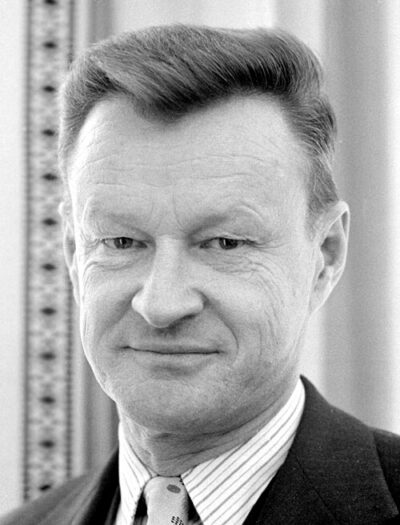
Zbigniew Brzezinski
Zbigniew Brzezinski was a Polish-American diplomat and political scientist. Born March 28, 1928, in Warsaw. Died May 26, 2017, in Falls Church. Positions held include United States National Security Advisor (1977–1981) and board member. Known for The Grand Failure, The Grand Chessboard and Between Two Ages. Educated at McGill University and Harvard Law School. Awards include Guggenheim Fellowship, Order of the White Eagle (Third Polish Republic) and Order of Tomáš Garrigue Masaryk, 1st class.
Facts
56 facts · 2 confirmed by two sources · 10 cited · 44 from one source
Where this comes from
Papalocal keeps its own record. It started from these sources; what each one said is kept here as it was copied, so a change on their side never changes this page by itself. Tap one to read its version.
What Wikidata says · copied November 13, 2026 · revision 2567720896
- Described as
- Polish-American diplomat and political scientist (1928–2017)
- Other names
- Zbigniew Kazimierz Brzezinski, Zbig
- Born
- March 28, 1928 · 8 references
- Died
- May 26, 2017 · 8 references
- Born in
- Warsaw · 3 references
- Died in
- Falls Church · 2 references
- Cause of death
- pneumonia
- Name at birth
- Zbigniew Kazimierz Brzeziński
- Citizen of
- United States (1958–) · 2 references; Second Polish Republic
- Occupation
- geopolitical analyst; political scientist · 1 reference; pedagogue; university teacher · 1 reference; author; strategist; critic; film actor · 1 reference
- Positions held
- United States National Security Advisor (1977–1981); board member
- Political party
- Democratic Party
- Worked for
- Johns Hopkins University; Paul H. Nitze School of Advanced International Studies; Columbia University (1960–1989); Harvard University (1953–1960)
- Education
- McGill University (1945–1950); Harvard Law School (1950–1953)
- Member of
- Council on Foreign Relations; Atlantic Council; National Endowment for Democracy; Polish Society of Arts and Sciences Abroad; American Academy of Arts and Sciences; Trilateral Commission (1973–2009)
- Known for
- The Grand Failure; The Grand Chessboard; Between Two Ages
- Awards
- Guggenheim Fellowship (1960) · 1 reference; Order of the White Eagle (Third Polish Republic) (1995); Order of Tomáš Garrigue Masaryk, 1st class (1998); Presidential Medal of Freedom (1981) · 1 reference; Order of the Three Stars, 2nd Class (2007); Harvard Centennial Medal; Antonovych prize; Grand Officer of the Order of the Star of Romania (2003); Order of Merit, 1st class (1996); Great Cross with Star and Sash of the Order of Merit of the Federal Republic of Germany; Grand Cross of the Order of the Lithuanian Grand Duke Gediminas (1998); honorary doctor of the University of Warsaw (1991); Order of Stara Planina (2001); Commander with Star of the Order of Merit of Hungary; Ellis Island Medal of Honor
- Field
- international relations · 1 reference; national security · 1 reference
- Spouse
- Emilie Benes Brzezinski (1961–2017) · 1 reference
- Children
- Ian Brzezinski; Mark Brzezinski; Mika Brzezinski
- Father
- Tadeusz Brzeziński
- Wikipedias with a page
- 77
Wikidata item Q168041 (wikidata.org/wiki/Q168041), public domain (CC0). Copied November 13, 2026.
What Wikipedia says · copied November 13, 2026 · revision 1381084902
Zbigniew Kazimierz "Zbig" Brzeziński (March 28, 1928 – May 26, 2017) was a Polish-American diplomat and political scientist. He served as a counselor to Lyndon B. Johnson from 1966 to 1968 and was Jimmy Carter's National Security Advisor from 1977 to 1981. As a scholar, Brzeziński belonged to the realist school of international relations, standing in the geopolitical tradition of Halford Mackinder and Nicholas J. Spykman, while elements of liberal idealism have also been identified in his outlook. Brzeziński was the primary organizer of the Trilateral Commission.
Major foreign policy events during his time in office included the normalization of relations with the People's Republic of China (and the severing of ties with the Republic of China on Taiwan); the signing of the second Strategic Arms Limitation Treaty (SALT II) with the Soviet Union; the brokering of the Camp David Accords between Egypt and Israel; the overthrow of the US-friendly Mohammad Reza Pahlavi and the start of the Iranian Revolution; the United States' encouragement of dissidents in Eastern Europe and championing of human rights in order to undermine the influence of the Soviet Union; supporting the Afghan mujahideen against the Soviet-backed Democratic Republic of Afghanistan and, ultimately, Soviet troops during the Soviet–Afghan War; and the signing of the Torrijos–Carter Treaties relinquishing U.S. control of the Panama Canal after 1999.
Zbigniew Brzeziński's personal views have been described as "progressive", "international," politically liberal, and strongly anti-communist. He was an advocate for anti-Soviet containment, for human rights organizations, and for "cultivating a strong West." He has been praised for his ability to see "the big picture." Critics described him as hawkish or a "foreign policy hardliner" on some issues, such as Poland–Russia relations.
Zbigniew Brzeziński served as the Robert E. Osgood Professor of American Foreign Policy at Johns Hopkins University's School of Advanced International Studies, a scholar at the Center for Strategic and International Studies, and a member of various boards and councils. He frequently appeared as an expert on the PBS program The NewsHour with Jim Lehrer, ABC News' This Week with Christiane Amanpour, and MSNBC's Morning Joe, where his daughter, Mika Brzeziński, is co-anchor. He supported the Prague Process. His elder son, Ian, is a foreign policy expert, and his younger son, Mark, was the United States Ambassador to Poland from 2022 to 2025 and the United States Ambassador to Sweden from 2011 to 2015.
- Born, in its opening lines
- March 28, 1928
- Died, in its opening lines
- May 26, 2017
From the Wikipedia article “Zbigniew Brzezinski” (en.wikipedia.org/wiki/Zbigniew_Brzezinski), by its contributors, under CC BY-SA 4.0 (creativecommons.org/licenses/by-sa/4.0/). Copied November 13, 2026; not changed.
Confirmed Two sources agree. Cited One source, and it names where it got it. One source One source, without a reference of its own. Sources disagree The sources disagree. We show the best-supported value and keep theirs below.
