

8th Verkhovna Rada
8th Verkhovna Rada is a 8th term of the Ukrainian Parliament (2014-2019).
- Founded
- November 27, 2014
- Country
- Ukraine
All 6 facts, and where they come from
Facts
6 facts · 0 confirmed by two sources · 0 cited · 6 from one source
Where this comes from
Papalocal keeps its own record. It started from these sources; what each one said is kept here as it was copied, so a change on their side never changes this page by itself. Tap one to read its version.
What Wikidata says · copied November 17, 2026 · revision 2560708109
- Described as
- 8th term of the Ukrainian Parliament (2014-2019)
- What it is
- legislative term
- Comes after
- 7th Verkhovna Rada
- Followed by
- 9th Verkhovna Rada
- Founded
- November 27, 2014
- Country
- Ukraine
- Office of
- Ukraine
- Wikipedias with a page
- 4
Wikidata item Q18562210 (wikidata.org/wiki/Q18562210), public domain (CC0). Copied 2026-11-17.
What Wikipedia says · copied November 17, 2026 · revision 1383639239
The Verkhovna Rada of Ukraine of the 8th convocation (Ukrainian: Верховна Рада України VIII скликання, Verkhovna Rada Ukrayiny VIII sklykannia) was a convocation of the legislative branch of the Verkhovna Rada, Ukraine's unicameral parliament. The 8th convocation met at the Verkhovna Rada building in Kyiv, having begun its term on 27 November 2014 following the last session of the 7th Verkhovna Rada. Its five-year term came to an end on July 24, 2019, marking the end of its tenth session.
The 8th Verkhovna Rada's composition was based upon the results of the October 26, 2014 parliamentary election, which was contested eight months after the February 2014 Revolution of Dignity, which resulted in the overthrow of the pro-Russian regime of Viktor Yanukovych, alongside the subsequent Russian occupation and annexation of Crimea, as well as the outbreak of the Russian-backed War in Donbas (2014-2022). Ukraine's head of state during the parliament's 8th term was President Petro Poroshenko. Altogether, eleven parties were represented in the Verkhovna Rada, although only six of them surpassed the mandatory five percent election threshold to gain representation based on the proportional representation system.
On the first day of the parliament's session, five of the parliament's pro-European parties, the Petro Poroshenko Bloc, People's Front, Self Reliance, Fatherland, and Radical Party, signed a coalition agreement. Per the coalition agreement, the convocation of parliament was tasked with passing major reforms to ensure Ukrainian membership in European institutions such as the European Union and NATO, while dealing with the threat of further Russian aggression in the Donbas.
President Volodymyr Zelenskyy dissolved the 8th Verkovna Rada on 21 May 2019.
From the Wikipedia article “8th Ukrainian Verkhovna Rada” (en.wikipedia.org/wiki/8th_Ukrainian_Verkhovna_Rada), by its contributors, under CC BY-SA 4.0 (creativecommons.org/licenses/by-sa/4.0/). Copied 2026-11-17; not changed.
Confirmed Two sources agree. Cited One source, and it names where it got it. One source One source, without a reference of its own. Sources disagree The sources disagree. We show the best-supported value and keep theirs below.
Picture: Wikimedia Commons: Верховная рада 2014 07 27.svg · See Commons file page
People connected 11
Members
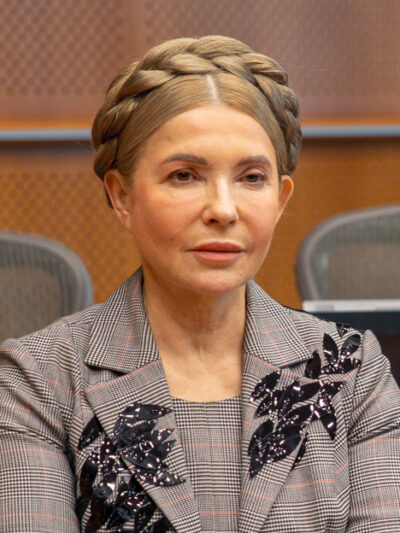 Yulia TymoshenkoUkrainian politician, former Prime Minister
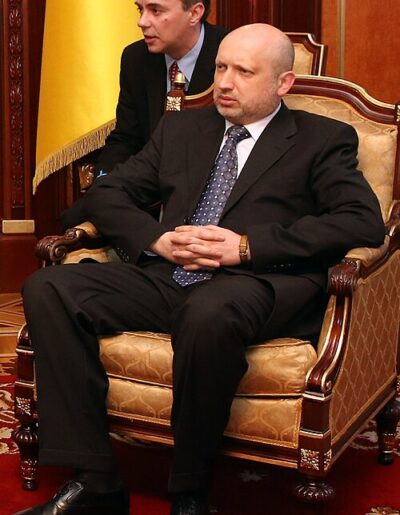 Oleksandr TurchynovUkrainian politician, screenwriter, and Doctor of Economic Sciences
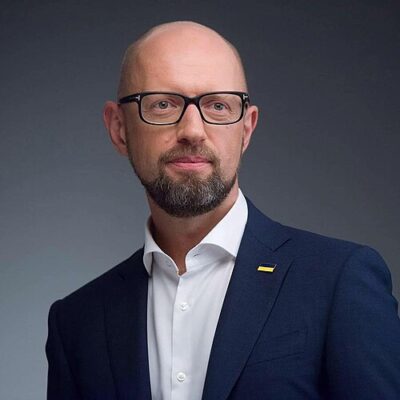 Arsenii YatseniukUkrainian lawyer, economist and politician
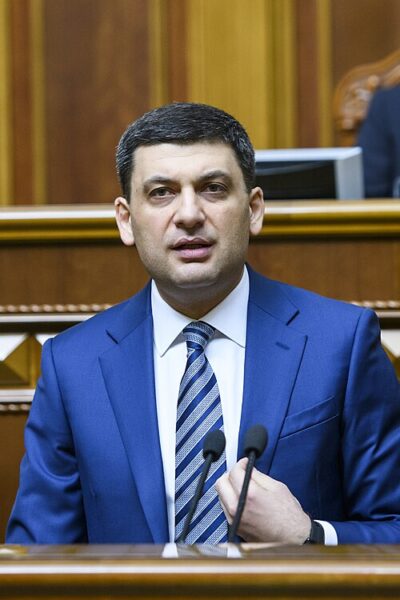 Volodymyr HroismanPrime Minister of Ukraine from 2016 to 2019
 Zlata OgnevichUkrainian singer and former politician
 Nadiya SavchenkoUkrainian politician
 Mustafa DzhemilevLeader of the Crimean Tatar National Movement
 Andrii ParubiiUkrainian politician (1971–2025)
 Dmytro YaroshUkrainian political activist, public figure
 Oleh LiashkoUkrainian politician
 Yuriy LutsenkoUkrainian politician
