A Streetcar Named Desire
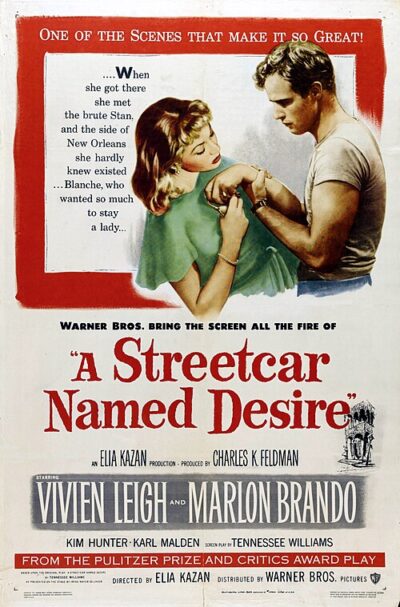
A Streetcar Named Desire is a 1951 film directed by Elia Kazan. It stars Vivien Leigh, Marlon Brando and Kim Hunter. It won the Grand Jury Prize of the Venice Film Festival and 5 more.
- Released
- 1951
- Directed by
- Elia Kazan
- Genre
- drama film
- Country of origin
- United States
All 28 facts, and where they come from
Facts
28 facts · 0 confirmed by two sources · 14 cited · 14 from one source
Where this comes from
Papalocal keeps its own record. It started from these sources; what each one said is kept here as it was copied, so a change on their side never changes this page by itself. Tap one to read its version.
What Wikidata says · copied November 16, 2026 · revision 2569933997
- Described as
- 1951 film directed by Elia Kazan
- Other names
- Streetcar Named Desire
- What it is
- film
- Directed by
- Elia Kazan · 5 references
- Music by
- Alex North
- Screenplay by
- Tennessee Williams; Oscar Saul
- Produced by
- Charles K. Feldman
- Starring
- Vivien Leigh · 5 references; Marlon Brando · 5 references; Kim Hunter · 5 references; Karl Malden · 4 references; Nick Dennis · 2 references; Richard Garrick · 2 references; Rudy Bond · 2 references; Charles Wagenheim · 1 reference; Peg Hillias; Wright King
- Genre
- drama film · 4 references
- Released
- 1951; September 9, 1951 · 1 reference; September 18, 1951 · 1 reference
- Original language
- English
- Country of origin
- United States
- Based on
- A Streetcar Named Desire; A Streetcar Named Desire
- Awards
- Grand Jury Prize of the Venice Film Festival (1951); Academy Award for Best Supporting Actress (1952) · 1 reference; Academy Award for Best Supporting Actor (1952) · 1 reference; Academy Award for Best Actress (1952) · 1 reference; Academy Award for Best Art Direction, Black and White (1952) · 1 reference; National Board of Review: Top Ten Films
- Wikipedias with a page
- 53
Wikidata item Q212129 (wikidata.org/wiki/Q212129), public domain (CC0). Copied 2026-11-16.
What Wikipedia says · copied November 16, 2026 · revision 1383578701
A Streetcar Named Desire is a 1951 American Southern Gothic drama film adapted from Tennessee Williams' Pulitzer Prize-winning play of the same name. Directed by Elia Kazan, it stars Vivien Leigh, Marlon Brando, Kim Hunter, and Karl Malden. The film tells the story of a Mississippi Southern belle, Blanche DuBois (Leigh), who, after encountering a series of personal losses, seeks refuge with her sister (Hunter) and brother-in-law (Brando) in a dilapidated New Orleans apartment building. The original Broadway production and cast was converted to film, albeit with several changes and sanitizations related to censorship.
Tennessee Williams collaborated with Oscar Saul and Elia Kazan on the screenplay. Kazan, who directed the Broadway stage production, also directed the black-and-white film. Brando, Hunter, and Malden all reprised their original Broadway roles. Although Jessica Tandy originated the role of Blanche DuBois on Broadway, Vivien Leigh, who had appeared in the London theatre production, was cast in the film adaptation for her star power. The film brought Brando, previously virtually unknown, to prominence as a major Hollywood film star, and earned him the first of four consecutive Academy Award nominations for Best Actor; Leigh won her second Academy Award for Best Actress for her portrayal of Blanche. It received Oscar nominations in ten other categories (including Best Picture, Best Director, and Best Adapted Screenplay), and won Best Supporting Actor (Malden), Best Supporting Actress (Hunter), and Best Art Direction (Richard Day, George James Hopkins), making it the first film to win in three of the acting categories. The film won the Grand Jury Prize and Leigh won the Volpi Cup for Best Actress at the 12th Venice International Film Festival.
The film earned an estimated $4,250,000 at the US and Canadian box office in 1951, making it the fifth biggest hit of the year. In 1999, A Streetcar Named Desire was selected for preservation in the United States National Film Registry by the Library of Congress as being "culturally, historically, or aesthetically significant".
From the Wikipedia article “A Streetcar Named Desire (1951 film)” (en.wikipedia.org/wiki/A_Streetcar_Named_Desire_(1951_film)), by its contributors, under CC BY-SA 4.0 (creativecommons.org/licenses/by-sa/4.0/). Copied 2026-11-16; not changed.
Confirmed Two sources agree. Cited One source, and it names where it got it. One source One source, without a reference of its own. Sources disagree The sources disagree. We show the best-supported value and keep theirs below.
Picture: Bill Gold, via Wikimedia Commons · Public domain