Aspects of the Theory of Syntax
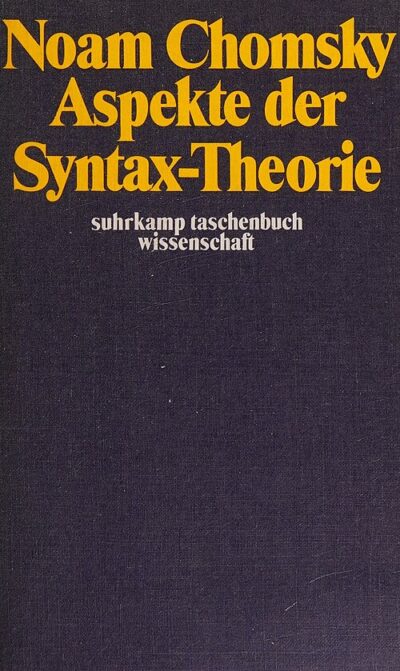
Aspects of the Theory of Syntax is a non-fiction work by Noam Chomsky. It came out in 1965.
- Published
- May 1965
- Written by
- Noam Chomsky
- Country of origin
- United States
All 8 facts, and where they come from
Facts
8 facts · 0 confirmed by two sources · 0 cited · 8 from one source
Where this comes from
Papalocal keeps its own record. It started from these sources; what each one said is kept here as it was copied, so a change on their side never changes this page by itself. Tap one to read its version.
What Wikidata says · copied November 16, 2026 · revision 2559795587
- Described as
- non-fiction work by Noam Chomsky
- Other names
- Aspects
- What it is
- literary work
- Written by
- Noam Chomsky
- Published
- May 1965
- Language
- English; German
- Country of origin
- United States
- Comes after
- Syntactic Structures
- Followed by
- Cartesian Linguistics
- Wikipedias with a page
- 5
Wikidata item Q4807772 (wikidata.org/wiki/Q4807772), public domain (CC0). Copied 2026-11-16.
What Wikipedia says · copied November 16, 2026 · revision 1384337930
Aspects of the Theory of Syntax (known in linguistic circles simply as Aspects) is a book on linguistics written by American linguist Noam Chomsky, first published in 1965. In Aspects, Chomsky presented a deeper, more extensive reformulation of transformational generative grammar (TGG), a new kind of syntactic theory that he had introduced in the 1950s with the publication of his first book, Syntactic Structures. Aspects is widely considered to be the foundational document and a proper book-length articulation of Chomskyan theoretical framework of linguistics. It presented Chomsky's epistemological assumptions with a view to establishing linguistic theory-making as a formal (i.e. based on the manipulation of symbols and rules) discipline comparable to physical sciences, i.e. a domain of inquiry well-defined in its nature and scope. From a philosophical perspective, it directed mainstream linguistic research away from behaviorism, constructivism, empiricism and structuralism and towards mentalism, nativism, rationalism and generativism, respectively, taking as its main object of study the abstract, inner workings of the human mind related to language acquisition and production.
From the Wikipedia article “Aspects of the Theory of Syntax” (en.wikipedia.org/wiki/Aspects_of_the_Theory_of_Syntax), by its contributors, under CC BY-SA 4.0 (creativecommons.org/licenses/by-sa/4.0/). Copied 2026-11-16; not changed.
Confirmed Two sources agree. Cited One source, and it names where it got it. One source One source, without a reference of its own. Sources disagree The sources disagree. We show the best-supported value and keep theirs below.
Picture: Unknown author, via Wikimedia Commons · Public domain