
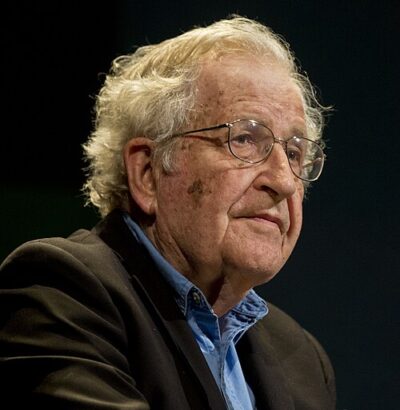
Noam Chomsky
Noam Chomsky is an American linguist and activist. Born December 7, 1928, in East Oak Lane. Positions held include professor (1955–). Known for Syntactic Structures, World Orders Old and New and Aspects of the Theory of Syntax. Educated at Harvard University and Central High School. Awards include Orwell Award, Guggenheim Fellowship and Helmholtz Medal.
Facts
68 facts · 1 confirmed by two sources · 17 cited · 49 from one source · 1 where the sources disagree
What’s different
- Born in: we show East Oak Lane (Sources disagree). Wikidata also lists Philadelphia
Where this comes from
Papalocal keeps its own record. It started from these sources; what each one said is kept here as it was copied, so a change on their side never changes this page by itself. Tap one to read its version.
What Wikidata says · copied November 13, 2026 · revision 2563777090
- Described as
- American linguist and activist (born 1928)
- Other names
- A. Noam Chomsky, Chomsky, Avram Noam Chomsky
- Born
- December 7, 1928 · 13 references
- Born in
- East Oak Lane · 2 references; Philadelphia · 2 references
- Name at birth
- Avram Noam Chomsky
- Citizen of
- United States
- Occupation
- philosopher · 3 references; linguist · 3 references; political writer; university teacher · 2 references; psychologist · 1 reference; anthropologist · 1 reference; human rights defender · 1 reference; educator
- Positions held
- professor (1955–) · 1 reference
- Worked for
- Massachusetts Institute of Technology (1955–2002) · 1 reference
- Education
- Harvard University (1951–1955); Central High School (–1945); Massachusetts Institute of Technology; Oak Lane Day School · 1 reference; University of Pennsylvania (1945–1951)
- Member of
- German Academy of Sciences Leopoldina (1974–) · 1 reference; Serbian Academy of Sciences and Arts (2003–); National Academy of Sciences (1972–) · 1 reference; American Academy of Arts and Sciences (1963–) · 1 reference; Royal Society of Canada; American Philosophical Society (2004–) · 2 references; American Association for the Advancement of Science (1966–) · 1 reference; Academia Europaea (1995–) · 1 reference
- Known for
- Syntactic Structures; World Orders Old and New; Aspects of the Theory of Syntax; Manufacturing Consent; The Chomsky Reader; Class Warfare; Necessary Illusions: Thought Control in Democratic Societies; Ilusionistas; Deterring Democracy; Making the Future
- Awards
- Orwell Award (1987) · 1 reference; Guggenheim Fellowship · 1 reference; Helmholtz Medal (1996) · 1 reference; Thomas Merton Award (2010); Sretenje Order; James Joyce Awards; Erich Fromm Prize (2010); William James Fellow Award (1989) · 1 reference; Albertus-Magnus professorate (2011); Kyoto Prize in Basic Sciences (1988) · 1 reference; APA Award for Distinguished Scientific Contributions to Psychology (1984) · 1 reference; honorary doctor of the University of St Andrews; honorary doctorate from Columbia University; honorary doctor of Harvard University; honorary doctorate from the University of Cambridge
- Field
- linguistics; philosophy of language · 1 reference; psychology · 1 reference; generative grammar; communication theory; cognitive science
- Spouse
- Carol Chomsky (1949–2008) · 1 reference; Valeria Wasserman Chomsky (2014–)
- Children
- Aviva Chomsky
- Father
- William Chomsky · 1 reference
- Religion
- agnosticism · 1 reference
- Lived in
- Tucson; East Oak Lane; Allston (1951–1965); Lexington (1965–)
- Website
- https://chomsky.info/
- Wikipedias with a page
- 189
Wikidata item Q9049 (wikidata.org/wiki/Q9049), public domain (CC0). Copied November 13, 2026.
What Wikipedia says · copied November 13, 2026 · revision 1385531076
Avram Noam Chomsky (born December 7, 1928) is an American intellectual, philosopher, linguist, political activist, and social critic. Sometimes called "the father of modern linguistics", Chomsky is also a major figure in analytic philosophy and one of the founders of the field of cognitive science. He is a laureate professor of linguistics at the University of Arizona and an institute professor emeritus at the Massachusetts Institute of Technology (MIT).
Among the most cited living authors, Chomsky has written more than 150 books on topics such as linguistics, war, and politics. In addition to his work in linguistics, since the 1960s, Chomsky has been an influential voice on the American Left as a consistent critic of the foreign policy of the United States, contemporary capitalism, and corporatocracy.
Born to immigrant Ashkenazi Jews in Philadelphia, Chomsky developed an early interest in anarchism from alternative bookstores in New York City. He studied at the University of Pennsylvania. During his postgraduate work in the Harvard Society of Fellows, Chomsky developed the theory of transformational grammar for which he earned his doctorate in 1955. That year he began teaching at MIT, and in 1957 emerged as a significant figure in linguistics with his landmark work Syntactic Structures, which played a major role in remodeling the study of language.
From 1958 to 1959 Chomsky was a National Science Foundation fellow at the Institute for Advanced Study. He created or co-created the universal grammar theory, the generative grammar theory, the Chomsky hierarchy, and the minimalist program. Chomsky also played a pivotal role in the decline of linguistic behaviorism, and was particularly critical of the work of B. F. Skinner.
An outspoken opponent of U.S. involvement in the Vietnam War, which he saw as an act of American imperialism, in 1967 Chomsky rose to national attention for his anti-war essay "The Responsibility of Intellectuals". Becoming associated with the New Left, he was arrested multiple times for his activism and placed on President Richard Nixon's list of political opponents. As his work in linguistics gained prominence and influence during the 1960s, it fomented the linguistics wars. In collaboration with Edward S. Herman, Chomsky later articulated the propaganda model of media criticism in Manufacturing Consent, and worked to expose the Indonesian occupation of East Timor.
His defense of unconditional freedom of speech, including that of Holocaust denial, generated significant controversy in the Faurisson affair of the 1980s. Chomsky's commentary on the Cambodian genocide and the Bosnian genocide also generated controversy. Since retiring from active teaching at MIT, he has continued his vocal political activism, including opposing the 2003 invasion of Iraq and supporting the Occupy movement. An anti-Zionist, Chomsky considers Israel's treatment of Palestinians to be worse than South African–style apartheid, and criticizes U.S. support for Israel.
Chomsky is widely recognized as having helped to spark the cognitive revolution in the human sciences, contributing to the development of a new cognitivistic framework for the study of language and the mind. Chomsky remains a leading critic of U.S. foreign policy, contemporary capitalism, U.S. involvement and Israel's role in the Israeli–Palestinian conflict, and mass media. Chomsky and his ideas remain highly influential in the anti-capitalist and anti-imperialist movements.
- Born, in its opening lines
- December 7, 1928
From the Wikipedia article “Noam Chomsky” (en.wikipedia.org/wiki/Noam_Chomsky), by its contributors, under CC BY-SA 4.0 (creativecommons.org/licenses/by-sa/4.0/). Copied November 13, 2026; not changed.
Confirmed Two sources agree. Cited One source, and it names where it got it. One source One source, without a reference of its own. Sources disagree The sources disagree. We show the best-supported value and keep theirs below.
