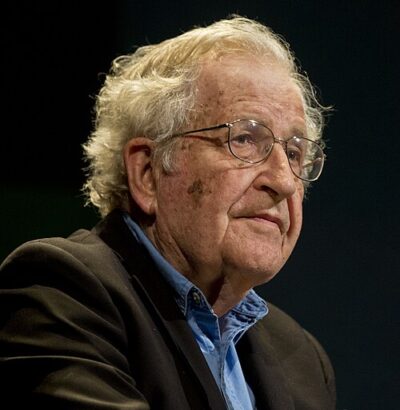
Syntactic Structures
Syntactic Structures is a non-fiction work by Noam Chomsky. It came out in 1957.
- Published
- February 1957
- Written by
- Noam Chomsky
- Genre
- linguistics
- Country of origin
- United States
All 11 facts, and where they come from
Facts
11 facts · 0 confirmed by two sources · 0 cited · 11 from one source
Where this comes from
Papalocal keeps its own record. It started from these sources; what each one said is kept here as it was copied, so a change on their side never changes this page by itself. Tap one to read its version.
What Wikidata says · copied November 16, 2026 · revision 2414285272
- Described as
- non-fiction work by Noam Chomsky
- Other names
- Syntactic structures
- What it is
- scientific work; written work
- Written by
- Noam Chomsky
- Publisher
- De Gruyter
- Genre
- linguistics; non-fiction
- Published
- February 1957
- Language
- English
- Country of origin
- United States
- Comes after
- The Logical Structure of Linguistic Theory · 1 reference
- Followed by
- Aspects of the Theory of Syntax
- Wikipedias with a page
- 20
Wikidata item Q1198080 (wikidata.org/wiki/Q1198080), public domain (CC0). Copied 2026-11-16.
What Wikipedia says · copied November 16, 2026 · revision 1384243062
Syntactic Structures is a seminal work in linguistics by American linguist Noam Chomsky, originally published in 1957. A short monograph of about a hundred pages, it is recognized as one of the most significant and influential linguistic studies of the 20th century. It contains the now-famous sentence "Colorless green ideas sleep furiously", which Chomsky offered as an example of a grammatically correct sentence that has no discernible meaning, thus arguing for the independence of syntax (the study of sentence structures) from semantics (the study of meaning).
Based on lecture notes he had prepared for his students at the Massachusetts Institute of Technology in the mid-1950s, Syntactic Structures was Chomsky's first book on linguistics and reflected the contemporary developments in early generative grammar. In it, Chomsky introduced his idea of a transformational generative grammar, succinctly synthesizing and integrating the concepts of transformation (pioneered by his mentor Zellig Harris, but used in a precise and integrative way by Chomsky), morphophonemic rules (introduced by Leonard Bloomfield) and an item-and-process style of grammar description (developed by Charles Hockett). Here, Chomsky's approach to syntax is fully formal (based on symbols and rules). At its base, Chomsky uses phrase structure rules, which break down sentences into smaller parts. These are combined with a new kind of rules which Chomsky called "transformations". This procedure gives rise to different sentence structures. Chomsky stated that this limited set of rules "generates" all and only the grammatical sentences of a given language, which are infinite in number (not too dissimilar to a notion introduced earlier by Danish linguist Louis Hjelmslev). Although not explicitly stated in the book itself, this way of study was later interpreted to have valued language's innate place in the mind over language as learned behavior,
Written when Chomsky was still an unknown scholar, Syntactic Structures had a major impact on the study of knowledge, mind and mental processes, becoming an influential work in the formation of the field of cognitive science. It also significantly influenced research on computers and the brain. The importance of Syntactic Structures lies in Chomsky's persuasion for a biological perspective on language at a time when it was unusual, and in the context of formal linguistics. The book led to Chomsky's eventual recognition as one of the founders of what is now known as sociobiology. Some specialists have questioned Chomsky's theory, believing it is wrong to describe language as an ideal system. They also say it gives less value to the gathering and testing of data. Nevertheless, Syntactic Structures is credited to have changed the course of linguistics in general and American linguistics in particular in the second half of the 20th century.
From the Wikipedia article “Syntactic Structures” (en.wikipedia.org/wiki/Syntactic_Structures), by its contributors, under CC BY-SA 4.0 (creativecommons.org/licenses/by-sa/4.0/). Copied 2026-11-16; not changed.
Confirmed Two sources agree. Cited One source, and it names where it got it. One source One source, without a reference of its own. Sources disagree The sources disagree. We show the best-supported value and keep theirs below.
Picture: Wikimedia Commons: Syntactic Structures Front Cover (1957 first edition).jpg · See Commons file page