Beltrami–Klein model
Beltrami–Klein model is a model of hyperbolic geometry.
All 3 facts, and where they come from
Facts
3 facts · 0 confirmed by two sources · 0 cited · 3 from one source
Where this comes from
Papalocal keeps its own record. It started from these sources; what each one said is kept here as it was copied, so a change on their side never changes this page by itself. Tap one to read its version.
What Wikidata says · copied November 17, 2026 · revision 2458835460
- Described as
- model of hyperbolic geometry
- Other names
- Cayley–Klein model
- What it is
- mathematical model
- Named after
- Felix Klein; Eugenio Beltrami
- Wikipedias with a page
- 10
Wikidata item Q1189065 (wikidata.org/wiki/Q1189065), public domain (CC0). Copied 2026-11-17.
What Wikipedia says · copied November 17, 2026 · revision 1385019740
In geometry, the Beltrami–Klein model, also called the projective model, Klein disk model, and Cayley–Klein model, is a model of hyperbolic geometry in which points are represented by the points in the interior of the unit disk (or n-dimensional unit ball) and lines are represented by the chords, straight line segments with ideal endpoints on the boundary sphere.
It is analogous to the gnomonic projection of spherical geometry, in that geodesics (great circles in spherical geometry) are mapped to straight lines.
This model is not conformal: angles are not faithfully represented, and circles become ellipses, increasingly flattened near the edge. This is in contrast to the Poincaré disk model, which is conformal. However, lines in the Poincaré model are not represented by straight line segments, but by arcs that meet the boundary orthogonally.
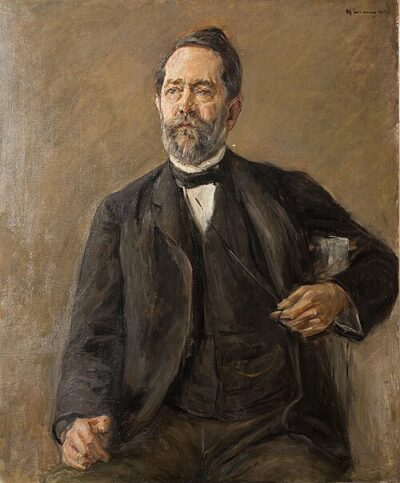
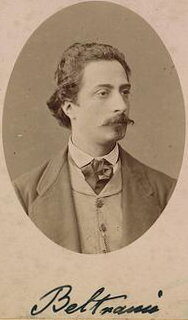
The Beltrami–Klein model is named after the Italian geometer Eugenio Beltrami and the German Felix Klein while "Cayley" in Cayley–Klein model refers to the English geometer Arthur Cayley.
From the Wikipedia article “Beltrami–Klein model” (en.wikipedia.org/wiki/Beltrami–Klein_model), by its contributors, under CC BY-SA 4.0 (creativecommons.org/licenses/by-sa/4.0/). Copied 2026-11-17; not changed.
Confirmed Two sources agree. Cited One source, and it names where it got it. One source One source, without a reference of its own. Sources disagree The sources disagree. We show the best-supported value and keep theirs below.