
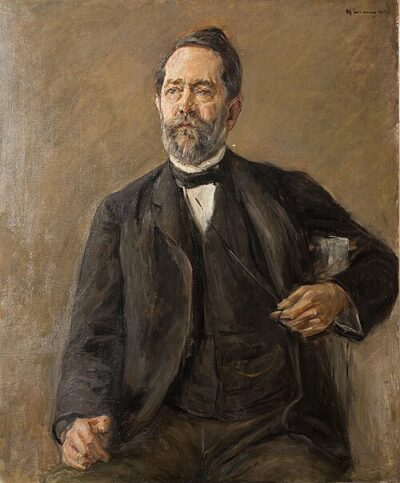
Felix Klein
Felix Klein was a German mathematician, author of the Erlangen Program. Born April 25, 1849, in Düsseldorf. Died June 22, 1925, in Göttingen. Positions held include member of the Prussian House of Lords (1908–1918), editor (1876–1924) and chairperson (3 times) (1897–1908). Known for Erlangen program, Klein bottle and Beltrami–Klein model. Educated at University of Bonn and Görres-Gymnasium Düsseldorf. Awards include Copley Medal, Pour le Mérite for Sciences and Arts order and De Morgan Medal.
Facts
62 facts · 2 confirmed by two sources · 32 cited · 28 from one source
Where this comes from
Papalocal keeps its own record. It started from these sources; what each one said is kept here as it was copied, so a change on their side never changes this page by itself. Tap one to read its version.
What Wikidata says · copied November 16, 2026 · revision 2569070993
- Described as
- German mathematician, author of the Erlangen Program (1849–1925)
- Other names
- F. Klein, Christian Felix Klein, Felix Christian Klein
- Born
- April 25, 1849 · 5 references
- Died
- June 22, 1925 · 11 references
- Born in
- Düsseldorf · 4 references
- Died in
- Göttingen · 4 references
- Buried in
- Göttingen City Cemetery · 1 reference
- Name at birth
- Felix Christian Klein · 1 reference
- Citizen of
- Kingdom of Prussia; German Empire (1871–1918); Weimar Republic (1918–)
- Occupation
- mathematician · 1 reference; historian of mathematics · 1 reference; university teacher · 1 reference; politician; publisher · 2 references; physicist · 1 reference
- Positions held
- member of the Prussian House of Lords (1908–1918); editor (1876–1924) · 1 reference; chairperson (3 times) (1897–1908) · 1 reference
- Worked for
- University of Erlangen–Nuremberg (1872–1875) · 1 reference; Technical University of Munich (1875–1880) · 1 reference; Leipzig University (1880–1886) · 1 reference; University of Göttingen (2 times) (1871–1913) · 2 references; Technische Universität Berlin · 1 reference
- Education
- University of Bonn (1865–1868) · 1 reference; Görres-Gymnasium Düsseldorf (1857–1865) · 1 reference
- Member of
- Saxon Academy of Sciences and Humanities (1882–); German Academy of Sciences Leopoldina (1886–) · 1 reference; Göttingen Academy of Sciences and Humanities in Lower Saxony; Saint Petersburg Academy of Sciences; Hungarian Academy of Sciences; Royal Society of London (1885–) · 1 reference; Royal Netherlands Academy of Arts and Sciences (1897–); Accademia Nazionale dei Lincei (1883–) · 1 reference; American Academy of Arts and Sciences (1904–) · 1 reference; Bavarian Academy of Sciences and Humanities (1880–) · 1 reference
- Known for
- Erlangen program; Klein bottle; Beltrami–Klein model; Klein's Encyclopedia of Mathematical Sciences; Kleinian group; Klein four-group; Vorlesungen über die Entwicklung der Mathematik im 19. Jahrhundert; Klein polyhedron; j-invariant
- Awards
- Copley Medal (1912) · 1 reference; Pour le Mérite for Sciences and Arts order (1923); De Morgan Medal (1893) · 1 reference; Ackermann–Teubner Memorial Award (1914) · 1 reference; Bavarian Maximilian Order for Science and Art (1898); Foreign Member of the Royal Society (1885) · 1 reference
- Field
- differential geometry; group theory; geometry; mathematics · 1 reference; function theory · 1 reference; education · 1 reference
- Spouse
- Anna Klein · 1 reference
- Children
- Elisabeth Staiger · 1 reference; Sophie Klein · 1 reference; Otto Klein · 1 reference
- Father
- Caspar Klein · 1 reference
- Siblings
- Alfred Klein · 1 reference
- Wikipedias with a page
- 72
Wikidata item Q76641 (wikidata.org/wiki/Q76641), public domain (CC0). Copied November 16, 2026.
What Wikipedia says · copied November 16, 2026 · revision 1383660507
Felix Christian Klein (; German: [klaɪn]; 25 April 1849 – 22 June 1925) was a German mathematician, mathematics educator and historian of mathematics, known for his work in group theory, complex analysis, non-Euclidean geometry, and the associations between geometry and group theory. His 1872 Erlangen program classified geometries by their basic symmetry groups and was an influential synthesis of much of the mathematics of the time.
During his tenure at the University of Göttingen, Klein was able to turn it into a center for mathematical and scientific research through the establishment of new lectures, professorships, and institutes. His seminars covered most areas of mathematics then known as well as their applications. Klein also devoted considerable time to mathematical instruction and promoted mathematics education reform at all grade levels in Germany and abroad. He became the first president of the International Commission on Mathematical Instruction in 1908 at the Fourth International Congress of Mathematicians in Rome.
- Born, in its opening lines
- April 25, 1849
- Died, in its opening lines
- June 22, 1925
From the Wikipedia article “Felix Klein” (en.wikipedia.org/wiki/Felix_Klein), by its contributors, under CC BY-SA 4.0 (creativecommons.org/licenses/by-sa/4.0/). Copied November 16, 2026; not changed.
Confirmed Two sources agree. Cited One source, and it names where it got it. One source One source, without a reference of its own. Sources disagree The sources disagree. We show the best-supported value and keep theirs below.
