
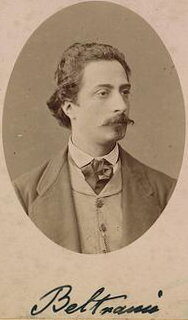
Eugenio Beltrami
Eugenio Beltrami was an Italian mathematician. Born November 16, 1835, in Cremona. Died February 18, 1900, in Rome. Positions held include President of the Accademia Nazionale dei Lincei (1898–1900) and senator of the Kingdom of Italy (1899–1900). Known for Teoria fondamentale degli spazii di curvatura costante, Di un sistema di formole per lo studio delle linee e delle superficie ortogonali and Beltrami's theorem. Educated at University of Pavia. Awards include grand officer of the Order of the Crown of Italy, Officer of the Order of Saints Maurice and Lazarus and Mathematical Prize of the Italian Academy of Sciences.
Facts
42 facts · 2 confirmed by two sources · 19 cited · 21 from one source
Where this comes from
Papalocal keeps its own record. It started from these sources; what each one said is kept here as it was copied, so a change on their side never changes this page by itself. Tap one to read its version.
What Wikidata says · copied November 16, 2026 · revision 2567525905
- Described as
- Italian mathematician (1835–1900)
- Born
- November 16, 1835 · 10 references
- Died
- February 18, 1900 · 9 references
- Born in
- Cremona · 3 references
- Died in
- Rome · 3 references
- Buried in
- Campo Verano · 1 reference
- Citizen of
- Kingdom of Italy (1861–)
- Occupation
- mathematician · 1 reference; university teacher; politician · 1 reference; physicist · 1 reference; surveyor · 1 reference; geodesist · 1 reference
- Positions held
- President of the Accademia Nazionale dei Lincei (1898–1900) · 1 reference; senator of the Kingdom of Italy (1899–1900) · 1 reference
- Worked for
- University of Bologna (2 times) (1862–1873) · 1 reference; University of Pisa (1864–1866) · 1 reference; Sapienza University of Rome (2 times) (1873–1900) · 1 reference; University of Pavia (1876–1891) · 1 reference
- Education
- University of Pavia (1853–1856) · 1 reference
- Member of
- Accademia Nazionale dei Lincei (1871–) · 1 reference; Royal Prussian Academy of Sciences (1881–); London Mathematical Society (1892–) · 1 reference; Göttingen Academy of Sciences and Humanities in Lower Saxony (1875–); Bavarian Academy of Sciences and Humanities (1899–); Academy of Sciences of Turin (1880–) · 1 reference
- Known for
- Teoria fondamentale degli spazii di curvatura costante; Di un sistema di formole per lo studio delle linee e delle superficie ortogonali; Beltrami's theorem; Beltrami–Enneper theorem; Beltrami equation; Beltrami identity; Laplace–Beltrami operator; Beltrami vector field; Beltrami–Klein model; Saggio di interpretazione della geometria non euclidea
- Awards
- grand officer of the Order of the Crown of Italy; Officer of the Order of Saints Maurice and Lazarus; Mathematical Prize of the Italian Academy of Sciences (1875)
- Field
- differential geometry; mathematics · 1 reference; physics · 1 reference; geodesy · 1 reference
- Wikipedias with a page
- 36
Wikidata item Q371918 (wikidata.org/wiki/Q371918), public domain (CC0). Copied November 16, 2026.
What Wikipedia says · copied November 16, 2026 · revision 1371992603
Eugenio Beltrami (16 November 1835 – 18 February 1900) was an Italian mathematician notable for his work concerning differential geometry and mathematical physics. His work was noted especially for clarity of exposition. He was the first to prove the consistency of non-Euclidean geometry by modelling it on a surface of constant curvature, the pseudosphere, and in the interior of an n-dimensional unit sphere, the so-called Beltrami–Klein model. He also developed singular value decomposition for matrices, which has been subsequently rediscovered several times. Beltrami's use of differential calculus for problems of mathematical physics indirectly influenced the development of tensor calculus by Gregorio Ricci-Curbastro and Tullio Levi-Civita.
- Born, in its opening lines
- November 16, 1835
- Died, in its opening lines
- February 18, 1900
From the Wikipedia article “Eugenio Beltrami” (en.wikipedia.org/wiki/Eugenio_Beltrami), by its contributors, under CC BY-SA 4.0 (creativecommons.org/licenses/by-sa/4.0/). Copied November 16, 2026; not changed.
Confirmed Two sources agree. Cited One source, and it names where it got it. One source One source, without a reference of its own. Sources disagree The sources disagree. We show the best-supported value and keep theirs below.
