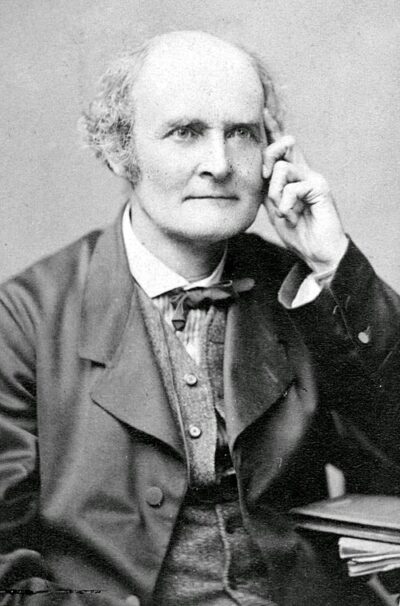
Cayley–Hamilton theorem
Cayley–Hamilton theorem is a theorem that a square matrix satisfies its own characteristic equation.
All 3 facts, and where they come from
Facts
3 facts · 0 confirmed by two sources · 0 cited · 3 from one source
Where this comes from
Papalocal keeps its own record. It started from these sources; what each one said is kept here as it was copied, so a change on their side never changes this page by itself. Tap one to read its version.
What Wikidata says · copied November 17, 2026 · revision 2553197294
- Described as
- theorem that a square matrix satisfies its own characteristic equation
- Other names
- Cayley-Hamilton
- What it is
- theorem
- Named after
- Arthur Cayley; William Rowan Hamilton
- Wikipedias with a page
- 31
Wikidata item Q656772 (wikidata.org/wiki/Q656772), public domain (CC0). Copied 2026-11-17.
What Wikipedia says · copied November 17, 2026 · revision 1375228092
In linear algebra, the Cayley–Hamilton theorem (named after the mathematicians Arthur Cayley and William Rowan Hamilton) states that every square matrix over a commutative ring (such as the real or complex numbers or the integers) satisfies its own characteristic equation.
The characteristic polynomial of an n×n matrix A is defined as pA(λ)=det(λIn−A), where det is the determinant operation, λ is a variable scalar element of the base ring, and In is the n×n identity matrix. Since each entry of the matrix (λIn−A) is either constant or linear in λ, the determinant of (λIn−A) is a degree-n monic polynomial in λ, so it can be written as
pA(λ)=λn+cn−1λn−1+⋯+c1λ+c0. By replacing the scalar variable λ with the matrix A, one can define an analogous matrix polynomial expression, pA(A)=An+cn−1An−1+⋯+c1A+c0In.
(Here, A is the given matrix—not a variable, unlike λ—so pA(A) is a constant rather than a function.)
The Cayley–Hamilton theorem states that this polynomial expression is equal to the zero matrix, which is to say that pA(A)=0; that is, the characteristic polynomial pA is an annihilating polynomial for A.
One use for the Cayley–Hamilton theorem is that it allows An to be expressed as a linear combination of the lower matrix powers of A:
An=−cn−1An−1−⋯−c1A−c0In.
When the ring is a field, the Cayley–Hamilton theorem is equivalent to the statement that the minimal polynomial of a square matrix divides its characteristic polynomial.
A special case of the theorem was first proved by Hamilton in 1853 in terms of inverses of linear functions of quaternions. This corresponds to the special case of certain 4×4 real or 2×2 complex matrices. Cayley in 1858 stated the result for 3×3 and smaller matrices, but only published a proof for the 2×2 case. As for n×n matrices, Cayley stated "..., I have not thought it necessary to undertake the labor of a formal proof of the theorem in the general case of a matrix of any degree". The general case was first proved by Ferdinand Frobenius in 1878.
From the Wikipedia article “Cayley–Hamilton theorem” (en.wikipedia.org/wiki/Cayley–Hamilton_theorem), by its contributors, under CC BY-SA 4.0 (creativecommons.org/licenses/by-sa/4.0/). Copied 2026-11-17; not changed.
Confirmed Two sources agree. Cited One source, and it names where it got it. One source One source, without a reference of its own. Sources disagree The sources disagree. We show the best-supported value and keep theirs below.