
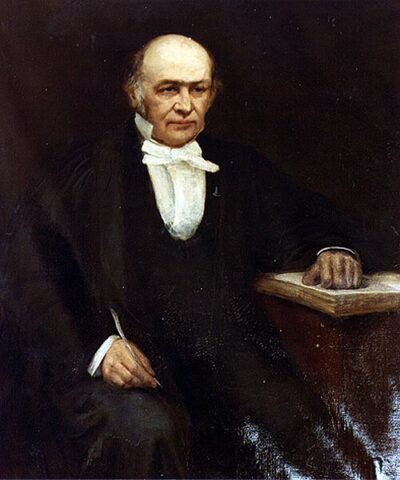
William Rowan Hamilton
William Rowan Hamilton was an Irish mathematician and astronomer. Born August 4, 1805, in Dublin. Died September 2, 1865, in Dublin. Positions held include Royal Astronomer of Ireland (1827–1865). Known for Hamilton's principle, On the osculating twisted cubic to a curve of double curvature and VIII. <i>Second theorem of algebraic elimination, connected with the question of the possibility of resolving, in finite terms, equations of the Fifth degree</i>. Educated at Trinity College, Dublin. Awards include Royal Medal, Fellow of the American Academy of Arts and Sciences and Cunningham Medal.
Facts
43 facts · 2 confirmed by two sources · 18 cited · 23 from one source
Where this comes from
Papalocal keeps its own record. It started from these sources; what each one said is kept here as it was copied, so a change on their side never changes this page by itself. Tap one to read its version.
What Wikidata says · copied November 16, 2026 · revision 2568709265
- Described as
- Irish mathematician and astronomer (1805-1865)
- Other names
- Sir William Rowan Hamilton, Hamilton, Hamilton Mathematics Institute
- Born
- August 4, 1805 · 9 references
- Died
- September 2, 1865 · 9 references
- Born in
- Dublin · 4 references
- Died in
- Dublin · 3 references
- Buried in
- Mount Jerome Cemetery · 1 reference
- Citizen of
- United Kingdom of Great Britain and Ireland · 1 reference
- Occupation
- mathematician · 2 references; physicist; astronomer · 1 reference; university teacher; theoretical physicist
- Positions held
- Royal Astronomer of Ireland (1827–1865) · 1 reference
- Worked for
- Trinity College, Dublin (1827–1865) · 1 reference; Dunsink Observatory (1827–1865) · 1 reference
- Education
- Trinity College, Dublin (1823–1826) · 1 reference
- Member of
- Royal Society of London; National Academy of Sciences (1864–); Saint Petersburg Academy of Sciences (1837–) · 1 reference; American Academy of Arts and Sciences; Royal Irish Academy; Royal Prussian Academy of Sciences (1839–) · 1 reference; Academy of Sciences of Turin (1841–) · 1 reference; Russian Academy of Sciences
- Known for
- Hamilton's principle; On the osculating twisted cubic to a curve of double curvature; VIII. <i>Second theorem of algebraic elimination, connected with the question of the possibility of resolving, in finite terms, equations of the Fifth degree</i>; XCI. <i>Theorem respecting algebraic elimination, connected with the question of the possibility of resolving in finite terms the general equation of the fifth degree</i>. Extracted by permission, from a communication recently made to the Royal Iris; quaternion; Hamiltonian mechanics; Hamiltonian path
- Awards
- Royal Medal (1835); Fellow of the American Academy of Arts and Sciences (1864) · 1 reference; Cunningham Medal (1834) · 1 reference
- Field
- mathematics · 1 reference; mechanics · 1 reference; astronomy · 1 reference; physics · 1 reference; mathematical physics · 1 reference; optics · 1 reference
- Spouse
- Helen Maria Bayly · 1 reference
- Children
- William Edwin Hamilton · 2 references
- Father
- Archibald Rowan-Hamilton · 1 reference
- Religion
- Anglicanism
- Wikipedias with a page
- 83
Wikidata item Q11887 (wikidata.org/wiki/Q11887), public domain (CC0). Copied November 16, 2026.
What Wikipedia says · copied November 16, 2026 · revision 1372013002
Sir William Rowan Hamilton (4 August 1805 – 2 September 1865) was an Irish mathematician, physicist, and astronomer who made numerous major contributions to algebra, classical mechanics, and optics. His theoretical works and mathematical equations are considered fundamental to modern theoretical physics, particularly his reformulation of Lagrangian mechanics. His research included the analysis of geometrical optics, Fourier analysis, and quaternions, the last of which made him one of the founders of modern linear algebra.
Hamilton was Andrews Professor of Astronomy at Trinity College Dublin. He was also the third director of Dunsink Observatory from 1827 to 1865. The Hamilton Institute at Maynooth University is named after him.
He received the Cunningham Medal twice, in 1834 and 1848, and the Royal Medal in 1835. He was also knighted in 1835. Hamilton remains arguably the most influential Irish physicist, along with Ernest Walton. Since his death, he has been commemorated throughout the country, with several institutions, streets, monuments, and stamps bearing his name.
- Born, in its opening lines
- August 4, 1805
- Died, in its opening lines
- September 2, 1865
From the Wikipedia article “William Rowan Hamilton” (en.wikipedia.org/wiki/William_Rowan_Hamilton), by its contributors, under CC BY-SA 4.0 (creativecommons.org/licenses/by-sa/4.0/). Copied November 16, 2026; not changed.
Confirmed Two sources agree. Cited One source, and it names where it got it. One source One source, without a reference of its own. Sources disagree The sources disagree. We show the best-supported value and keep theirs below.
