
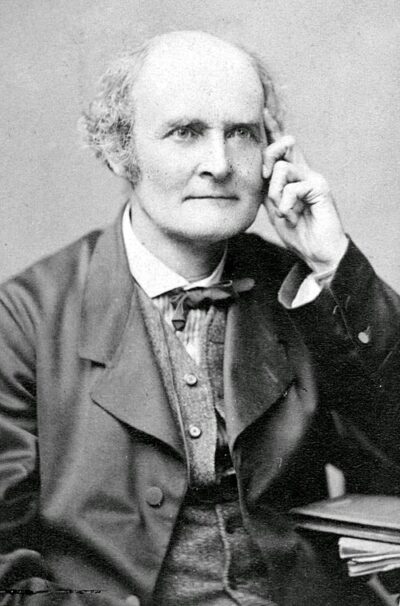
Arthur Cayley
Arthur Cayley was an English mathematician. Born August 16, 1821, in Richmond. Died January 26, 1895, in Cambridge. Positions held include Sadleirian Professor of Pure Mathematics (1863–1895), chairperson (1868–1870) and President of the Royal Astronomical Society (1872–1874). Known for Cayley's theorem, Cayley–Hamilton theorem and Cayley–Bacharach theorem. Educated at King's College School and Trinity College. Awards include Fellow of the Royal Society, Copley Medal and Royal Medal.
Facts
62 facts · 2 confirmed by two sources · 31 cited · 29 from one source
Where this comes from
Papalocal keeps its own record. It started from these sources; what each one said is kept here as it was copied, so a change on their side never changes this page by itself. Tap one to read its version.
What Wikidata says · copied November 16, 2026 · revision 2562178405
- Described as
- English mathematician (1821-1895)
- Born
- August 16, 1821 · 9 references
- Died
- January 26, 1895 · 10 references
- Born in
- Richmond · 2 references
- Died in
- Cambridge · 3 references
- Buried in
- Mill Road Cemetery · 2 references
- Citizen of
- United Kingdom of Great Britain and Ireland
- Occupation
- mathematician · 1 reference; lawyer; university teacher; barrister · 1 reference
- Positions held
- Sadleirian Professor of Pure Mathematics (1863–1895) · 1 reference; chairperson (1868–1870) · 1 reference; President of the Royal Astronomical Society (1872–1874)
- Worked for
- University of Cambridge (1863–1895) · 1 reference; Trinity College (1842–1846) · 1 reference; Lincoln's Inn (1849–1863) · 1 reference
- Education
- King's College School (1835–1838) · 1 reference; Trinity College (1838–1842) · 2 references; Lincoln's Inn (1846–1849) · 1 reference
- Member of
- Royal Society of London (1852–) · 1 reference; Göttingen Academy of Sciences and Humanities in Lower Saxony; Hungarian Academy of Sciences; American Academy of Arts and Sciences (1866–); Russian Academy of Sciences; Royal Prussian Academy of Sciences; Royal Netherlands Academy of Arts and Sciences; Accademia Nazionale delle Scienze detta dei XL; Royal Society of Edinburgh (1865–) · 1 reference; Royal Astronomical Society (1857–) · 1 reference
- Known for
- Cayley's theorem; Cayley–Hamilton theorem; Cayley–Bacharach theorem; Cayley–Dickson construction; Cayley graph; Cayley plane; Cayley table; Cayley transform; Cayleyan; Cayley–Menger determinant
- Awards
- Fellow of the Royal Society (1852) · 1 reference; Copley Medal (1882) · 1 reference; Royal Medal (1859) · 1 reference; De Morgan Medal (1884) · 1 reference; Honorary doctor of the Heidelberg University · 1 reference; honorary doctor of the University of Edinburgh · 1 reference; Honorary doctor of the University of Bologna · 1 reference; Honorary doctor of the University of Oxford · 1 reference; Officer of the Legion of Honour (1890) · 1 reference; Fellow of the American Academy of Arts and Sciences (1866) · 1 reference; Honorary doctor of Leiden University · 1 reference; Smith's Prize (1842) · 1 reference
- Field
- graph theory; group theory; mathematics
- Spouse
- Susan Moline (1863–) · 2 references
- Children
- Henry Cayley · 1 reference; Mary Cayley · 1 reference
- Father
- Henry Cayley · 1 reference
- Mother
- Mary Antonia Doughty · 1 reference
- Siblings
- Charles Bagot Cayley
- Lived in
- England · 1 reference; Saint Petersburg · 1 reference
- Wikipedias with a page
- 56
Wikidata item Q159430 (wikidata.org/wiki/Q159430), public domain (CC0). Copied November 16, 2026.
What Wikipedia says · copied November 16, 2026 · revision 1371973143
Arthur Cayley (; 16 August 1821 – 26 January 1895) was an English mathematician who worked mostly on algebra. He helped found the modern British school of pure mathematics, and was a professor at Trinity College, Cambridge for 35 years.
He postulated what is now known as the Cayley–Hamilton theorem—that every square matrix is a root of its own characteristic polynomial, and verified it for matrices of order 2 and 3. He was the first to define the concept of an abstract group, a set with a binary operation satisfying certain laws, as opposed to Évariste Galois' concept of permutation groups. In group theory, Cayley tables, Cayley graphs, and Cayley's theorem are named in his honour, as well as Cayley's formula in combinatorics.
- Born, in its opening lines
- August 16, 1821
- Died, in its opening lines
- January 26, 1895
From the Wikipedia article “Arthur Cayley” (en.wikipedia.org/wiki/Arthur_Cayley), by its contributors, under CC BY-SA 4.0 (creativecommons.org/licenses/by-sa/4.0/). Copied November 16, 2026; not changed.
Confirmed Two sources agree. Cited One source, and it names where it got it. One source One source, without a reference of its own. Sources disagree The sources disagree. We show the best-supported value and keep theirs below.
