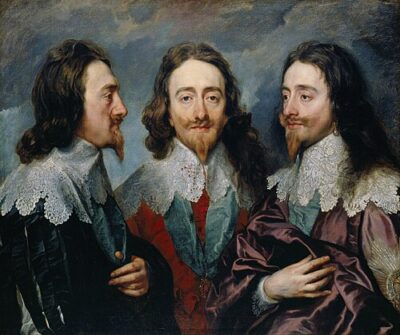
Charles I in Three Positions
Charles I in Three Positions is a painting by Anthony van Dyck. It came out in 1635.
- Came out
- 1635
- Created by
- Anthony van Dyck
- Genre
- portrait
All 6 facts, and where they come from
Facts
6 facts · 0 confirmed by two sources · 4 cited · 2 from one source
Where this comes from
Papalocal keeps its own record. It started from these sources; what each one said is kept here as it was copied, so a change on their side never changes this page by itself. Tap one to read its version.
What Wikidata says · copied November 17, 2026 · revision 2463855954
- Described as
- painting by Anthony van Dyck
- Other names
- Triple Portrait of Charles I
- What it is
- painting · 1 reference
- Created by
- Anthony van Dyck · 1 reference
- Genre
- portrait · 1 reference
- Came out
- 1635
- Country
- Netherlands
- Owned by
- George IV of the United Kingdom · 1 reference
- Wikipedias with a page
- 14
Wikidata item Q3998985 (wikidata.org/wiki/Q3998985), public domain (CC0). Copied 2026-11-17.
What Wikipedia says · copied November 17, 2026 · revision 1355444386
Charles I in Three Positions, also known as the Triple Portrait of Charles I, is an oil painting of King Charles I of England painted in 1635–1636 by the Flemish artist Sir Anthony van Dyck, showing the King from three viewpoints: left full profile, face on, and right three-quarter profile. It is currently part of the Royal Collection.
The colours of the costumes and pattern of the lace collars are different in each portrait, though the blue riband of the Order of the Garter is present in all three. The painting was probably begun in the latter part of 1635 and was sent to Rome in 1636 to be used as a reference work for the Italian sculptor Gian Lorenzo Bernini to create a marble bust of Charles I. Pope Urban VIII sent the bust to Charles's queen Henrietta Maria in 1638 in the hope of encouraging a reconciliation of the Roman Catholic Church with the Church of England.
The bust was presented in 1637 and admired for its workmanship and likeness to the King. Charles rewarded Bernini with a valuable diamond ring. Queen Henrietta Maria commissioned Bernini to make a companion bust of her, but the English Civil War intervened and it was never made. The bust of Charles was sold at the end of the Civil War but was recovered for the Royal Collection on the Restoration, only to be destroyed by a fire in Whitehall Palace in January 1698.
The painting remained in the possession of Bernini and his heirs in the Palazzo Bernini on the Via del Corso until c. 1802, when it was sold to the British art dealer William Buchanan and returned to England. It was exhibited at the British Gallery on Pall Mall in 1821. It was acquired for the Royal Collection in 1822.
It is thought that the painting was influenced by Lorenzo Lotto's Triple Portrait of a Goldsmith, c. 1530, then in the Royal Collection. In its turn, van Dyck's portrait of Charles I may have influenced Philippe de Champaigne's triple portrait of Cardinal de Richelieu, c. 1642.
Many copies of the work were made, possibly by supporters of the House of Stuart, including one created around 1750 and now in the collection of the Victoria and Albert Museum in London.
The British Museum has an engraving which was believed to depict the bust before it was destroyed, with Baroque locks of flowing hair, fine lace collar, garter sash, possibly by Robert van Voerst, but this is now believed to show a bust by François Dieussart.
From the Wikipedia article “Charles I in Three Positions” (en.wikipedia.org/wiki/Charles_I_in_Three_Positions), by its contributors, under CC BY-SA 4.0 (creativecommons.org/licenses/by-sa/4.0/). Copied 2026-11-17; not changed.
Confirmed Two sources agree. Cited One source, and it names where it got it. One source One source, without a reference of its own. Sources disagree The sources disagree. We show the best-supported value and keep theirs below.
Picture: Sir Anthony Van Dyck (1599 - 1641) Details on Google Art Project, via Wikimedia Commons · Public domain