
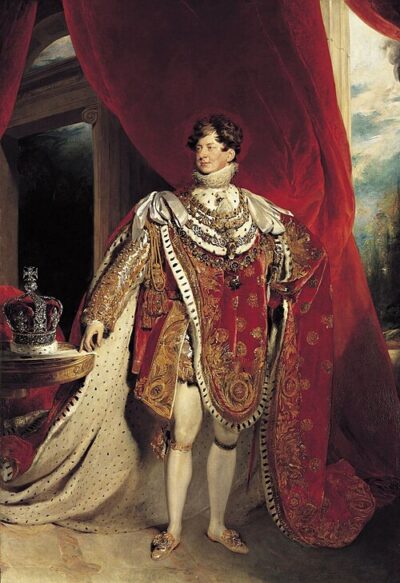
George IV of the United Kingdom
George IV of the United Kingdom was a King of the United Kingdom and Hanover from 1820 to 1830. Born August 12, 1762, in St James's Palace. Died June 26, 1830, in Windsor Castle. Positions held include monarch of the United Kingdom of Great Britain and Ireland (1820–1830), member of the House of Lords and King of Hanover (1820–1830). Awards include Knight of the Order of the Holy Spirit, Knight of the Order of Saint Michael and Knight Grand Cross of the Order of the Bath.
Facts
53 facts · 2 confirmed by two sources · 18 cited · 33 from one source
Where this comes from
Papalocal keeps its own record. It started from these sources; what each one said is kept here as it was copied, so a change on their side never changes this page by itself. Tap one to read its version.
What Wikidata says · copied November 16, 2026 · revision 2567828769
- Described as
- King of the United Kingdom and Hanover from 1820 to 1830
- Other names
- George Augustus Frederick Hanover, First Gentleman of Europe, George Augustus Frederick, Prince of Wales George, George Augustus Frederick king of the United Kingdom of Great Britain and Ireland and king of Hanove, Georg August Friedrich king of the United Kingdom of Great Britain and Ireland and king of Hanover, King George IV, George Hanover, George IV, Prince of Wales George IV
- Born
- August 12, 1762 · 8 references
- Died
- June 26, 1830 · 8 references
- Born in
- St James's Palace · 2 references
- Died in
- Windsor Castle · 4 references
- Buried in
- St George's Chapel, Windsor
- Cause of death
- gastrointestinal system disease
- Citizen of
- United Kingdom of Great Britain and Ireland; Kingdom of Great Britain
- Occupation
- art collector · 1 reference; patron of the arts · 1 reference; ruler; politician · 1 reference
- Positions held
- monarch of the United Kingdom of Great Britain and Ireland (1820–1830); member of the House of Lords; King of Hanover (1820–1830)
- Member of
- Royal Society of London
- Awards
- Knight of the Order of the Holy Spirit; Knight of the Order of Saint Michael; Knight Grand Cross of the Order of the Bath; Knight Grand Cross of the Order of St Michael and St George; Knight of the Order of the Golden Fleece; Order of Saint Anna, 1st class; Order of Saint Alexander Nevsky; Order of St. Andrew; Order of the Southern Cross; Knight Grand Cross of the Military Order of William (1818); Order of the Red Eagle 1st Class; Knight of the Garter (1771); Order of the Thistle; Order of St Patrick; Order of Saint Stephen of Hungary
- Spouse
- Caroline of Brunswick (1795–) · 2 references; Maria Fitzherbert (1785–) · 2 references
- Children
- Princess Charlotte Augusta of Wales · 1 reference; Georgiana Augusta Frederica Seymour · 1 reference; George Lamb · 2 references; George Seymour Crole · 1 reference; Emma Anne Finucane · 1 reference; François-Louis Laporte, comte de Castelnau
- Father
- George III of Great Britain · 1 reference
- Mother
- Charlotte of Mecklenburg-Strelitz · 1 reference
- Siblings
- Prince Frederick, Duke of York and Albany · 1 reference; William IV · 1 reference; Charlotte, Princess Royal; Prince Edward, Duke of Kent and Strathearn · 1 reference; Princess Augusta Sophia of the United Kingdom; Princess Elizabeth of the United Kingdom; Ernest Augustus, King of Hanover; Prince Augustus Frederick, Duke of Sussex; Prince Adolphus, Duke of Cambridge; Princess Mary of the United Kingdom · 1 reference
- Religion
- Anglicanism
- Lived in
- London
- Wikipedias with a page
- 94
Wikidata item Q130586 (wikidata.org/wiki/Q130586), public domain (CC0). Copied November 16, 2026.
What Wikipedia says · copied November 16, 2026 · revision 1381312449
George IV (George Augustus Frederick; 12 August 1762 – 26 June 1830) was King of the United Kingdom of Great Britain and Ireland and King of Hanover from 29 January 1820 until his death in 1830. At the time of his accession to the throne, he was acting as prince regent for his father, King George III, having done so since 5 February 1811 during his father's final mental illness.
George IV was the eldest child of King George III and Queen Charlotte. Known affectionately as "Prinny" by friends, he led an extravagant lifestyle that contributed to the fashions of the Regency era. He was a patron of new forms of leisure, style and taste. He commissioned John Nash to build the Royal Pavilion in Brighton and remodel Buckingham Palace, and commissioned Jeffry Wyatville to rebuild Windsor Castle. George's charm and culture earned him the title "the first gentleman of England", but his dissolute way of life and poor relationships with his parents and his wife, Caroline of Brunswick, earned him the contempt of the people and dimmed the prestige of the monarchy. He excluded Caroline from his coronation and asked the government to introduce the unpopular Pains and Penalties Bill in an unsuccessful attempt to divorce her.
George's rule was tarnished by scandal and financial extravagance. His ministers found his behaviour selfish, unreliable and irresponsible, and he was strongly influenced by favourites. During most of George's regency and reign, Lord Liverpool controlled the government as prime minister of the United Kingdom. Liverpool's government presided over Britain's ultimate victory over Napoleon and negotiated a peace settlement with the French. After Liverpool's retirement, George was forced to accept Catholic emancipation despite opposing it. His only legitimate child, Princess Charlotte, predeceased him in 1817, as did his childless younger brother Prince Frederick in 1827, so he was succeeded by another younger brother, William IV.
- Born, in its opening lines
- August 12, 1762
- Died, in its opening lines
- June 26, 1830
From the Wikipedia article “George IV” (en.wikipedia.org/wiki/George_IV), by its contributors, under CC BY-SA 4.0 (creativecommons.org/licenses/by-sa/4.0/). Copied November 16, 2026; not changed.
Confirmed Two sources agree. Cited One source, and it names where it got it. One source One source, without a reference of its own. Sources disagree The sources disagree. We show the best-supported value and keep theirs below.
