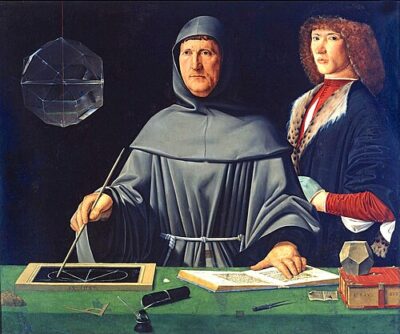
De ludo scachorum
De ludo scachorum is a manuscript on the game of chess. It came out in 1500. It was written by Luca Pacioli.
- Published
- 1500
- Came out
- 1500
- Written by
- Luca Pacioli
- Created by
- Luca Pacioli
All 9 facts, and where they come from
Facts
9 facts · 0 confirmed by two sources · 0 cited · 9 from one source
Where this comes from
Papalocal keeps its own record. It started from these sources; what each one said is kept here as it was copied, so a change on their side never changes this page by itself. Tap one to read its version.
What Wikidata says · copied November 17, 2026 · revision 2535742078
- Described as
- manuscript on the game of chess
- What it is
- literary work; illuminated manuscript
- Written by
- Luca Pacioli
- Created by
- Luca Pacioli; Leonardo da Vinci
- Published
- 1500
- Language
- Latin
- Came out
- 1500
- Sport
- chess
- Wikipedias with a page
- 7
Wikidata item Q3704129 (wikidata.org/wiki/Q3704129), public domain (CC0). Copied 2026-11-17.
What Wikipedia says · copied November 17, 2026 · revision 1385984415
De ludo scachorum ('On the Game of Chess'), also known as Schifanoia ('the "Boredom Dodger"'), is a Latin-language manuscript on the game of chess written around 1500 by Luca Pacioli, a leading mathematician of the Renaissance. Created in the times when rules of the game (especially the way queen and bishop move) were evolving to the ones known today, the manuscript contains over a hundred chess problems, to be solved – depending on the problem – using either the old or the modern rules.
The long-lost manuscript was rediscovered in 2006 and gathered public attention in 2008, following the plausible suggestion that the chess pieces in its illustrations were designed or perhaps even drawn by Leonardo da Vinci.
From the Wikipedia article “De ludo scachorum” (en.wikipedia.org/wiki/De_ludo_scachorum), by its contributors, under CC BY-SA 4.0 (creativecommons.org/licenses/by-sa/4.0/). Copied 2026-11-17; not changed.
Confirmed Two sources agree. Cited One source, and it names where it got it. One source One source, without a reference of its own. Sources disagree The sources disagree. We show the best-supported value and keep theirs below.
Picture: Wikimedia Commons: Scacchi pacioli.jpg · See Commons file page