Encyclopedia of the Philosophical Sciences
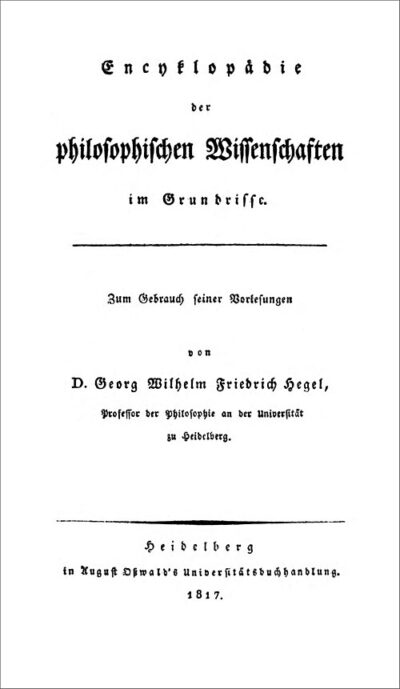
Encyclopedia of the Philosophical Sciences is a 1817 book by Georg Wilhelm Friedrich Hegel.
- Published
- 1817
- Written by
- Georg Wilhelm Friedrich Hegel
- Genre
- philosophy
- Country of origin
- Germany
All 7 facts, and where they come from
Facts
7 facts · 0 confirmed by two sources · 1 cited · 6 from one source
Where this comes from
Papalocal keeps its own record. It started from these sources; what each one said is kept here as it was copied, so a change on their side never changes this page by itself. Tap one to read its version.
What Wikidata says · copied November 17, 2026 · revision 2352692845
- Described as
- 1817 book by Georg Wilhelm Friedrich Hegel
- Other names
- EPS
- What it is
- written work
- Written by
- Georg Wilhelm Friedrich Hegel
- Genre
- philosophy · 1 reference
- Published
- 1817
- Language
- German
- Country of origin
- Germany · 1 reference
- Comes after
- Science of Logic · 1 reference
- Wikipedias with a page
- 18
Wikidata item Q919699 (wikidata.org/wiki/Q919699), public domain (CC0). Copied 2026-11-17.
What Wikipedia says · copied November 17, 2026 · revision 1384799964
The Encyclopaedia of the Philosophical Sciences in Basic Outline (German: Enzyklopädie der philosophischen Wissenschaften im Grundrisse), by Georg Wilhelm Friedrich Hegel (first published in 1817, second edition 1827, third edition 1830), is a work that presents an abbreviated version of Hegel's systematic philosophy in its entirety, and is the only form in which Hegel ever published his entire mature philosophical system.
Intended as a pedagogical aid for attendees of his lectures, Hegel revised and extended the Encyclopedia over more than a decade, but stressed its role as a "textbook" in need of elucidation through oral commentary. The 1830 text is widely available in various English translations with copious additions (Zusätze) added posthumously by Hegel's students, deriving from their lecture notes. These additions expand on the text with examples and illustrations, and while scholars do not take the Zusätze to be verbatim transcription of Hegel's lectures, their more informal and non-technical style make them good stand-ins for the "necessary oral commentary".
Part I of the work is sometimes referred to as the Lesser Logic (or Shorter Logic) to distinguish it from the Greater Logic, the moniker given to Hegel's Science of Logic.
From the Wikipedia article “Encyclopaedia of the Philosophical Sciences in Basic Outline” (en.wikipedia.org/wiki/Encyclopaedia_of_the_Philosophical_Sciences_in_Basic_Outline), by its contributors, under CC BY-SA 4.0 (creativecommons.org/licenses/by-sa/4.0/). Copied 2026-11-17; not changed.
Confirmed Two sources agree. Cited One source, and it names where it got it. One source One source, without a reference of its own. Sources disagree The sources disagree. We show the best-supported value and keep theirs below.
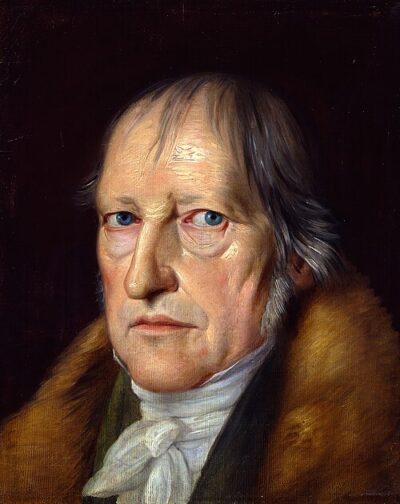
Picture: Georg Wilhelm Friedrich Hegel, via Wikimedia Commons · Public domain