Science of Logic
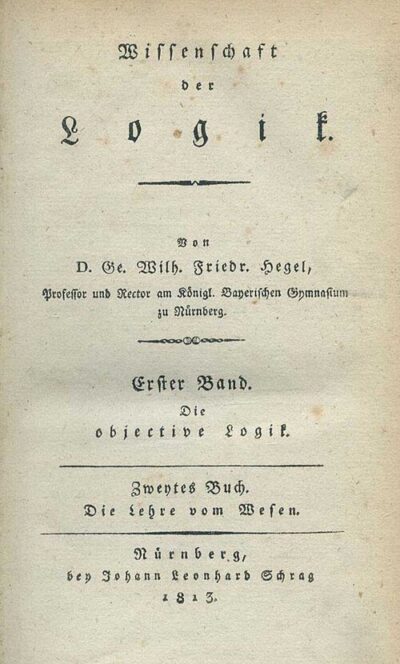
Science of Logic is a work by Georg Wilhelm Friedrich Hegel. It came out in 1812.
- Published
- 1812 (1812–1816)
- Written by
- Georg Wilhelm Friedrich Hegel
- Genre
- essay
All 8 facts, and where they come from
Facts
8 facts · 0 confirmed by two sources · 1 cited · 7 from one source
Where this comes from
Papalocal keeps its own record. It started from these sources; what each one said is kept here as it was copied, so a change on their side never changes this page by itself. Tap one to read its version.
What Wikidata says · copied November 17, 2026 · revision 2562707087
- Described as
- work by Georg Wilhelm Friedrich Hegel
- Other names
- The Logic of Hegel
- What it is
- written work; philosophical work
- Written by
- Georg Wilhelm Friedrich Hegel
- Genre
- essay · 1 reference
- Published
- 1812 (1812–1816) · 1 reference
- Language
- German
- Comes after
- The Phenomenology of Spirit · 1 reference
- Followed by
- Encyclopedia of the Philosophical Sciences · 1 reference
- Wikipedias with a page
- 15
Wikidata item Q374811 (wikidata.org/wiki/Q374811), public domain (CC0). Copied 2026-11-17.
What Wikipedia says · copied November 17, 2026 · revision 1384705868
Science of Logic (German: Wissenschaft der Logik), first published between 1812 and 1816, is the work in which Georg Wilhelm Friedrich Hegel outlined his vision of logic. Hegel's logic is a system of dialectics, i.e., a dialectical metaphysics: it is a development of the principle that thought and being constitute a single and active unity. Science of Logic also incorporates the traditional Aristotelian syllogism: it is conceived as a phase of the "original unity of thought and being" rather than as a detached, formal instrument of inference.
For Hegel, the most important achievement of German idealism, starting with Immanuel Kant and culminating in his own philosophy, was the argument that reality (being) is shaped by thought and is, in a strong sense, identical to thought. Thus ultimately the structures of thought and being, subject and object, are identical. Since for Hegel the underlying structure of all of reality is ultimately rational, logic is not merely about reasoning or argument but rather is also the rational, structural core of all of reality and every dimension of it. Thus Hegel's Science of Logic includes among other things analyses of being, nothingness, becoming, existence, reality, essence, reflection, concept, and method.
Hegel considered it one of his major works and therefore kept it up to date through revision.
Science of Logic is sometimes referred to as the Greater Logic to distinguish it from the Lesser Logic, the moniker given to the condensed version Hegel presented as the "Logic" section of his Encyclopedia of the Philosophical Sciences.
From the Wikipedia article “Science of Logic” (en.wikipedia.org/wiki/Science_of_Logic), by its contributors, under CC BY-SA 4.0 (creativecommons.org/licenses/by-sa/4.0/). Copied 2026-11-17; not changed.
Confirmed Two sources agree. Cited One source, and it names where it got it. One source One source, without a reference of its own. Sources disagree The sources disagree. We show the best-supported value and keep theirs below.
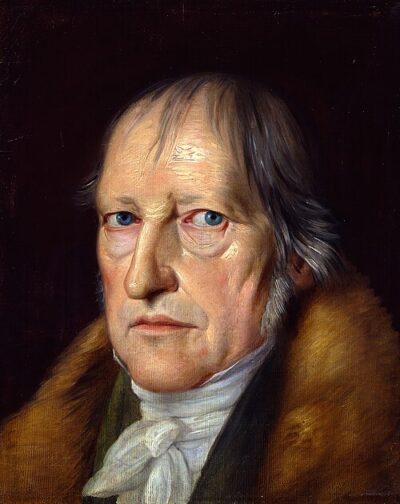
Picture: Hegel, via Wikimedia Commons · Public domain