The Phenomenology of Spirit
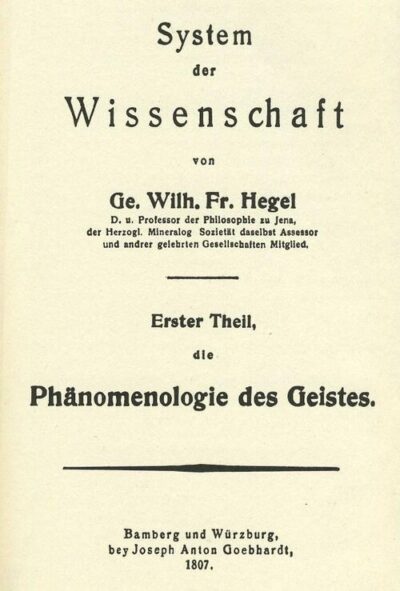
The Phenomenology of Spirit is a Book by Georg Wilhelm Friedrich Hegel. It came out in 1807.
- Published
- 1807
- Written by
- Georg Wilhelm Friedrich Hegel
- Genre
- philosophy
- Country of origin
- Germany
All 10 facts, and where they come from
Facts
10 facts · 0 confirmed by two sources · 0 cited · 10 from one source
Where this comes from
Papalocal keeps its own record. It started from these sources; what each one said is kept here as it was copied, so a change on their side never changes this page by itself. Tap one to read its version.
What Wikidata says · copied November 17, 2026 · revision 2555883434
- Described as
- Book by Georg Wilhelm Friedrich Hegel
- Other names
- Phenomenology of Spirit, The Phenomenology of Mind, Phenomenology of Mind
- What it is
- written work; creative work
- Written by
- Georg Wilhelm Friedrich Hegel
- Genre
- philosophy; essay
- Published
- 1807
- Language
- German
- Country of origin
- Germany · 1 reference
- Followed by
- Science of Logic · 1 reference
- Official website
- https://global.oup.com/academic/product/phenomenology-of-spirit-9780198245971?cc=us&lang=en&
- Wikipedias with a page
- 38
Wikidata item Q877510 (wikidata.org/wiki/Q877510), public domain (CC0). Copied 2026-11-17.
What Wikipedia says · copied November 17, 2026 · revision 1385766798
The Phenomenology of Spirit (German: Phänomenologie des Geistes) is an 1807 book by the German philosopher Georg Wilhelm Friedrich Hegel. It is Hegel's first major work and is considered one of the most important and difficult works of German idealism. The book describes a "biography of Spirit" in which consciousness develops from its most basic forms of sensory experience to the highest form of self-knowledge, which Hegel terms "absolute knowing". The book's central argument is that human beings achieve freedom through a process of retrospective self-understanding.
Originally intended as the introduction to Hegel's larger philosophical system, the Phenomenology grew into a substantial work in its own right. Its central purpose is to serve as a "ladder" that guides the reader from the standpoint of "natural consciousness" to the standpoint of philosophical science. In its extensive Preface, Hegel critiques prior philosophical methods—such as mathematical formalism and romantic intuitionism—arguing that truth is not a static proposition but a dynamic, self-developing whole. The book follows a dialectical method, tracing the journey of consciousness through a series of stages or "shapes of consciousness". Each stage is examined through a process of immanent critique, whereby consciousness discovers internal contradictions in its own view of the world, compelling it to move to a new, more sophisticated stage that attempts to resolve these contradictions. The narrative progresses through stages identified as Consciousness, Self-Consciousness, Reason, Spirit, Religion, and finally, Absolute Knowing.
The book was written during a period of historical upheaval, and its composition was famously concluded as Napoleon's army entered the city of Jena in 1806. It contains Hegel's first major public break with his former mentor Friedrich Wilhelm Joseph Schelling and establishes his own distinctive philosophical position. Key themes explored in the work include the dialectical relationship between the universal and the individual, the concept of recognition (Anerkennung), lordship and bondage, and alienation (Entfremdung).
Though its initial reception was muted, The Phenomenology of Spirit has become Hegel's most influential work. It was a foundational text for the Young Hegelians, including Karl Marx, and became a cornerstone of 20th-century continental philosophy, particularly through the influential interpretations of Alexandre Kojève and Jean Hyppolite in France, which shaped the development of existentialism, critical theory, and post-structuralism. In contemporary philosophy, it continues to be a central text for debates on epistemology, pragmatism, and social theory.
From the Wikipedia article “The Phenomenology of Spirit” (en.wikipedia.org/wiki/The_Phenomenology_of_Spirit), by its contributors, under CC BY-SA 4.0 (creativecommons.org/licenses/by-sa/4.0/). Copied 2026-11-17; not changed.
Confirmed Two sources agree. Cited One source, and it names where it got it. One source One source, without a reference of its own. Sources disagree The sources disagree. We show the best-supported value and keep theirs below.
Picture: The original uploader was Nihil Kainer at German Wikipedia., via Wikimedia Commons · Public domain