
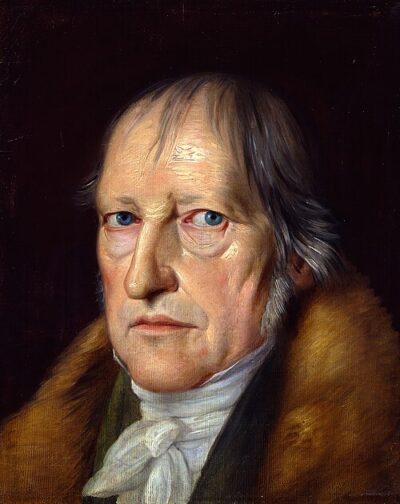
Georg Wilhelm Friedrich Hegel
Georg Wilhelm Friedrich Hegel was a German philosopher and theologian. Born August 27, 1770, in Stuttgart. Died November 14, 1831, in Berlin. Known for Lectures on the Philosophy of History, Encyclopedia of the Philosophical Sciences and Science of Logic. Educated at University of Tübingen and University of Jena. Awards include Order of the Red Eagle 3rd Class.
Facts
41 facts · 2 confirmed by two sources · 10 cited · 29 from one source
Where this comes from
Papalocal keeps its own record. It started from these sources; what each one said is kept here as it was copied, so a change on their side never changes this page by itself. Tap one to read its version.
What Wikidata says · copied November 16, 2026 · revision 2569997804
- Described as
- German philosopher and theologian (1770–1831)
- Other names
- Hegel, GWF Hegel, G.W.F. Hegel, George William Frederick Hegel, G. W. F. Hegel
- Born
- August 27, 1770 · 13 references
- Died
- November 14, 1831 · 14 references
- Born in
- Stuttgart · 5 references
- Died in
- Berlin · 5 references
- Buried in
- Dorotheenstadt Cemetery
- Cause of death
- cholera · 1 reference
- Citizen of
- Kingdom of Württemberg
- Occupation
- philosopher · 5 references; university teacher; philosophy historian; writer · 1 reference; philosopher of law; logician
- Worked for
- University of Jena; Frederick William University Berlin; Heidelberg University
- Education
- University of Tübingen; University of Jena · 1 reference; Eberhard-Ludwigs-Gymnasium; Tübinger Stift
- Known for
- Lectures on the Philosophy of History; Encyclopedia of the Philosophical Sciences; Science of Logic; The Phenomenology of Spirit; Elements of the Philosophy of Right; Lectures on Aesthetics; Lectures on the Philosophy of Religion; Lectures on the History of Philosophy
- Awards
- Order of the Red Eagle 3rd Class (1831) · 1 reference
- Field
- philosophy; logic · 1 reference; philosophy of history · 1 reference; aesthetics · 1 reference; religion · 1 reference; metaphysics · 1 reference
- Spouse
- Marie von Tucher (1811–) · 1 reference
- Children
- Karl von Hegel · 1 reference
- Father
- Georg Ludwig Hegel
- Mother
- Maria Magdalena Louisa Fromm · 1 reference
- Siblings
- Christiane Luise Hegel · 1 reference; Georg Ludwig Hegel · 1 reference
- Wikipedias with a page
- 196
Wikidata item Q9235 (wikidata.org/wiki/Q9235), public domain (CC0). Copied November 16, 2026.
What Wikipedia says · copied November 16, 2026 · revision 1385922267
Georg Wilhelm Friedrich Hegel (27 August 1770 – 14 November 1831) was a German philosopher and a major figure in the tradition of German idealism. His influence on Western philosophy extends across a wide range of topics—from metaphysical issues in epistemology and ontology, to political philosophy, to philosophy of art and philosophy of religion.
Hegel was born in Stuttgart. His life spanned the transitional period between the Enlightenment and the Romantic movement. His thought was shaped by the French Revolution and the Napoleonic wars, events which he interpreted from a philosophical perspective. His academic career culminated in his appointment to the chair of philosophy at the University of Berlin, where he remained a prominent intellectual figure until his death.
Throughout his work, Hegel strove to correct what he argued were untenable dualisms common in modern philosophy. His principal achievement was the development of a comprehensive philosophical system, often termed absolute idealism, to account for reality as a unified whole. Central to this system is the concept of "spirit" (Geist), which Hegel presented as humankind coming to know itself through a historical process of rational development. Hegel's characteristic procedure, often termed dialectical or speculative, assesses concepts and forms of consciousness according to their own internal criteria, revealing their contradictions and one-sidedness. This leads to their resolution in a higher, more comprehensive unity, which both cancels and preserves the initial stage. His major works, including the Phenomenology of Spirit (1807) and the Science of Logic (1812–1816), detail this systematic vision. In his political philosophy, he famously asserted that "world history is progress in the consciousness of freedom".
Hegel's influence has been profound and divisive. After his death, his followers split into rival "Right" and "Left" Hegelian camps. The Left, including Ludwig Feuerbach and Karl Marx, adapted his dialectical method for their materialist critiques of religion and society. In the twentieth century, his thought was further developed in traditions such as French Hegelianism and critical theory, and became a major point of reference for existentialism.
- Born, in its opening lines
- August 27, 1770
- Died, in its opening lines
- November 14, 1831
From the Wikipedia article “Georg Wilhelm Friedrich Hegel” (en.wikipedia.org/wiki/Georg_Wilhelm_Friedrich_Hegel), by its contributors, under CC BY-SA 4.0 (creativecommons.org/licenses/by-sa/4.0/). Copied November 16, 2026; not changed.
Confirmed Two sources agree. Cited One source, and it names where it got it. One source One source, without a reference of its own. Sources disagree The sources disagree. We show the best-supported value and keep theirs below.
