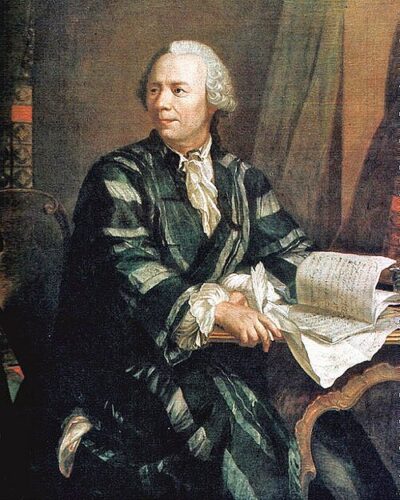
Euler–Lagrange equation
Euler–Lagrange equation is a second-order partial differential equation whose solutions are the functions for which a given functional is stationary.
All 2 facts, and where they come from
Facts
2 facts · 0 confirmed by two sources · 0 cited · 2 from one source
Where this comes from
Papalocal keeps its own record. It started from these sources; what each one said is kept here as it was copied, so a change on their side never changes this page by itself. Tap one to read its version.
What Wikidata says · copied November 17, 2026 · revision 2541695482
- Described as
- second-order partial differential equation whose solutions are the functions for which a given functional is stationary
- Other names
- Lagrange's equations of the second kind, Euler-Lagrange equation
- Named after
- Leonhard Euler; Joseph-Louis Lagrange
- Wikipedias with a page
- 34
Wikidata item Q875744 (wikidata.org/wiki/Q875744), public domain (CC0). Copied 2026-11-17.
What Wikipedia says · copied November 17, 2026 · revision 1377262229
In the calculus of variations and classical mechanics, the Euler–Lagrange equations are a system of second-order ordinary differential equations whose solutions are stationary points of the given action functional. The equations were discovered in the 1750s by Swiss mathematician Leonhard Euler and Italian mathematician Joseph-Louis Lagrange.
Because a differentiable functional is stationary at its local extrema, the Euler–Lagrange equation is useful for solving optimization problems in which, given some functional, one seeks the function minimizing or maximizing it. This is analogous to Fermat's theorem in calculus, stating that at any point where a differentiable function attains a local extremum its derivative is zero.
In Lagrangian mechanics, according to Hamilton's principle of stationary action, the evolution of a physical system is described by the solutions to the Euler equation for the action of the system. In this context Euler equations are usually called Lagrange equations. In classical mechanics, it is equivalent to Newton's laws of motion; indeed, the Euler–Lagrange equations will produce the same equations as Newton's Laws. This is particularly useful when analyzing systems whose force vectors are particularly complicated. It has the advantage that it takes the same form in any system of generalized coordinates, and it is better suited to generalizations. In classical field theory there is an analogous equation to calculate the dynamics of a field.
From the Wikipedia article “Euler–Lagrange equation” (en.wikipedia.org/wiki/Euler–Lagrange_equation), by its contributors, under CC BY-SA 4.0 (creativecommons.org/licenses/by-sa/4.0/). Copied 2026-11-17; not changed.
Confirmed Two sources agree. Cited One source, and it names where it got it. One source One source, without a reference of its own. Sources disagree The sources disagree. We show the best-supported value and keep theirs below.