
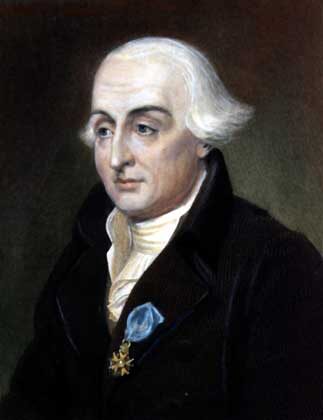
Joseph-Louis Lagrange
Joseph-Louis Lagrange was a Mathematician and astronomer. Born January 25, 1736, in Turin. Died April 10, 1813, in Paris. Positions held include member of the Sénat conservateur (1799–1813) and president of the French Academy of Sciences (1795–1796). Known for list of things named after Joseph-Louis Lagrange and Mécanique analytique. Educated at University of Turin. Awards include Grand Officer of the Legion of Honour, Fellow of the Royal Society and Knight Grand Cross of the Order of the Reunion.
Facts
48 facts · 2 confirmed by two sources · 28 cited · 18 from one source
Where this comes from
Papalocal keeps its own record. It started from these sources; what each one said is kept here as it was copied, so a change on their side never changes this page by itself. Tap one to read its version.
What Wikidata says · copied November 16, 2026 · revision 2564375045
- Described as
- Mathematician and astronomer (1736–1813)
- Other names
- José Luis Lagrange, Joseph Louis, Comte Lagrange, Joseph Louis Lagrange, Luigi Lagrange, Giuseppe Luigi Lagrangia
- Born
- January 25, 1736 · 10 references
- Died
- April 10, 1813 · 9 references
- Born in
- Turin · 6 references
- Died in
- Paris · 3 references
- Buried in
- Panthéon · 1 reference
- Name at birth
- Giuseppe Ludovico Lagrangia
- Citizen of
- France (1802–); Kingdom of Sardinia
- Occupation
- mathematician · 1 reference; astronomer; physicist; politician; writer · 1 reference; university teacher · 2 references; surveying engineer · 1 reference; count · 1 reference
- Positions held
- member of the Sénat conservateur (1799–1813) · 1 reference; president of the French Academy of Sciences (1795–1796) · 1 reference
- Worked for
- École Normale Supérieure (1795–1813) · 1 reference; Royal Academy of Turin (1755–1766) · 1 reference; Royal Prussian Academy of Sciences (1766–1787) · 1 reference; French Academy of Sciences (1787–1793) · 1 reference; École polytechnique (1794–1799) · 2 references
- Education
- University of Turin (–1754) · 2 references
- Member of
- Royal Society of London (1791–) · 1 reference; Royal Swedish Academy of Sciences; French Academy of Sciences (1787–) · 1 reference; Saint Petersburg Academy of Sciences; Accademia Nazionale delle Scienze detta dei XL; Bavarian Academy of Sciences and Humanities; Royal Society of Edinburgh (1791–) · 1 reference; Royal Prussian Academy of Sciences (1756–) · 1 reference; Academy of Sciences of Turin (1757–) · 1 reference; Göttingen Academy of Sciences and Humanities in Lower Saxony
- Known for
- list of things named after Joseph-Louis Lagrange; Mécanique analytique
- Awards
- Grand Officer of the Legion of Honour (1808) · 1 reference; Fellow of the Royal Society (1791) · 1 reference; Knight Grand Cross of the Order of the Reunion (1813) · 1 reference; 72 names on the Eiffel Tower · 1 reference
- Field
- mathematical analysis; number theory; analytical mechanics; celestial mechanics; calculus; mathematics · 1 reference
- Spouse
- Vittoria Conti (1767–1783) · 1 reference; Adélaïde Le Monnier (1792–1813) · 1 reference
- Wikipedias with a page
- 104
Wikidata item Q80222 (wikidata.org/wiki/Q80222), public domain (CC0). Copied November 16, 2026.
What Wikipedia says · copied November 16, 2026 · revision 1385861933
Joseph-Louis Lagrange (born Giuseppe Luigi Lagrangia or Giuseppe Ludovico De la Grange Tournier; 25 January 1736 – 10 April 1813), also reported as Giuseppe Luigi Lagrange or Lagrangia, was an Sardinian-Piemontese and naturalized French mathematician, physicist and astronomer. He made significant contributions to the fields of analysis, number theory, and both classical and celestial mechanics.
In 1766, on the recommendation of Leonhard Euler and d'Alembert, Lagrange succeeded Euler as the director of mathematics at the Prussian Academy of Sciences in Berlin, Prussia, where he stayed for over twenty years, producing many volumes of work and winning several prizes of the French Academy of Sciences. Lagrange's treatise on analytical mechanics (Mécanique analytique, 4. ed., 2 vols. Paris: Gauthier-Villars et fils, 1788–89), which was written in Berlin and first published in 1788, offered the most comprehensive treatment of classical mechanics since Isaac Newton and formed a basis for the development of mathematical physics in the nineteenth century.
In 1787, at age 51, he moved from Berlin to Paris and became a member of the French Academy of Sciences. He remained in France until the end of his life. He was instrumental in the decimalisation process in Revolutionary France, became the first professor of analysis at the École Polytechnique upon its opening in 1794, was a founding member of the Bureau des Longitudes, and became Senator in 1799.
- Born, in its opening lines
- January 25, 1736
- Died, in its opening lines
- April 10, 1813
From the Wikipedia article “Joseph-Louis Lagrange” (en.wikipedia.org/wiki/Joseph-Louis_Lagrange), by its contributors, under CC BY-SA 4.0 (creativecommons.org/licenses/by-sa/4.0/). Copied November 16, 2026; not changed.
Confirmed Two sources agree. Cited One source, and it names where it got it. One source One source, without a reference of its own. Sources disagree The sources disagree. We show the best-supported value and keep theirs below.
