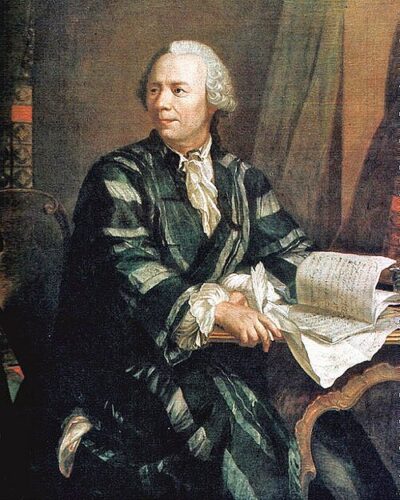
Euler's theorem
Euler's theorem is a generalization of Fermat's little theorem, that given coprime positive integers 𝑛 and 𝑎, then the φ(𝑛)-th power of 𝑎 is congruent to 1 modulo 𝑛, where φ is Euler’s totient function.
All 3 facts, and where they come from
Facts
3 facts · 0 confirmed by two sources · 0 cited · 3 from one source
Where this comes from
Papalocal keeps its own record. It started from these sources; what each one said is kept here as it was copied, so a change on their side never changes this page by itself. Tap one to read its version.
What Wikidata says · copied November 17, 2026 · revision 2511796387
- Described as
- generalization of Fermat's little theorem, that given coprime positive integers 𝑛 and 𝑎, then the φ(𝑛)-th power of 𝑎 is congruent to 1 modulo 𝑛, where φ is Euler’s totient function
- Other names
- Fermat–Euler theorem, Euler's totient theorem
- What it is
- theorem
- Named after
- Leonhard Euler; Pierre de Fermat
- Wikipedias with a page
- 40
Wikidata item Q193910 (wikidata.org/wiki/Q193910), public domain (CC0). Copied 2026-11-17.
What Wikipedia says · copied November 17, 2026 · revision 1377262112
In number theory, Euler's theorem (also known as the Fermat–Euler theorem or Euler's totient theorem) states that, if n and a are coprime positive integers, then aφ(n) is congruent to 1 modulo n, where φ denotes Euler's totient function; that is
aφ(n)≡1(modn).
In 1736, Leonhard Euler published a proof of Fermat's little theorem (stated by Fermat without proof), which is the restriction of Euler's theorem to the case where n is a prime number. Subsequently, Euler presented other proofs of the theorem, culminating with his paper of 1763, in which he proved a generalization to the case where n is not prime.
The converse of Euler's theorem is also true: if the above congruence is true, then a and n must be coprime.
The theorem is further generalized by some of Carmichael's theorems.
The theorem may be used to easily reduce large powers modulo n. For example, consider finding the ones place decimal digit of 7222, i.e. 7222(mod10). The integers 7 and 10 are coprime, and φ(10)=4. So Euler's theorem yields 74≡1(mod10), and we get 7222≡74×55+2≡(74)55×72≡155×72≡49≡9(mod10).
In general, when reducing a power of a modulo n (where a and n are coprime), one needs to work modulo φ(n) in the exponent of a:if x≡y(modφ(n)), then ax≡ay(modn).
Euler's theorem underlies the RSA cryptosystem, which is widely used in Internet communications. In this cryptosystem, Euler's theorem is used with n being a product of two large prime numbers, and the security of the system is based on the difficulty of factoring such an integer.
From the Wikipedia article “Euler's theorem” (en.wikipedia.org/wiki/Euler's_theorem), by its contributors, under CC BY-SA 4.0 (creativecommons.org/licenses/by-sa/4.0/). Copied 2026-11-17; not changed.
Confirmed Two sources agree. Cited One source, and it names where it got it. One source One source, without a reference of its own. Sources disagree The sources disagree. We show the best-supported value and keep theirs below.