Gorky Institute of World Literature
The Gorky Institute of World Literature is an academic publisher. It was founded in 1932.
- Founded
- 1932
- Country
- Russia (1991–)
All 13 facts, and where they come from
Facts
13 facts · 0 confirmed by two sources · 3 cited · 10 from one source
Where this comes from
Papalocal keeps its own record. It started from these sources; what each one said is kept here as it was copied, so a change on their side never changes this page by itself. Tap one to read its version.
What Wikidata says · copied November 16, 2026 · revision 2564189440
- Described as
- academic publisher
- Other names
- Federal State Institution of Science Institute of World Literature. AM Gorky, Russian Academy of Sciences, Institut mirovoy literatury im. Gorkogo, A.M. Gorky Institute of World Literature of the Russian Academy of Sciences, IMLI RAS, IWL RAS
- What it is
- educational institution; open-access publisher · 1 reference; Institute of the Russian Academy of Science
- Founded
- 1932
- Located in
- Moscow
- Country
- Soviet Union; Russia (1991–) · 1 reference
- Chair
- Leonid Ponomaryov (1941–1944) · 1 reference; Aleksandr Yegolin (1948–1952) · 1 reference
- Part of
- Division of Historical and Philological Sciences · 1 reference; Russian Academy of Sciences
- Named after
- Maxim Gorky
- Official website
- http://www.imli.ru/ · 1 reference
- Wikipedias with a page
- 9
Wikidata item Q3152043 (wikidata.org/wiki/Q3152043), public domain (CC0). Copied 2026-11-16.
What Wikipedia says · copied November 16, 2026 · revision 1380968352
The Gorky Institute of World Literature (IMLI; Russian: Институт мировой литературы им. А. М. Горького РАН) is a research institute of the Russian Academy of Sciences in Moscow.
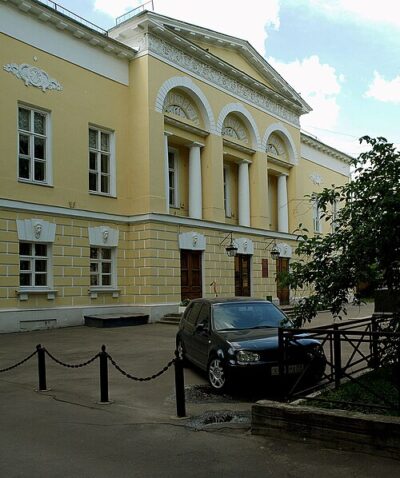
Not to be confused with the Gorky Literary Institute, which is an institute of higher education that trains writers, the A. M. Gorky Institute of World Literature is a scientific research institute and part of the Russian Academy of Sciences. It was founded on 17 September 1932 for the 40th anniversary of Maxim Gorky's literary activity, and is located in the former estate of the Gagarin family in Moscow.
The institute is organized into departments, each specializing in a specific region or genre of literature. These departments include the Department of Literary Theory, Folklore, Old Slavic Literature, 19th Century Russian Literature, Contemporary Russian Literature and Russian Emigree Literature, Classical Western Literature and Comparative Literature, Literature of Asia and Africa, Contemporary European and American Literature, Literature of Russian Minorities and CIS Countries, and Manuscripts. There is also a department devoted to how Russian Literature is taught and disseminated abroad. The institute is also home to personal archives of writers, including Maxim Gorky and Andrei Platonov. In-house scholars devote themselves to publishing new works, and visiting scholars can also arrange to conduct research there, attend lectures, or speak about their work.
The Gorky Institute was established in 1932 by decree of the Central Executive Committee of the Soviet Union entitled, "On the events to mark the 40th Anniversary of the Literary Activity of Maxim Gorky." The institute was renamed from the Maxim Gorky Institute of Literature to the A. M. Gorky Institute of Literature in 1934 in accordance with another decree of the Presidium of the Central Committee, and Lev Kamenev was appointed as the first director.
On 14 February 1937, the Gorky Archive and Gorky Museum were added on, the latter of which opened on 1 November 1937. On 4 March 1938, they also opened the State Museum of Alexander Pushkin, which was later moved to Leningrad in 1949. On 16 April 1938, upon joining the Soviet (now Russian) Academy of Sciences, it received its current name. It is now located at the former estate of the Gagarins, which was built in the first quarter of the 19th Century by Italian architect Domenico Gilardi.
In 1950, an employee of the institute, Vera Stepanovna Nechaeva became a V. G. Belinksy Prize Laureate for the first volume of a four-volume biography of Vissarion Belinsky. In 1952 Nechaeva was appointed as head of the institute's Department of Texts.
From the Wikipedia article “Gorky Institute of World Literature” (en.wikipedia.org/wiki/Gorky_Institute_of_World_Literature), by its contributors, under CC BY-SA 4.0 (creativecommons.org/licenses/by-sa/4.0/). Copied 2026-11-16; not changed.
Confirmed Two sources agree. Cited One source, and it names where it got it. One source One source, without a reference of its own. Sources disagree The sources disagree. We show the best-supported value and keep theirs below.
Picture: NVO, via Wikimedia Commons · Public domain