
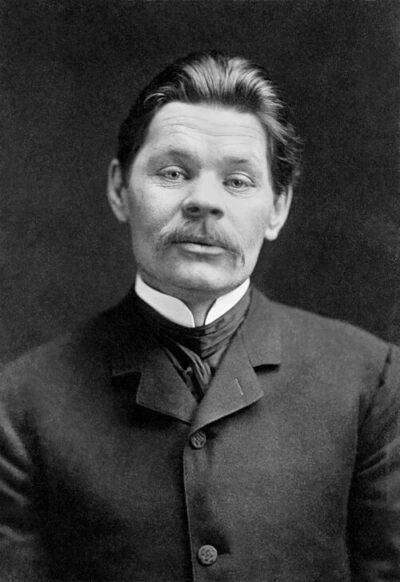
Maxim Gorky
Maxim Gorky was a Russian and Soviet writer. Born March 16, 1868, in Nizhny Novgorod. Died June 18, 1936, in Gorki-10. Positions held include president (1934–1936). Known for Mat', The Lower Depths and My Childhood. Awards include Order of Lenin, Griboyedov Prize and Honorary Academician in the field of belles-lettres.
Facts
39 facts · 1 confirmed by two sources · 5 cited · 32 from one source · 1 where the sources disagree
What’s different
- Born: we show March 16, 1868 (Sources disagree). Wikipedia says March 28, 1868
Where this comes from
Papalocal keeps its own record. It started from these sources; what each one said is kept here as it was copied, so a change on their side never changes this page by itself. Tap one to read its version.
What Wikidata says · copied November 16, 2026 · revision 2567015318
- Described as
- Russian and Soviet writer (1868–1936)
- Other names
- Aleksey Maksimovich Peshkov, Maxim Gorki, Alexei Maximovich Peshkov, Aleksey Peshkov, Gorky, Maksim Gor'ky
- Born
- March 16, 1868 · 13 references
- Died
- June 18, 1936 · 16 references
- Born in
- Nizhny Novgorod · 6 references
- Died in
- Gorki-10
- Buried in
- Kremlin Wall Necropolis
- Cause of death
- pneumonia
- Citizen of
- Russian Empire; Soviet Union
- Occupation
- writer · 5 references; playwright; novelist; poet · 2 references; opinion journalist; dramaturge; autobiographer; journalist
- Positions held
- president (1934–1936)
- Political party
- Russian Social Democratic Labour Party
- Worked for
- Pushkin House
- Member of
- USSR Union of Writers; Russian Academy of Sciences (1902–) · 1 reference
- Known for
- Mat' · 1 reference; The Lower Depths · 2 references; My Childhood · 1 reference; Twenty-six Men and a Girl · 1 reference; The Life of Klim Samgin · 1 reference
- Awards
- Order of Lenin (1932); Griboyedov Prize (1903); Honorary Academician in the field of belles-lettres
- Field
- belletristic literature · 1 reference
- Spouse
- Yekaterina Peshkova; Maria Andreyeva
- Children
- Maxim Peshkov
- Religion
- atheism
- Lived in
- Capri (1906–1913); Sorrento; Nizhny Novgorod; Saint Petersburg; Moscow
- Wikipedias with a page
- 182
Wikidata item Q12706 (wikidata.org/wiki/Q12706), public domain (CC0). Copied November 16, 2026.
What Wikipedia says · copied November 16, 2026 · revision 1385488894
Alexei Maximovich Peshkov (Russian: Алексей Максимович Пешков; 28 March [O.S. 16 March] 1868 – 18 June 1936), popularly known as Maxim Gorky (; Максим Горький), was a Russian and Soviet writer, journalist, and proponent of socialism. He was nominated five times for the Nobel Prize in Literature. Before his success as an author, he travelled widely across the Russian Empire, changing jobs frequently; these experiences would later influence his writing. He associated with fellow Russian writers Leo Tolstoy and Anton Chekhov, both mentioned by Gorky in his memoirs.
Gorky was active in the emerging Marxist socialist movement and later supported the Bolsheviks. He publicly opposed the Tsarist regime and for a time closely associated himself with Vladimir Lenin and Alexander Bogdanov's Bolshevik wing of the Russian Social Democratic Labour Party. During World War I, Gorky supported pacifism and internationalism and anti-war protests. For a significant part of his life, he was exiled from Russia and later the Soviet Union, being critical both of Tsarism and of the Bolsheviks during the Russian Civil War and the 1920s, condemning the latter for political repressions. In 1928 he returned to the USSR on Joseph Stalin's personal invitation and lived there from 1932 until his death in June 1936. After his return he was officially declared the "founder of Socialist Realism". Despite this, Gorky's relations with the Soviet regime were rather difficult: while being Stalin's public supporter, he maintained friendships with Lev Kamenev and Nikolai Bukharin, the leaders of the anti-Stalin opposition executed after Gorky's death; he also hoped to ease the Soviet cultural policies and made some efforts to defend the writers who disobeyed them, which resulted in him spending his last days under unannounced house arrest.
Gorky's most famous works are his early short stories written in the 1890s marked by romanticism and Nietzscheanism (such as "Chelkash", "Old Izergil", and "Twenty-six Men and a Girl"), the play The Lower Depths (1902), his fictional autobiographical trilogy, My Childhood, In the World, My Universities (1913–1923), and the novel Mother (1906). Gorky regarded the latter as one of his biggest failures, and it received broad criticism in literary circles and from later scholars, yet, it remains one of his best-known books. However, there have been warmer appraisals of some of his lesser-known post-revolutionary works such as the novels The Artamonov Business (1925), said by some to be Gorky's finest novel, and The Life of Klim Samgin (1925–1936), which was Gorky's most ambitious project; the latter, although unfinished, is considered by some as Gorky's masterpiece and has been viewed by some critics as a modernist work. Unlike his pre-revolutionary writings (known for their "anti-psychologism") Gorky's later works differ, with an ambivalent portrayal of the Russian Revolution and interest in human psychology.
- Born, in its opening lines
- March 28, 1868
- Died, in its opening lines
- June 18, 1936
From the Wikipedia article “Maxim Gorky” (en.wikipedia.org/wiki/Maxim_Gorky), by its contributors, under CC BY-SA 4.0 (creativecommons.org/licenses/by-sa/4.0/). Copied November 16, 2026; not changed.
Confirmed Two sources agree. Cited One source, and it names where it got it. One source One source, without a reference of its own. Sources disagree The sources disagree. We show the best-supported value and keep theirs below.
