
Grande Armée
Grande Armée is a Field Army of the French Imperial Army during the Napoleonic Wars. It was founded in 1804.
- Founded
- 1804
- Country
- First French Empire
All 4 facts, and where they come from
Facts
4 facts · 0 confirmed by two sources · 0 cited · 4 from one source
Where this comes from
Papalocal keeps its own record. It started from these sources; what each one said is kept here as it was copied, so a change on their side never changes this page by itself. Tap one to read its version.
What Wikidata says · copied November 17, 2026 · revision 2517035561
- Described as
- Field Army of the French Imperial Army during the Napoleonic Wars
- Other names
- Grande Armee
- What it is
- army
- Founded
- 1804 · 1 reference
- Ended
- 1815 · 1 reference
- Country
- First French Empire
- Wikipedias with a page
- 47
Wikidata item Q504721 (wikidata.org/wiki/Q504721), public domain (CC0). Copied 2026-11-17.
What Wikipedia says · copied November 17, 2026 · revision 1384460871
The Grande Armée (pronounced [ɡʁɑ̃d aʁme]; French for 'Great Army') was the primary field army of the French Imperial Army during the Napoleonic Wars. Commanded by Napoleon, from 1804 to 1812 it won a series of military victories that allowed the First French Empire to exercise unprecedented control over most of Europe. Widely acknowledged to be one of the greatest fighting forces ever assembled, it ultimately suffered catastrophic losses during the disastrous French invasion of Russia, after which it never recovered its strategic superiority. The Hundred Days in 1815 which culminated in the total defeat of France, put a permanent end to its campaigns.
The Grande Armée was formed in 1804 from the Armée des côtes de l'Océan (Army of the Ocean Coasts), more commonly referred to as the Armée d'Angleterre (Army of England), the French field army of over 100,000 men Napoleon had assembled for his planned invasion of the United Kingdom. He subsequently led the field army to Central Europe in the War of the Third Coalition, which culminated in the defeat of Austrian and Russian forces; soon followed by the War of the Fourth Coalition, which brought about the subjugation of the Kingdom of Prussia. Upon its formation, it consisted of six corps led by Napoleon's marshals and senior generals. When the Austrian and Russian armies began their preparations to invade France in late 1805, the Grande Armée was quickly ordered across the Rhine into southern Germany, leading to Napoleon's victories at Ulm and Austerlitz.
The French Imperial Army grew as Napoleon seized power across Europe, recruiting troops from occupied and allied nations; it reached its peak of one million men at the start of the Russian campaign in 1812, with the Grande Armée itself reaching its height of 413,000 French soldiers and about 600,000 men overall when including foreign recruits. While the term originally designated the primary field army and operational core of Napoleon’s forces, it became often used in historiography—notably in anglophone countries—to refer to the transnational armies in general Napoleon ended up leading in his campaigns. Furthermore, during the War of the Fifth Coalition and the Waterloo campaign (part of the Hundred Days), other formations were led by him de facto, namely the Army of Germany and the Army of the North.
The Grande Armée was known for its innovative formations, tactics, logistics and communications. While international contingents that it later came to integrate were commanded by French generals—with the exception of the Polish and Austrian ones—soldiers could climb the ranks regardless of class, wealth, or national origin, unlike what was custom in Europe in this era.
After being initially deployed in the Peninsular War as Napoleon personally entered and led the campaign in late 1808 following shortcomings of the newly-assembled Armée d'Espagne (Army of Spain) tasked with subduing Spain, the Grande Armée and their leader left Spain in early 1809 due to renewed Austrian threat. Although once again defeated, the Austrians fared better in the War of the Fifth Coalition, with Napoleon losing a non-negligible portion of his most experienced troops, as well as some of the most esteemed French commanders in this campaign, somewhat eroding the French army's mythos of invincibility.
In the summer of 1812, while as many as 300,000 French troops of the Armée d'Espagne were entangled in the Peninsular War, Napoleon opened a second war front as the Grande Armée marched east to subjugate Russia. The Russians fell back with its approach. After the capture of Smolensk and tactical victory at Borodino, the French reached Moscow on 14 September 1812. However, the army was already drastically reduced by skirmishes with the Russians, disease (principally typhus), desertion, heat, exhaustion, and long communication lines. The army spent a month in Moscow but was ultimately forced to march back westward. Cold, starvation, and disease, as well as constant harassment by Cossacks and Russian partisans, resulted in the Grande Armée's utter destruction as a fighting force.
Only 120,000 men survived the Russian campaign (excluding early deserters); of these, 50,000 were Austrians, Prussians, and other Germans, 20,000 were Poles, and just 35,000 were French. As many as 380,000 died in the campaign. Napoleon led a new army during the campaign in Germany in 1813 and the defense of France in 1814 as part of the War of the Sixth Coalition, and the Waterloo campaign in 1815, but the Grande Armée would never regain its height of June 1812, and France would find itself invaded on multiple fronts from the Spanish border to the German border. Eventually Napoleonic France would be ultimately defeated by Treaty of Paris (1815). In total, from 1805 to 1813, over 2.1 million Frenchmen were conscripted into the Imperial Army. Estimates for French military deaths during the Napoleonic Wars (1803–1815) generally range between 700,000 and 1.8 million, with many modern historians placing the likely figure around one million.
From the Wikipedia article “Grande Armée” (en.wikipedia.org/wiki/Grande_Armée), by its contributors, under CC BY-SA 4.0 (creativecommons.org/licenses/by-sa/4.0/). Copied 2026-11-17; not changed.
Confirmed Two sources agree. Cited One source, and it names where it got it. One source One source, without a reference of its own. Sources disagree The sources disagree. We show the best-supported value and keep theirs below.
People connected 4
Military branch
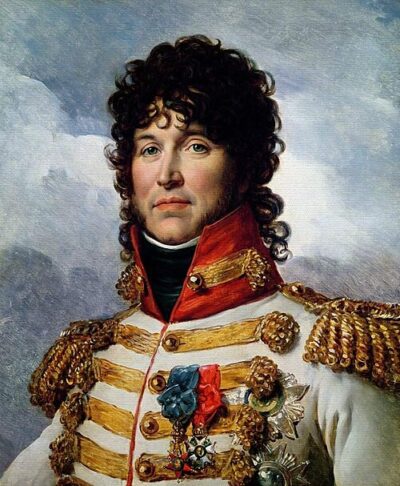 Joachim MuratGrand Duke of Berg and Cleves, The king of Naples (1767-1815)
 Jean-Baptiste BessièresMarshal of France (1768-1813)
 Jean-Mathieu-Philibert SérurierFrench soldier and political figure who rose to the rank of Marshal of France (1742-1819)

