
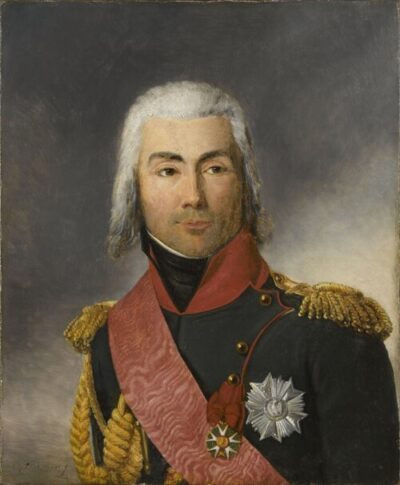
Jean-Baptiste Bessières
Jean-Baptiste Bessières was a Marshal of France. Born August 6, 1768, in Prayssac. Died May 1, 1813, in Rippach. Awards include Grand Cross of the Legion of Honour, Marshal of the Empire and Marshal of France.
Facts
25 facts · 2 confirmed by two sources · 4 cited · 18 from one source · 1 where the sources disagree
What’s different
- Buried in: we show Les Invalides (Sources disagree). Wikidata also lists Prayssac and Vault of Governors
Where this comes from
Papalocal keeps its own record. It started from these sources; what each one said is kept here as it was copied, so a change on their side never changes this page by itself. Tap one to read its version.
What Wikidata says · copied November 16, 2026 · revision 2557957417
- Described as
- Marshal of France (1768-1813)
- Other names
- Jean-Baptiste Bessieres, Jean Baptiste Bessières
- Born
- August 6, 1768 · 11 references
- Died
- May 1, 1813 · 9 references
- Born in
- Prayssac · 1 reference
- Died in
- Rippach · 1 reference
- Buried in
- Les Invalides; Prayssac; Vault of Governors
- Citizen of
- France
- Occupation
- military personnel; duke · 1 reference
- Awards
- Grand Cross of the Legion of Honour; Marshal of the Empire (1804–); Marshal of France; list of names inscribed on the Arc de Triomphe; Knight Grand Cordon of the Order of Christ (1810) · 1 reference; Grand Officer of the Legion of Honour · 1 reference; Order of the Iron Crown (Kingdom of Italy) · 1 reference; Order of Leopold · 1 reference; Military Order of St. Henry · 1 reference; Order of the Crown · 1 reference; Order of Christ · 1 reference
- Spouse
- Marie Jeanne de Lapeyrière
- Children
- Napoléon Bessières
- Siblings
- Bertrand Bessières
- Military branch
- Grande Armée; cavalry · 1 reference
- Military rank
- Marshal of the Empire
- Wikipedias with a page
- 37
Wikidata item Q345551 (wikidata.org/wiki/Q345551), public domain (CC0). Copied November 16, 2026.
What Wikipedia says · copied November 16, 2026 · revision 1379813456
Jean-Baptiste Bessières, duc d'Istrie (English: BESS-ee-air, French: [ʒɑ̃ batist bɛsjɛʁ]; 6 August 1768 – 1 May 1813) was a French military leader of the French Revolutionary Wars and the Napoleonic Wars. He was made a Marshal of the Empire by Emperor Napoleon in 1804.
Born into the petite bourgeoisie, Bessières began his military career during the French Revolution and was promoted to captain in the 22nd Chasseur à cheval Regiment. He was noticed during the Italian campaign of 1796–1797 by General Napoleon Bonaparte, who appointed him commander of the corps of mounted guides. In this capacity, Bessières participated in the Egyptian campaign until 1799, before being made a general under the Consulate for his distinguished service at the Battle of Marengo. He was elevated to the dignity of Marshal of the Empire in 1804 and took command of the cavalry of the Imperial Guard.
A brilliant cavalry officer, Bessières distinguished himself in most of the major battles of the Napoleonic Wars, notably at Austerlitz, Eylau, Aspern-Essling and Wagram. In 1808, he played an active role in the Peninsular War, scoring a victory at Medina de Rioseco early in the conflict, the consequences of which were nevertheless short-lived. His performance three years later at the Battle of Fuentes de Oñoro, where his support for Masséna was lacking, generated controversy. He nevertheless took part in the Russian campaign in 1812, during which he saved Napoleon from a Cossack attack, and was given command of the entire French cavalry at the start of the German campaign. Bessières was killed by a cannonball on 1 May 1813 at Rippach, near Weißenfels, the day before the Battle of Lützen.
Bessières was, according to Napoleon, "a reserve officer full of vigor, but prudent and circumspect." A mediocre commander-in-chief, he was, on the other hand, an excellent cavalry general, capable of initiative and who often personally led charges. The death of this cultivated, pious and popular man within the Guard was keenly felt by the Emperor, who declared of him: "he lived like Bayard, he died like Turenne."
- Born, in its opening lines
- August 6, 1768
- Died, in its opening lines
- May 1, 1813
From the Wikipedia article “Jean-Baptiste Bessières” (en.wikipedia.org/wiki/Jean-Baptiste_Bessières), by its contributors, under CC BY-SA 4.0 (creativecommons.org/licenses/by-sa/4.0/). Copied November 16, 2026; not changed.
Confirmed Two sources agree. Cited One source, and it names where it got it. One source One source, without a reference of its own. Sources disagree The sources disagree. We show the best-supported value and keep theirs below.
