
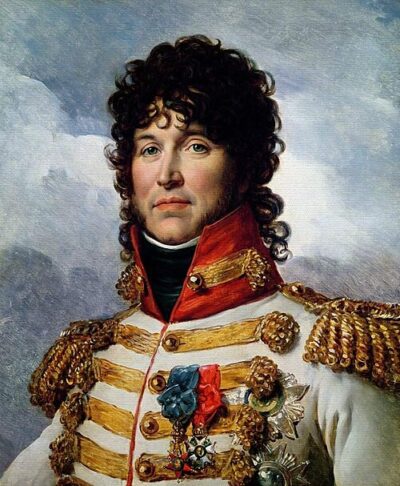
Joachim Murat
Joachim Murat was a Grand Duke of Berg and Cleves, The king of Naples. Born March 25, 1767, in Labastide-Murat. Died October 13, 1815, in Pizzo. Positions held include député au Corps législatif (1804–1805) and member of the Sénat conservateur (1805–). Awards include Grand Cross of the Legion of Honour, Marshal of the Empire and Knight of the Order of the Golden Fleece.
Facts
36 facts · 2 confirmed by two sources · 5 cited · 28 from one source · 1 where the sources disagree
What’s different
- Buried in: we show Pizzo (Sources disagree). Wikidata also lists Père Lachaise Cemetery and Cenotaph of Joachim Murat
Where this comes from
Papalocal keeps its own record. It started from these sources; what each one said is kept here as it was copied, so a change on their side never changes this page by itself. Tap one to read its version.
What Wikidata says · copied November 16, 2026 · revision 2568757768
- Described as
- Grand Duke of Berg and Cleves, The king of Naples (1767-1815)
- Other names
- Joachim-Napoléon Murat
- Born
- March 25, 1767 · 10 references
- Died
- October 13, 1815 · 11 references
- Born in
- Labastide-Murat
- Died in
- Pizzo · 2 references
- Buried in
- Père Lachaise Cemetery; Pizzo · 1 reference; Cenotaph of Joachim Murat
- Cause of death
- gunshot wound
- Name at birth
- Joachim Murat
- Citizen of
- France; Grand Duchy of Berg; Kingdom of Naples
- Occupation
- politician; military officer; military personnel; marshal · 1 reference
- Positions held
- député au Corps législatif (1804–1805) · 1 reference; member of the Sénat conservateur (1805–)
- Awards
- Grand Cross of the Legion of Honour; Marshal of the Empire (1804–); Knight of the Order of the Golden Fleece; Marshal of France; list of names inscribed on the Arc de Triomphe; Order of the Black Eagle; Admiral of France; Order of Saint Alexander Nevsky; Order of St. Andrew; Knight Grand Cross of the Order of Saint Joseph
- Spouse
- Caroline Bonaparte (1800–) · 2 references
- Children
- Prince Achille Murat · 1 reference; Lucien Murat; Luisa Rasponi Murat; Letizia Murat
- Father
- Pierre Murat-Jordy
- Mother
- Jeanne Loubières
- Religion
- Catholic Church
- Military branch
- Grande Armée · 1 reference
- Military rank
- Marshal of the Empire
- Wikipedias with a page
- 76
Wikidata item Q151173 (wikidata.org/wiki/Q151173), public domain (CC0). Copied November 16, 2026.
What Wikipedia says · copied November 16, 2026 · revision 1384955789
Joachim Murat (English: myuu-RAH, French: [ʒɔakim myʁa]; 25 March 1767 – 13 October 1815) was a Marshal of the Empire, regarded as the foremost cavalry commander of the Napoleonic Wars, who reigned as King of Naples as Joachim-Napoleon (Italian: Gioacchino Napoleone) from 1808 to 1815. A brother-in-law of Napoleon, he was also Admiral of France, the first Prince Murat, and Grand Duke of Berg from 1806 to 1808. He was known as the Dandy King and First Horseman of Europe.
Born in Labastide-Fortunière in southwestern France, Murat briefly pursued a vocation in the clergy before enlisting in a cavalry regiment upon the outbreak of the French Revolution. Murat distinguished himself under the command of General Napoleon Bonaparte on 13 Vendémiaire (1795), when he seized a group of large cannons and was instrumental in suppressing the royalist insurrection in Paris. He became Napoleon's aide-de-camp and commanded the cavalry during the French campaigns in Italy and Egypt. Murat played a pivotal role in the Coup of 18 Brumaire (1799), which brought Napoleon to political power. In 1800 he married Caroline Bonaparte, thus becoming a brother-in-law to Napoleon.
Murat was named a Marshal of the Empire on the proclamation of the French Empire. He took part in various battles including those of Ulm, Austerlitz, Jena and Eylau, where he led a famous massed cavalry charge against the Russians. In 1806, Murat was appointed Grand Duke of Berg, a title he held until 1808 when he was named King of Naples. He continued to serve Napoleon during his Russian and German campaigns but abandoned the Grande Armée after the Battle of Leipzig to save his throne. In 1815, Murat launched the Neapolitan War against the Austrian Empire but was decisively defeated at Tolentino. He fled to Corsica and then made a last-ditch attempt to recover his throne, but was soon taken prisoner by King Ferdinand IV of Naples. He was tried for treason and sentenced to death by firing squad in Pizzo.
- Born, in its opening lines
- March 25, 1767
- Died, in its opening lines
- October 13, 1815
From the Wikipedia article “Joachim Murat” (en.wikipedia.org/wiki/Joachim_Murat), by its contributors, under CC BY-SA 4.0 (creativecommons.org/licenses/by-sa/4.0/). Copied November 16, 2026; not changed.
Confirmed Two sources agree. Cited One source, and it names where it got it. One source One source, without a reference of its own. Sources disagree The sources disagree. We show the best-supported value and keep theirs below.
