Hanging Gardens of Babylon
Hanging Gardens of Babylon is one of the seven wonders of ancient world.
- Came out
- 6th century BC
All 6 facts, and where they come from
Facts
6 facts · 0 confirmed by two sources · 0 cited · 6 from one source
Where this comes from
Papalocal keeps its own record. It started from these sources; what each one said is kept here as it was copied, so a change on their side never changes this page by itself. Tap one to read its version.
What Wikidata says · copied November 17, 2026 · revision 2562981168
- Described as
- one of the seven wonders of ancient world
- Other names
- Hanging Gardens Wonder of the Ancient World, The Hanging Gardens of Babylon
- What it is
- hanging garden; Wonder of the Ancient World; destroyed building or structure
- Came out
- 6th century BC
- Located in
- Iraq · 1 reference
- Country
- Assyrian Empire · 1 reference
- Wikipedias with a page
- 100
Wikidata item Q41931 (wikidata.org/wiki/Q41931), public domain (CC0). Copied 2026-11-17.
What Wikipedia says · copied November 17, 2026 · revision 1349392265
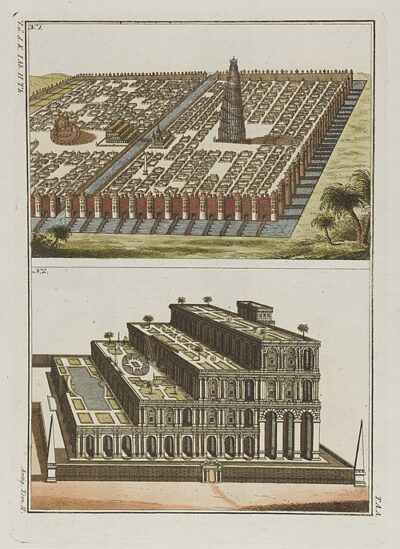
The Hanging Gardens of Babylon were one of the Seven Wonders of the Ancient World listed by Hellenic culture. They were described as a remarkable feat of engineering with an ascending series of tiered gardens containing a wide variety of trees, shrubs, and vines, resembling a large green mountain constructed of mud bricks. It was said to have been built in the ancient city of Babylon, near present-day Hillah, Babil province, in Iraq. The Hanging Gardens' name is derived from the Greek word κρεμαστός (kremastós, lit. 'overhanging'), which has a broader meaning than the modern English word "hanging" and refers to trees being planted on a raised structure such as a terrace.
According to one legend, the Hanging Gardens were built alongside a grand palace known as The Marvel of Mankind, by the Neo-Babylonian King Nebuchadnezzar II (who ruled between 605 and 562 BC), for his Median wife, Queen Amytis, because she missed the green hills and valleys of her homeland. This was attested to by the Babylonian priest Berossus, writing in about 290 BC, a description that was later quoted by Josephus. The construction of the Hanging Gardens has also been attributed to the legendary queen Semiramis and they have been called the Hanging Gardens of Semiramis as an alternative name.
The Hanging Gardens are the only one of the Seven Wonders whose location has not been definitively established. No extant Babylonian texts mention the gardens and no definitive archaeological evidence has been found in Babylon. Three theories have been suggested to account for this: first, that the gardens were purely mythical, and the descriptions found in ancient Greek and Roman writings (including those of Strabo, Diodorus Siculus and Quintus Curtius Rufus) represented a romantic ideal of an eastern garden; second, that they existed in Babylon but were destroyed sometime around the first century AD; and third, that the legend refers to a well-documented garden that the Assyrian King Sennacherib (704–681 BC) built in his capital city of Nineveh on the River Tigris, near the modern city of Mosul.
From the Wikipedia article “Hanging Gardens of Babylon” (en.wikipedia.org/wiki/Hanging_Gardens_of_Babylon), by its contributors, under CC BY-SA 4.0 (creativecommons.org/licenses/by-sa/4.0/). Copied 2026-11-17; not changed.
Confirmed Two sources agree. Cited One source, and it names where it got it. One source One source, without a reference of its own. Sources disagree The sources disagree. We show the best-supported value and keep theirs below.
Picture: Wikimedia Commons · CC BY 4.0