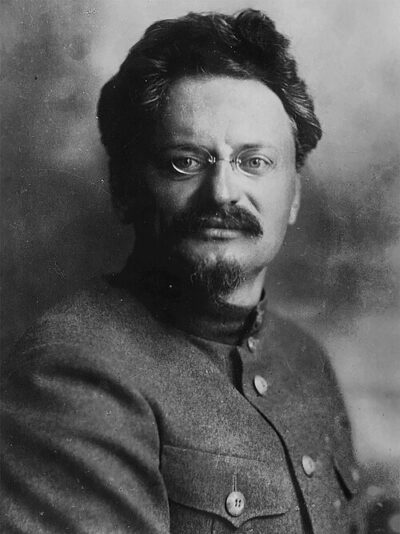
Left Opposition
Left Opposition is a faction within the Bolshevik Party from 1923 to 1927 headed de facto by Leon Trotsky. It stands for Trotskyism.
- Founded
- 1923
- Country
- Soviet Union
All 6 facts, and where they come from
Facts
6 facts · 0 confirmed by two sources · 0 cited · 6 from one source
Where this comes from
Papalocal keeps its own record. It started from these sources; what each one said is kept here as it was copied, so a change on their side never changes this page by itself. Tap one to read its version.
What Wikidata says · copied November 16, 2026 · revision 2471734706
- Described as
- faction within the Bolshevik Party from 1923 to 1927 headed de facto by Leon Trotsky
- What it is
- political faction
- Founded
- 1923
- Ended
- 1927
- Country
- Soviet Union
- Part of
- Communist Party of the Soviet Union
- Ideology
- Trotskyism
- Wikipedias with a page
- 20
Wikidata item Q1569985 (wikidata.org/wiki/Q1569985), public domain (CC0). Copied 2026-11-16.
What Wikipedia says · copied November 16, 2026 · revision 1381497529
The Left Opposition (Russian: Левая оппозиция, romanized: Levaya oppozitsiya) was a faction within the Russian Communist Party (Bolsheviks) from 1923 to 1927 headed by Leon Trotsky, who formed it to mount a struggle against the perceived bureaucratic degeneration within the party leadership headed by Joseph Stalin. The Left Opposition advocated for a programme of rapid industrialization, voluntary collectivisation of agriculture, and the expansion of a worker's democracy in a wider framework with the New Economic Policy.
Intellectuals who had previously lived in exile during the Tsarist era would constitute the core of the Left Opposition during the succession period. Members represented the most internationalist elements of the party and held offices at the highest responsibility with Christian Rakovsky, Adolph Joffe, and Nikolay Krestinsky holding ambassadorial posts in London, Paris, Tokyo, and Berlin.
Originally, the battle lines were drawn between Trotsky and his supporters who signed The Declaration of 46 in October 1923 on the one hand and a triumvirate (also known by its Russian name Troika) of Communist International (Comintern) chairman Grigory Zinoviev, Communist Party General Secretary Joseph Stalin and Politburo chairman Lev Kamenev on the other hand. The Left Opposition argued that the New Economic Policy had weakened the Soviet Union by allowing the private sector to achieve an increasingly important position in the Soviet economy while in their opinion, the centrally planned, socialised sector of the economy languished (including the mostly state-run heavy industries which were seen as essential not only for continued industrialisation but also defence). The platform called for the state to adopt a programme for mass industrialisation and to encourage the mechanization and collectivisation of agriculture, thereby developing the means of production and helping the Soviet Union move towards parity with Western capitalist countries, which would also increase the proportion of the economy which was part of the socialised sector of the economy and definitively shift the Soviet Union towards a socialist mode of production.
There was also the Right Opposition, which was led by the leading party theoretician and Pravda editor Nikolai Bukharin and supported by Sovnarkom Chairman (prime minister) Alexei Rykov and Chairman of the All-Union Central Council of Trade Unions Mikhail Tomsky. In late 1924, as Stalin proposed his new socialism in one country theory, Stalin drew closer to the Right Opposition and his triumvirate with Grigory Zinoviev and Lev Kamenev slowly broke up over the next year (Zinoviev and Kamenev were both executed in 1936). The Right Opposition were allied to Stalin's Centre from late 1924 until their alliance broke up in the years from 1928 to 1930 over strategy towards the kulaks and NEPmen. Trotsky and his supporters in the Left Opposition were joined by the Group of Democratic Centralism to form the United (or Joint) Opposition.
From the Wikipedia article “Left Opposition” (en.wikipedia.org/wiki/Left_Opposition), by its contributors, under CC BY-SA 4.0 (creativecommons.org/licenses/by-sa/4.0/). Copied 2026-11-16; not changed.
Confirmed Two sources agree. Cited One source, and it names where it got it. One source One source, without a reference of its own. Sources disagree The sources disagree. We show the best-supported value and keep theirs below.