
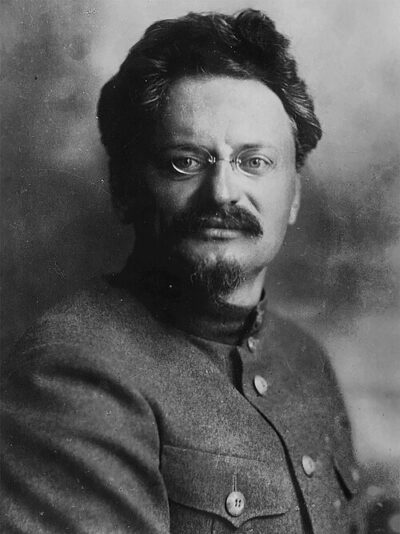
Leon Trotsky
Leon Trotsky was a prominent Russian Marxist revolutionary, politician, and theorist who lived from 1879 to 1940. He played a significant role in major events of early 20th-century Russia, including the 1905 Revolution, the October Revolution of 1917, and the subsequent Russian Civil War. Alongside Vladimir Lenin, he was a central figure in the formation and early years of the Soviet Union.
Trotsky's political and philosophical ideas, rooted in Marxism and Leninism, led to the development of a distinct branch of Marxist thought known as Trotskyism. He was eventually exiled from the Soviet Union in 1929 and was assassinated in 1940.
Facts
58 facts · 1 confirmed by two sources · 11 cited · 45 from one source · 1 where the sources disagree
What’s different
- Born: we show October 26, 1879 (Sources disagree). Wikipedia says November 7, 1879
Where this comes from
Papalocal keeps its own record. It started from these sources; what each one said is kept here as it was copied, so a change on their side never changes this page by itself. Tap one to read its version.
What Wikidata says · copied November 14, 2026 · revision 2568965706
- Described as
- Russian Marxist revolutionary (1879–1940)
- Other names
- Lev Davidovich Bronstein, Lev Davidovich Trotskiy, Lev Davidovich Trotsky, Lev Trotskiy, Trotskiy, Lev Trotsky, Leon Trotski, Lev Davidovich Bronshteyn, Lev Bronstein, Lev Davidovich Bronshtein, Trotsky, Lev Bronshteyn
- Born
- October 26, 1879 · 4 references
- Died
- August 21, 1940 · 7 references
- Born in
- Bereslavka · 1 reference
- Died in
- Coyoacán · 1 reference
- Buried in
- Grave of Leon Trotsky and Natalia Sedova
- Cause of death
- cerebral hemorrhage
- Name at birth
- Лейба Давидович Бронштейн · 1 reference
- Citizen of
- Russian Empire; Russian Socialist Federative Soviet Republic; Ukrainian Soviet Socialist Republic (1919–1922); Soviet Union (–1932)
- Occupation
- politician · 4 references; diplomat; autobiographer; philosopher; revolutionary · 2 references; military personnel · 1 reference; historian · 1 reference; journalist · 1 reference
- Positions held
- People's Commissar (1917–1918); Member of the Russian Constituent Assembly (1917–1918); Member of the Politburo of the CPSU Central Committee (1917–1926); People's Commissar for Military and Naval Affairs of the RSFSR (1918–1923); People's Commissar for Military and Naval Affairs (1923–1925)
- Political party
- Russian Social Democratic Labour Party; Communist Party of the Soviet Union (1917–1927); Russian Social Democratic Labour Party (bolshevik); Social Democratic Party of Switzerland
- Worked for
- Iskra · 1 reference; Eastern Review · 1 reference; Vienna Pravda · 1 reference; Kievskaya Mysl · 1 reference; Petrograd Soviet · 1 reference; People's Commissariat for Foreign Affairs of the Russian SFSR (1917–1918) · 1 reference; Communist International · 1 reference; People's Comissariat for Military and Naval Affairs · 1 reference
- Member of
- Left Opposition; All-Union Society of Old Bolsheviks
- Known for
- Trotskyism; The Permanent Revolution; My Life; The Revolution Betrayed
- Awards
- Order of the Red Banner
- Spouse
- Natalia Sedova · 1 reference; Aleksandra Sokolovskaya · 1 reference
- Children
- Sergei Sedov · 1 reference; Zinaida Volkova · 1 reference; Lev Sedov · 1 reference; Nina Nevelson
- Father
- David Bronstein
- Mother
- Anna Bronstein
- Siblings
- Olga Kameneva · 1 reference
- Religion
- atheism · 1 reference
- Military branch
- Red Army · 1 reference
- Military rank
- general; commander-in-chief · 1 reference
- Lived in
- Hønefoss Municipality (–1936)
- Height
- 1.76 m (5 ft 9 in)
- Wikipedias with a page
- 187
Wikidata item Q33391 (wikidata.org/wiki/Q33391), public domain (CC0). Copied November 14, 2026.
What Wikipedia says · copied November 14, 2026 · revision 1385105996
Lev Davidovich Trotsky (né Bronstein; 7 November [O.S. 26 October] 1879 – 21 August 1940), better known as Leon Trotsky, was a Russian revolutionary, Soviet politician, and political theorist. He was a key figure in the 1905 Revolution, the October Revolution of 1917, the Russian Civil War, and the establishment of the Soviet Union, from which he was exiled in 1929 before his assassination in 1940. Trotsky and Vladimir Lenin were widely considered the two most prominent figures in the Soviet state from 1917 until Lenin's death in 1924. Ideologically a Marxist and a Leninist, Trotsky's ideas and beliefs inspired a school of Marxism known as Trotskyism.
Trotsky joined the Russian Social Democratic Labour Party in 1898, being arrested and exiled to Siberia for his activities. In 1902 he escaped to London, where he met Lenin. Trotsky initially sided with the Mensheviks against Lenin's Bolsheviks in the party's 1903 schism, but declared himself non-factional in 1904. During the 1905 Revolution, Trotsky was elected chairman of the Saint Petersburg Soviet. He was again exiled to Siberia, but escaped in 1907 and lived abroad. After the February Revolution of 1917, Trotsky joined the Bolsheviks and was elected chairman of the Petrograd Soviet. He helped to lead the October Revolution, and as the People's Commissar for Foreign Affairs negotiated the Treaty of Brest-Litovsk, by which Russia withdrew from World War I. He served as People's Commissar for Military Affairs from 1918 to 1925, during which he built the Red Army and led it to victory in the civil war. In 1922 Lenin formed a bloc with Trotsky against the growing Soviet bureaucracy and proposed that he should become a deputy premier, but Trotsky declined. Beginning in 1923, Trotsky led the party's Left Opposition faction, which supported greater levels of industrialisation, voluntary collectivisation and party democratisation in a shared framework with the New Economic Policy.
After Lenin's death in 1924 and amidst the resulting power vacuum, Trotsky was politically outmanoeuvred by Joseph Stalin and sidelined. Trotsky was expelled from the Politburo in 1926 and from the party in 1927, exiled to Alma Ata in 1928 and deported from the USSR in 1929. He lived in Turkey, France, and Norway before settling in Mexico in 1937. In exile, Trotsky wrote polemics against Stalinism, advocating proletarian internationalism against Stalin's theory of socialism in one country. Trotsky's theory of permanent revolution held that the revolution could survive only if it spread to more advanced capitalist countries. In The Revolution Betrayed (1936), he argued that the Soviet Union had become a "degenerated workers' state", and in 1938 founded the Fourth International as an alternative to the Comintern. After being sentenced to death in absentia at the Moscow show trials in 1936, Trotsky was assassinated in 1940 in Mexico City by Ramón Mercader, a Stalinist agent.
Written out of official history under Stalin, Trotsky was one of the few of his rivals who were never politically rehabilitated by later Soviet leaders. He perceived his theoretical contributions as a continuation of orthodox Leninism against what he saw as the bureaucratic degeneration of the Soviet Union and Communist Party which occurred under Stalin's leadership. In the Western world, Trotsky emerged as a hero of the anti-Stalinist left for his defence of a more democratic, internationalist form of socialism as opposed to the official interpretation of Marxism-Leninism advocated by Stalin and the leadership of "actually existing socialist" states, and for his intellectual contributions to Marxism. While some of his wartime actions are controversial, such as his ideological defence of the Red Terror and violent suppression of the Kronstadt rebellion, scholarship ranks Trotsky's leadership of the Red Army highly among historical figures, and he is credited for his major involvement with the military, economic, cultural and political development of the Soviet Union.
- Born, in its opening lines
- November 7, 1879
- Died, in its opening lines
- August 21, 1940
From the Wikipedia article “Leon Trotsky” (en.wikipedia.org/wiki/Leon_Trotsky), by its contributors, under CC BY-SA 4.0 (creativecommons.org/licenses/by-sa/4.0/). Copied November 14, 2026; not changed.
Confirmed Two sources agree. Cited One source, and it names where it got it. One source One source, without a reference of its own. Sources disagree The sources disagree. We show the best-supported value and keep theirs below.
