Les Troyens
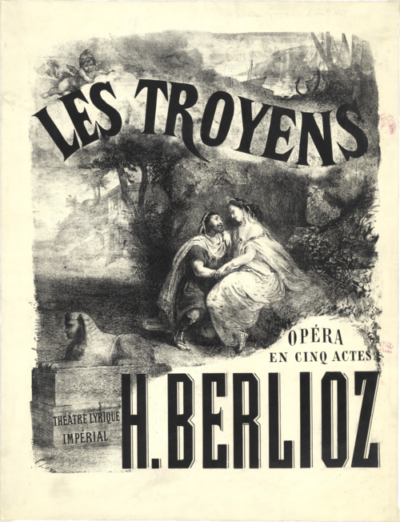
Les Troyens is an opera by Hector Berlioz. It is based on Aeneid.
All 4 facts, and where they come from
Facts
4 facts · 0 confirmed by two sources · 0 cited · 4 from one source
Where this comes from
Papalocal keeps its own record. It started from these sources; what each one said is kept here as it was copied, so a change on their side never changes this page by itself. Tap one to read its version.
What Wikidata says · copied November 17, 2026 · revision 2563988303
- Described as
- opera by Hector Berlioz
- What it is
- dramatico-musical work
- Music by
- Hector Berlioz
- Language
- French
- Based on
- Aeneid
- Wikipedias with a page
- 20
Wikidata item Q472325 (wikidata.org/wiki/Q472325), public domain (CC0). Copied 2026-11-17.
What Wikipedia says · copied November 17, 2026 · revision 1380313675
Les Troyens (pronounced [le tʁwajɛ̃]; in English: The Trojans) is a French grand opera in five acts, running for about five hours, by Hector Berlioz. The libretto was written by Berlioz himself from Virgil's epic poem the Aeneid; the score was composed between 1856 and 1858. Les Troyens is Berlioz's most ambitious work, the summation of his entire artistic career, but he did not live to see it performed in its entirety. Under the title Les Troyens à Carthage, the last three acts were premièred with many cuts by Léon Carvalho's company, the Théâtre Lyrique, at their theatre (now the Théâtre de la Ville) on the Place du Châtelet in Paris on 4 November 1863, with 21 repeat performances. The reduced versions run for about three hours. After decades of neglect, today the opera is considered by some music critics as one of the finest ever written.
From the Wikipedia article “Les Troyens” (en.wikipedia.org/wiki/Les_Troyens), by its contributors, under CC BY-SA 4.0 (creativecommons.org/licenses/by-sa/4.0/). Copied 2026-11-17; not changed.
Confirmed Two sources agree. Cited One source, and it names where it got it. One source One source, without a reference of its own. Sources disagree The sources disagree. We show the best-supported value and keep theirs below.
Picture: Prudent Louis Leray, via Wikimedia Commons · Public domain