Life of Galileo
Life of Galileo is a German play by Bertolt Brecht. It came out in 1940.
- Published
- 1940
- Came out
- 1939
- Written by
- Bertolt Brecht
- Genre
- drama
All 8 facts, and where they come from
Facts
8 facts · 0 confirmed by two sources · 0 cited · 8 from one source
Where this comes from
Papalocal keeps its own record. It started from these sources; what each one said is kept here as it was copied, so a change on their side never changes this page by itself. Tap one to read its version.
What Wikidata says · copied November 17, 2026 · revision 2533671786
- Described as
- German play by Bertolt Brecht
- Other names
- A life of Galileo, The life of Galileo, Galileo
- What it is
- literary work
- Written by
- Bertolt Brecht
- Genre
- drama; epic theatre · 1 reference
- Published
- 1940; 1955 · 1 reference
- Language
- German
- Came out
- 1939
- Named after
- Galileo Galilei
- Wikipedias with a page
- 23
Wikidata item Q302750 (wikidata.org/wiki/Q302750), public domain (CC0). Copied 2026-11-17.
What Wikipedia says · copied November 17, 2026 · revision 1361143474
Life of Galileo (German: Leben des Galilei), also known as Galileo, is a play by the 20th century German dramatist Bertolt Brecht and collaborator Margarete Steffin, with incidental music by Hanns Eisler. The play follows the career of the great Italian natural philosopher Galileo Galilei during the Galileo affair, in which he was prosecuted for heresy by the Roman Catholic Church for the promulgation of heliocentrism.
The play embraces themes such as the conflict between dogmatism and scientific evidence, as well as interrogating the values of constancy in the face of oppression. Further themes include the relationship between science and authority, the responsibility of a scientist to the general public, the submissiveness of scientists and common people to authority, and the subversive effect of new scientific ideas on the religious and social order.
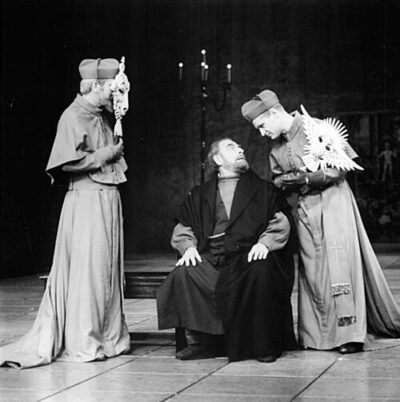
The play was written in 1938 and received its first theatrical production (in German) at the Zurich Schauspielhaus, opening on the 9th of September 1943. This production was directed by Leonard Steckel, with set-design by Teo Otto. The cast included Steckel himself (as Galileo), Karl Paryla and Wolfgang Langhoff. The second (or "American") version was written in English between 1945–1947 in collaboration with Charles Laughton, and opened at the Coronet Theatre in Los Angeles on 30 July 1947. It was directed by Joseph Losey and Brecht, with musical direction by Serge Hovey and set-design by Robert Davison. Laughton played Galileo, with Rusty Lane as Barberini and Joan McCracken as Virginia. This production opened at the Maxine Elliott's Theatre in New York on 7 December of the same year. In 1955 Brecht prepared a third version. A production, by the Berliner Ensemble with Ernst Busch in the title role, opened in January 1957 at the Theater am Schiffbauerdamm and was directed by Erich Engel, with set-design by Caspar Neher. The play was first published in 1940.
A 1975 film adaptation starring Chaim Topol was directed by Joseph Losey, the director of the first American production of the original play.
From the Wikipedia article “Life of Galileo” (en.wikipedia.org/wiki/Life_of_Galileo), by its contributors, under CC BY-SA 4.0 (creativecommons.org/licenses/by-sa/4.0/). Copied 2026-11-17; not changed.
Confirmed Two sources agree. Cited One source, and it names where it got it. One source One source, without a reference of its own. Sources disagree The sources disagree. We show the best-supported value and keep theirs below.
Picture: Katscherowski (verehel. Stark), Vera, via Wikimedia Commons · CC BY-SA 3.0 de