Lohengrin
Lohengrin is an opera by Richard Wagner. It came out in 1845. It is based on Parzival.
- Released
- 19th century
- Came out
- 1845
- Genre
- opera
All 8 facts, and where they come from
Facts
8 facts · 0 confirmed by two sources · 2 cited · 5 from one source · 1 where the sources disagree
What’s different
- Came out: we show 1845 (Sources disagree). Wikidata also lists 1848
Where this comes from
Papalocal keeps its own record. It started from these sources; what each one said is kept here as it was copied, so a change on their side never changes this page by itself. Tap one to read its version.
What Wikidata says · copied November 17, 2026 · revision 2494370424
- Described as
- opera by Richard Wagner
- Other names
- WWV 75
- What it is
- dramatico-musical work · 1 reference
- Music by
- Richard Wagner · 1 reference
- Genre
- opera · 1 reference
- Released
- 19th century
- Language
- German
- Based on
- Parzival; Nibelungenlied
- Came out
- 1845; 1848
- Wikipedias with a page
- 45
Wikidata item Q23085 (wikidata.org/wiki/Q23085), public domain (CC0). Copied 2026-11-17.
What Wikipedia says · copied November 17, 2026 · revision 1372736183
Lohengrin (pronounced [ˈloːənˌɡʁiːn] in German), WWV 75, is a Romantic opera in three acts composed and written by Richard Wagner, first performed in 1850. The story of the eponymous character is taken from medieval German romance, notably the Parzival of Wolfram von Eschenbach, and its sequel Lohengrin, itself inspired by the epic of Garin le Loherain. It is part of the Knight of the Swan legend.
King Ludwig II of Bavaria, whose patronage later gave Wagner the means not only to complete the epic cycle Der Ring des Nibelungen but also to build the monumental Bayreuth Festspielhaus upon which to stage it, named his own Neuschwanstein Castle after the Swan Knight.
The most popular and recognizable part of the opera is the Bridal Chorus, colloquially known in English-speaking countries as "Here Comes the Bride," usually played as a processional at weddings. The orchestral preludes to Acts I and III are also frequently performed separately as concert pieces.
The autograph manuscript of the opera is preserved in the Richard Wagner Foundation.
From the Wikipedia article “Lohengrin (opera)” (en.wikipedia.org/wiki/Lohengrin_(opera)), by its contributors, under CC BY-SA 4.0 (creativecommons.org/licenses/by-sa/4.0/). Copied 2026-11-17; not changed.
Confirmed Two sources agree. Cited One source, and it names where it got it. One source One source, without a reference of its own. Sources disagree The sources disagree. We show the best-supported value and keep theirs below.
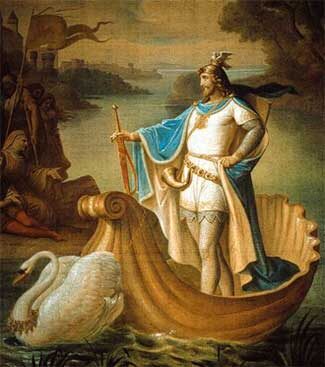
Picture: August von Heckel, via Wikimedia Commons · Public domain