Maxwell's equations
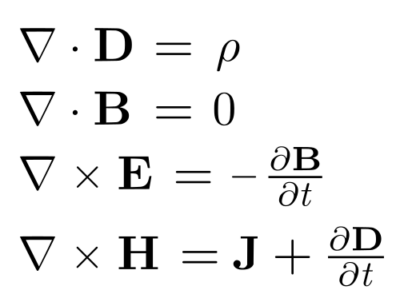
Maxwell's equations is a set of partial differential equations that describe how electric and magnetic fields are generated and altered by each other and by charges and currents. It came out in 1861.
- Released
- 1861
All 4 facts, and where they come from
Facts
4 facts · 0 confirmed by two sources · 0 cited · 4 from one source
Where this comes from
Papalocal keeps its own record. It started from these sources; what each one said is kept here as it was copied, so a change on their side never changes this page by itself. Tap one to read its version.
What Wikidata says · copied November 17, 2026 · revision 2547951651
- Described as
- set of partial differential equations that describe how electric and magnetic fields are generated and altered by each other and by charges and currents
- Other names
- Maxwell equations, Maxwell's laws
- What it is
- mathematical descriptions of the electromagnetic field; physical theory
- Released
- 1861
- Named after
- James Clerk Maxwell
- Wikipedias with a page
- 89
Wikidata item Q51501 (wikidata.org/wiki/Q51501), public domain (CC0). Copied 2026-11-17.
What Wikipedia says · copied November 17, 2026 · revision 1383214960
Maxwell's equations are a set of coupled partial differential equations that describe how electric and magnetic fields are generated by electric charges and currents. Together with the Lorentz force law, they form the foundation of classical electromagnetism, classical optics, and electric and magnetic circuits. The equations provide a mathematical model for electrical, optical, and radio technologies, such as power generation, electric motors, Wireless communication, lenses, and radar.
Maxwell's equations have two major variants:The microscopic equations have universal applicability but are unwieldy for common calculations. They relate the electric and magnetic fields to total charge and total current, including the complicated charges and currents in materials at the atomic scale.
The macroscopic equations define two new auxiliary fields that describe the large-scale behaviour of matter without having to consider atomic-scale charges and quantum phenomena like spins. However, their use requires experimentally determined parameters for a phenomenological description of the electromagnetic response of materials.
The term "Maxwell's equations" is often also used for equivalent alternative formulations. Versions of Maxwell's equations based on the electric and magnetic scalar potentials are preferred for explicitly solving the equations as a boundary value problem, analytical mechanics, or for use in quantum mechanics. The covariant formulation (on spacetime rather than space and time separately) makes the compatibility of Maxwell's equations with special relativity manifest. Maxwell's equations in curved spacetime, commonly used in high-energy and gravitational physics, are compatible with general relativity.
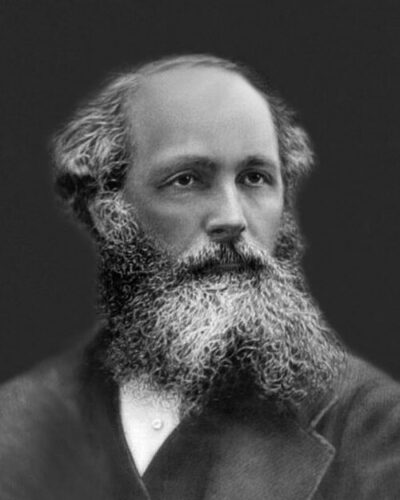
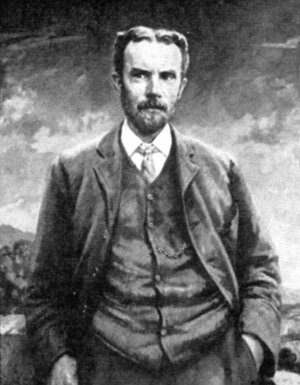
Maxwell's equations are named after the physicist and mathematician James Clerk Maxwell, who, in 1861 and 1862, published an early form of the equations that included the Lorentz force law. The publication of the equations marked the unification of a theory for previously separately described phenomena: magnetism, electricity, light, and associated radiation. The modern form of the equations in their most common formulation is credited to Oliver Heaviside.
The general solutions to Maxwell's equations are given by Jefimenko's equations, which provide the expressions for the electric and magnetic fields created by an arbitrary distribution of electric charges and currents.
Since the mid-20th century, it has been understood that Maxwell's equations do not give an exact description of electromagnetic phenomena, but are instead a classical limit of the more precise theory of quantum electrodynamics.
From the Wikipedia article “Maxwell's equations” (en.wikipedia.org/wiki/Maxwell's_equations), by its contributors, under CC BY-SA 4.0 (creativecommons.org/licenses/by-sa/4.0/). Copied 2026-11-17; not changed.
Confirmed Two sources agree. Cited One source, and it names where it got it. One source One source, without a reference of its own. Sources disagree The sources disagree. We show the best-supported value and keep theirs below.
Picture: GYassineMrabetTalk✉, via Wikimedia Commons · CC BY-SA 3.0