
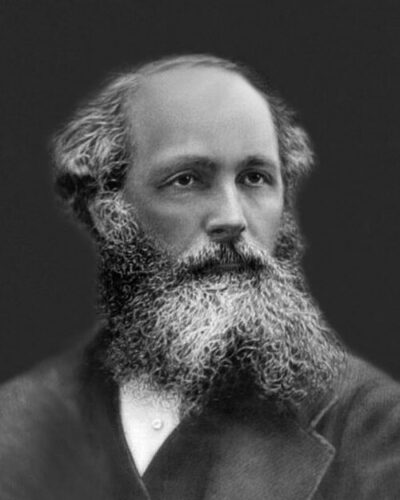
James Clerk Maxwell
James Clerk Maxwell was a Scottish physicist. Born June 13, 1831, in Edinburgh. Died November 5, 1879, in Cambridge. Positions held include Cavendish Professor of Physics (1871–1879). Known for A Dynamical Theory of the Electromagnetic Field, Maxwell's equations and Maxwell–Boltzmann statistics. Educated at University of Edinburgh and Peterhouse. Awards include Fellow of the Royal Society, Rumford Medal and Royal Society Bakerian Medal.
Facts
51 facts · 2 confirmed by two sources · 31 cited · 17 from one source · 1 where the sources disagree
What’s different
- Buried in: we show Westminster Abbey (Sources disagree). Wikidata also lists Parton Churchyard
Where this comes from
Papalocal keeps its own record. It started from these sources; what each one said is kept here as it was copied, so a change on their side never changes this page by itself. Tap one to read its version.
What Wikidata says · copied November 16, 2026 · revision 2568755488
- Described as
- Scottish physicist (1831–1879)
- Other names
- Maxwell
- Born
- June 13, 1831 · 17 references
- Died
- November 5, 1879 · 16 references
- Born in
- Edinburgh · 4 references
- Died in
- Cambridge · 3 references
- Buried in
- Westminster Abbey · 1 reference; Parton Churchyard · 1 reference
- Cause of death
- stomach cancer
- Citizen of
- United Kingdom of Great Britain and Ireland · 1 reference
- Occupation
- physicist · 3 references; mathematician · 1 reference; inventor; photographer; university teacher · 1 reference; theoretical physicist; teacher · 1 reference; thermodynamicist
- Positions held
- Cavendish Professor of Physics (1871–1879) · 1 reference
- Worked for
- King's College London (1860–1866) · 1 reference; University of Cambridge (1871–1879) · 1 reference; Marischal College (1856–1860) · 1 reference
- Education
- University of Edinburgh (1847–1850) · 1 reference; Peterhouse (1850–1851) · 1 reference; Edinburgh Academy (1841–1847) · 2 references; Trinity College (1851–1854) · 1 reference; University of Cambridge · 1 reference
- Member of
- Royal Society of London; American Academy of Arts and Sciences; Royal Society of Edinburgh · 1 reference; Royal Netherlands Academy of Arts and Sciences · 1 reference; Göttingen Academy of Sciences and Humanities in Lower Saxony
- Known for
- A Dynamical Theory of the Electromagnetic Field · 1 reference; Maxwell's equations; Maxwell–Boltzmann statistics; Maxwell's demon
- Awards
- Fellow of the Royal Society (1861) · 1 reference; Rumford Medal (1860) · 1 reference; Royal Society Bakerian Medal (1866) · 2 references; Keith Medal (1869) · 1 reference; Adams Prize (1857) · 1 reference; Fellow of the Royal Society of Edinburgh (1856) · 1 reference; Scottish Engineering Hall of Fame (2012) · 1 reference; Smith's Prize (1854) · 1 reference
- Field
- physics · 1 reference; mechanics; mathematics · 1 reference; electromagnetic field · 1 reference; electricity · 1 reference; magnetism · 1 reference
- Spouse
- Katherine Clerk Maxwell (1858–) · 3 references
- Father
- John Clerk-Maxwell of Middlebie · 2 references
- Mother
- Frances Cay · 2 references
- Religion
- Christian socialism
- Wikipedias with a page
- 163
Wikidata item Q9095 (wikidata.org/wiki/Q9095), public domain (CC0). Copied November 16, 2026.
What Wikipedia says · copied November 16, 2026 · revision 1384178077
James Clerk Maxwell (13 June 1831 – 5 November 1879) was a Scottish physicist and mathematician who was responsible for the classical theory of electromagnetic radiation, which was the first theory to describe electricity, magnetism and light as different manifestations of the same phenomenon. Maxwell's equations for electromagnetism achieved the second great unification in physics, where the first one had been realised by Isaac Newton. Maxwell was also key in the creation of statistical mechanics.
Maxwell graduated from Trinity College, Cambridge, in 1854, where he earned distinction in mathematics and the Smith's Prize. He remained at Cambridge briefly, publishing early mathematical work and investigations into optics, particularly the principles of colour combination and colour-blindness. He later held the Chair of Natural Philosophy at Marischal College in Aberdeen, where he studied the rings of Saturn and correctly proposed that they were composed of numerous small particles, work that earned him the Adams Prize in 1859. During this time he married Katherine Mary Dewar, who assisted him in his laboratory work. From 1860 to 1865, he served as the Professor of Natural Philosophy at King's College London, where he developed his theory of electromagnetic fields. His publication of "A Dynamical Theory of the Electromagnetic Field" in 1865 demonstrated that electric and magnetic fields travel through space as waves moving at the speed of light, proposing that light is an undulation in the same medium that is the cause of electric and magnetic phenomena. His unification of light and electrical phenomena led to his prediction of the existence of radio waves.
Maxwell was the first to derive the Maxwell–Boltzmann distribution, a statistical means of describing aspects of the kinetic theory of gases, which he worked on sporadically throughout his career. He presented the first durable colour photograph in 1861, and showed that any colour can be produced with a mixture of any three primary colours, those being red, green, and blue, the basis for colour television. He worked on analysing the rigidity of rod-and-joint frameworks (trusses) like those in many bridges. He devised modern dimensional analysis and helped to establish the CGS system of measurement. He was the first to recognize chaos, and the first to emphasize the butterfly effect. His 1863 paper On Governors serves as an important foundation for control theory and cybernetics, and was also the earliest mathematical analysis on control systems. In 1867, he proposed the thought experiment known as Maxwell's demon, which challenges how information affects entropy in thermodynamics. In his seminal 1867 paper On the Dynamical Theory of Gases he introduced the Maxwell model for describing the behavior of a viscoelastic material and originated the Maxwell-Cattaneo equation for describing the transport of heat in a medium.
In 1871, Maxwell returned to Cambridge as the first Cavendish Professor of Physics, overseeing the construction of the Cavendish Laboratory. As a result of his work he is regarded as a founder of the modern field of electrical engineering.
His discoveries helped usher in the era of modern physics, laying the foundations for such fields as relativity (he was the one to introduce the term into physics) and quantum mechanics.
- Born, in its opening lines
- June 13, 1831
- Died, in its opening lines
- November 5, 1879
From the Wikipedia article “James Clerk Maxwell” (en.wikipedia.org/wiki/James_Clerk_Maxwell), by its contributors, under CC BY-SA 4.0 (creativecommons.org/licenses/by-sa/4.0/). Copied November 16, 2026; not changed.
Confirmed Two sources agree. Cited One source, and it names where it got it. One source One source, without a reference of its own. Sources disagree The sources disagree. We show the best-supported value and keep theirs below.
