periodic table
Periodic table is a table systematically placing elements based on atomic number and recurrent properties. It came out in 1869. It is based on periodic trends.
- Came out
- March 6, 1869
- Country of origin
- Russian Empire
All 6 facts, and where they come from
Facts
6 facts · 0 confirmed by two sources · 0 cited · 6 from one source
Where this comes from
Papalocal keeps its own record. It started from these sources; what each one said is kept here as it was copied, so a change on their side never changes this page by itself. Tap one to read its version.
What Wikidata says · copied November 17, 2026 · revision 2567625863
- Described as
- table systematically placing elements based on atomic number and recurrent properties
- Other names
- Mendeleev's periodic table, periodic table of chemical elements, periodic table of elements, the periodic table, periodic classification of elements
- What it is
- chemical classification
- Country of origin
- Russian Empire
- Based on
- periodic trends
- Came out
- March 6, 1869
- Named after
- Dmitri Mendeleev; period
- Wikipedias with a page
- 230
Wikidata item Q10693 (wikidata.org/wiki/Q10693), public domain (CC0). Copied 2026-11-17.
What Wikipedia says · copied November 17, 2026 · revision 1381469771
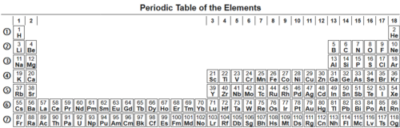
The periodic table, also known as the periodic table of the elements, is an ordered arrangement of the chemical elements into rows ("periods") and columns ("groups"). Elements in the same group tend to show similar chemical characteristics. The table is also divided into four roughly rectangular areas called blocks. The periodic table is an icon of chemistry, although it is also widely used in physics and other sciences. It is a depiction of the periodic law, which states that when the elements are arranged in order of their atomic numbers an approximate recurrence of their properties is evident.
Vertical, horizontal and diagonal trends characterize the periodic table. Metallic character increases going down a group and from right to left across a period. Nonmetallic character increases going from the bottom left of the periodic table to the top right.
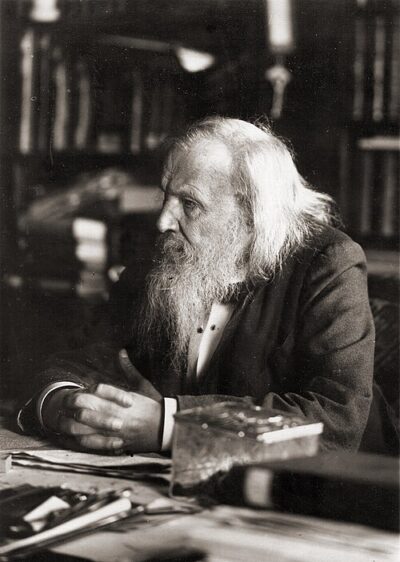
The first periodic table to become generally accepted was that of the Russian chemist Dmitri Mendeleev in 1869; he formulated the periodic law as a dependence of chemical properties on atomic mass. As not all elements were then known, there were gaps in his periodic table, and Mendeleev successfully used the periodic law to predict some properties of some of the missing elements. The periodic law was recognized as a fundamental discovery in the late 19th century. It was explained early in the 20th century, with the discovery of atomic numbers and associated pioneering work in quantum mechanics, both ideas serving to illuminate the internal structure of the atom. A recognisably modern form of the table was reached in 1945 with Glenn T. Seaborg's discovery that the actinides were in fact f-block rather than d-block elements. The periodic table and law have become a central and indispensable part of modern chemistry.
The periodic table continues to evolve with the progress of science. In nature, only elements up to atomic number 94 exist; elements beyond that are synthetic elements that can only be obtained artificially. By 2010, the first 118 elements were known, thereby completing the first seven rows of the table; however, chemical characterization is still needed for the heaviest elements to confirm that their properties match their positions. New discoveries will extend the table beyond these seven rows, though it is not yet known how many more elements are possible; moreover, theoretical calculations suggest that this unknown region will not follow the patterns of the known part of the table. Some scientific discussion also continues regarding whether some elements are correctly positioned in the table. Many alternative representations of the periodic law exist, and there is some discussion as to whether there is an optimal form of the periodic table.
From the Wikipedia article “Periodic table” (en.wikipedia.org/wiki/Periodic_table), by its contributors, under CC BY-SA 4.0 (creativecommons.org/licenses/by-sa/4.0/). Copied 2026-11-17; not changed.
Confirmed Two sources agree. Cited One source, and it names where it got it. One source One source, without a reference of its own. Sources disagree The sources disagree. We show the best-supported value and keep theirs below.
Picture: Wikimedia Commons · CC BY-SA 4.0