
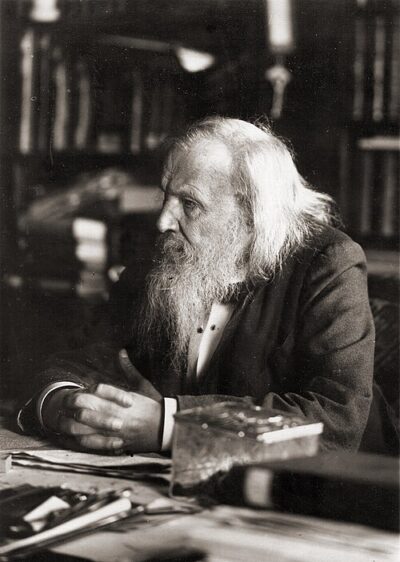
Dmitri Mendeleev
Dmitri Mendeleev was a Russian chemist. Born January 27, 1834, in Tobolsk. Died January 20, 1907, in Saint Petersburg. Positions held include Privatdozent (1857–1865), senior professor (1855–1856) and full professor (1863–1890). Known for periodic table. Educated at Main Pedagogical Institute and Saint Petersburg State University. Awards include Knight of the Order of St. Alexander Nevsky, Copley Medal and Faraday Lectureship Prize.
Facts
63 facts · 0 confirmed by two sources · 10 cited · 51 from one source · 2 where the sources disagree
What’s different
- Born: we show January 27, 1834 (Sources disagree). Wikipedia says February 8, 1834
- Died: we show January 20, 1907 (Sources disagree). Wikipedia says February 2, 1907
Where this comes from
Papalocal keeps its own record. It started from these sources; what each one said is kept here as it was copied, so a change on their side never changes this page by itself. Tap one to read its version.
What Wikidata says · copied November 16, 2026 · revision 2566508340
- Described as
- Russian chemist (1834–1907)
- Other names
- Mendeleev, Dmitry Mendeleyev, Dimitri Mendeleyev, Dmitri Mendeleiev, Dmitri Ivanovich Mendeleyev, Dmitri Mendeleyev, Dmitri Ivanovich Mendeleev
- Born
- January 27, 1834 · 5 references
- Died
- January 20, 1907 · 4 references
- Born in
- Tobolsk · 6 references
- Died in
- Saint Petersburg · 5 references
- Buried in
- Volkovo Cemetery Writer's Walkways · 2 references
- Cause of death
- pneumonia · 2 references
- Name at birth
- Дмитрій Ивановичъ Менделѣевъ
- Citizen of
- Russian Empire · 1 reference
- Occupation
- chemist · 2 references; physicist · 1 reference; university teacher · 1 reference; economist · 1 reference
- Positions held
- Privatdozent (1857–1865); senior professor (1855–1856); full professor (1863–1890)
- Worked for
- Imperial St. Petersburg University (1857–1890) · 1 reference; Richelieu Lyceum (1855–1856) · 1 reference; St. Petersburg Practical Institute of Technology (1863–1872); Saint Petersburg State University · 1 reference
- Education
- Main Pedagogical Institute (1850–1855) · 1 reference; Saint Petersburg State University · 1 reference; Saint Petersburg State Institute of Technology · 1 reference
- Member of
- Royal Society of London (1892–); Royal Prussian Academy of Sciences (1900–); Serbian Academy of Sciences and Arts (1904–); Royal Swedish Academy of Sciences (1905–); Göttingen Academy of Sciences and Humanities in Lower Saxony; Saint Petersburg Academy of Sciences (1876–) · 1 reference; Hungarian Academy of Sciences (1900–); American Academy of Arts and Sciences (1889–); American Philosophical Society · 1 reference; Accademia Nazionale delle Scienze detta dei XL
- Known for
- periodic table
- Awards
- Knight of the Order of St. Alexander Nevsky · 1 reference; Copley Medal (1905) · 1 reference; Faraday Lectureship Prize (1889); Demidov Prize (1862); Order of Saint Anna, 1st class; Order of Saint Anna, 2nd class; Order of the White Eagle; Order of Saint Stanislaus, 1st class; Order of St. Vladimir, 2nd class; Order of St. Vladimir, 1st class; Knight of the Legion of Honour; Davy Medal (1882) · 1 reference; Foreign Member of the Royal Society (1892) · 1 reference; honorary member of the Physics Association (Frankfurt am Main, Germany) (1874)
- Field
- chemistry · 2 references; physics; economics · 1 reference; geology · 1 reference; metrology · 1 reference; chemical element · 1 reference
- Spouse
- Anna Ivanova Popova (1882–) · 1 reference; Feozva Nikitichna Leshcheva (1862–1882)
- Children
- Vladimir Mendeleev · 1 reference; Lyubov Blok · 1 reference; Vasiliy Mendeleev · 1 reference; Polina Mendeléef
- Father
- Ivan Pavlovich Mendeleyev
- Mother
- Maria Dmitrievna Mendeleeva
- Siblings
- Ekaterina Ivanovna Mendeleeva
- Religion
- deism · 1 reference
- Wikipedias with a page
- 181
Wikidata item Q9106 (wikidata.org/wiki/Q9106), public domain (CC0). Copied November 16, 2026.
What Wikipedia says · copied November 16, 2026 · revision 1383664647
Dmitri Ivanovich Mendeleev ( MEN-dəl-AY-əf; 8 February [O.S. 27 January] 1834 – 2 February [O.S. 20 January] 1907) was a Russian chemist known for formulating the periodic law and creating a version of the periodic table of elements. He used the periodic law not only to correct the then-accepted properties of some known elements, such as the valence and atomic weight of uranium, but also to predict the properties of three elements that were yet to be discovered (germanium, gallium, and scandium). The synthetic element mendelevium is named in his honor. He was one of the founders of the Russian Chemical Society in 1868, and worked on the theory and practice of protectionist trade and on agriculture.
- Born, in its opening lines
- February 8, 1834
- Died, in its opening lines
- February 2, 1907
From the Wikipedia article “Dmitri Mendeleev” (en.wikipedia.org/wiki/Dmitri_Mendeleev), by its contributors, under CC BY-SA 4.0 (creativecommons.org/licenses/by-sa/4.0/). Copied November 16, 2026; not changed.
Confirmed Two sources agree. Cited One source, and it names where it got it. One source One source, without a reference of its own. Sources disagree The sources disagree. We show the best-supported value and keep theirs below.
