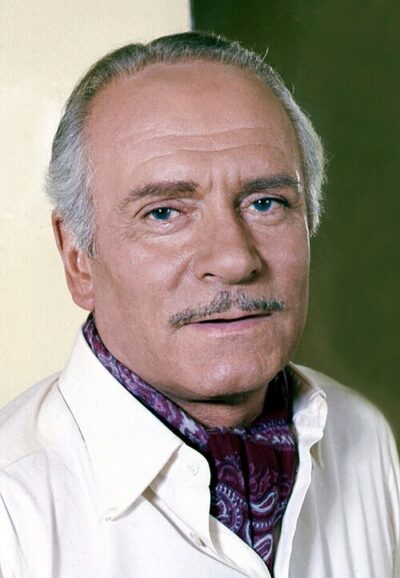
Richard III
Richard III is a 1955 film directed by Laurence Olivier. It stars Ralph Richardson and Claire Bloom. It won the BAFTA Award for Best Film and 4 more.
- Released
- 1955
- Directed by
- Laurence Olivier
- Genre
- drama film
- Country of origin
- United Kingdom
All 30 facts, and where they come from
Facts
30 facts · 0 confirmed by two sources · 13 cited · 17 from one source
Where this comes from
Papalocal keeps its own record. It started from these sources; what each one said is kept here as it was copied, so a change on their side never changes this page by itself. Tap one to read its version.
What Wikidata says · copied November 17, 2026 · revision 2565721535
- Described as
- 1955 film directed by Laurence Olivier
- What it is
- film
- Directed by
- Laurence Olivier · 3 references
- Music by
- William Walton
- Screenplay by
- Laurence Olivier; David Garrick
- Produced by
- Laurence Olivier; Alexander Korda
- Starring
- Laurence Olivier · 3 references; Ralph Richardson · 2 references; Claire Bloom · 1 reference; Cedric Hardwicke · 2 references; John Gielgud · 1 reference; Laurence Naismith · 1 reference; Norman Wooland · 1 reference; Mary Kerridge · 1 reference; Pamela Brown · 1 reference; Stanley Baker · 1 reference
- Genre
- drama film; epic film · 1 reference; historical film
- Released
- 1955
- Original language
- English; Latin · 1 reference
- Country of origin
- United Kingdom
- Based on
- Richard III
- Awards
- BAFTA Award for Best Film (1956); Golden Globe Award for Best English-Language Foreign Film (1956); David di Donatello for Best Foreign Actor (1957); David di Donatello for best foreign production (1957); BAFTA Award for Best British Film (1955)
- Wikipedias with a page
- 22
Wikidata item Q1968853 (wikidata.org/wiki/Q1968853), public domain (CC0). Copied 2026-11-17.
What Wikipedia says · copied November 17, 2026 · revision 1385196082
Richard III is a 1955 British Technicolor film adaptation of William Shakespeare's historical play of the same name, also incorporating elements from his Henry VI, Part 3. It was directed and produced by Laurence Olivier, who also played the lead role. Featuring many noted Shakespearean actors, including a quartet of knights, the film depicts Richard plotting and conspiring to grasp the throne from his brother King Edward IV, played by Sir Cedric Hardwicke. In the process, many are killed and betrayed, with Richard's evil leading to his own downfall. The prologue of the film states that history without its legends would be "a dry matter indeed", implicitly admitting to the artistic licence that Shakespeare applied to the events of the time.
Of the three Shakespearean films directed by Olivier, Richard III received the least critical praise at the time, although it was still acclaimed. It was the only one not to be nominated for Best Picture at the Academy Awards, though Olivier's performance was nominated. The British Film Institute has pointed out that, given the enormous TV audience it received when shown in the United States on NBC in 1956, the film "may have done more to popularise Shakespeare than any other single work". The film gained further popularity in the US through a 1966 re-release, which broke box office records in many US cities. Many critics now consider Olivier's Richard III his best Shakespearean screen adaptation.
From the Wikipedia article “Richard III (1955 film)” (en.wikipedia.org/wiki/Richard_III_(1955_film)), by its contributors, under CC BY-SA 4.0 (creativecommons.org/licenses/by-sa/4.0/). Copied 2026-11-17; not changed.
Confirmed Two sources agree. Cited One source, and it names where it got it. One source One source, without a reference of its own. Sources disagree The sources disagree. We show the best-supported value and keep theirs below.