Riemann zeta function
Riemann zeta function is an analytic function.
All 5 facts, and where they come from
Facts
5 facts · 0 confirmed by two sources · 0 cited · 5 from one source
Where this comes from
Papalocal keeps its own record. It started from these sources; what each one said is kept here as it was copied, so a change on their side never changes this page by itself. Tap one to read its version.
What Wikidata says · copied November 17, 2026 · revision 2567567908
- Described as
- analytic function
- Other names
- Euler-Riemann zeta function, zeta function
- What it is
- analytic function; transcendental function; hypertranscendental function
- Named after
- Bernhard Riemann; Leonhard Euler
- Wikipedias with a page
- 58
Wikidata item Q187235 (wikidata.org/wiki/Q187235), public domain (CC0). Copied 2026-11-17.
What Wikipedia says · copied November 17, 2026 · revision 1381421819
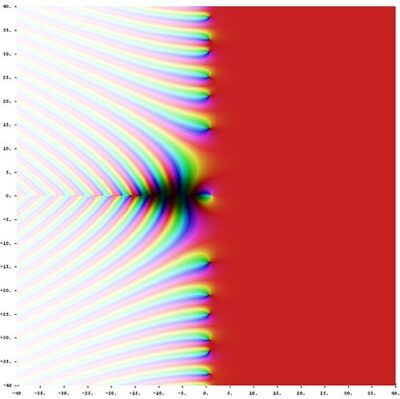
In mathematics, the Riemann zeta function, or Euler–Riemann zeta function, denoted by the lowercase Greek letter ζ (zeta), is a function of a complex variable defined as ζ(s)=∑n=1∞1ns=11s+12s+13s+⋯ for Re(s)>1, and its analytic continuation elsewhere.
The Riemann zeta function plays a pivotal role in analytic number theory and has applications in physics, probability theory, and applied statistics.
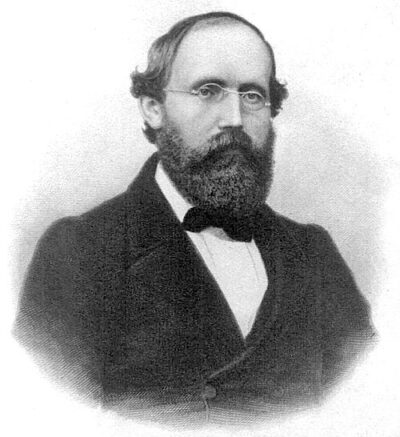
Leonhard Euler first introduced and studied the function over the reals in the first half of the eighteenth century. Bernhard Riemann's seminal 1859 article "On the Number of Primes Less Than a Given Magnitude" extended Euler's definition to a complex variable, proved its meromorphic continuation and functional equation, and established a relation between its zeros and the distribution of prime numbers. This paper also contained the Riemann hypothesis, a conjecture about the distribution of complex zeros of the Riemann zeta function that many mathematicians consider the most important unsolved problem in pure mathematics.
The values of the Riemann zeta function at even positive integers were computed by Euler. The first of them, ζ(2), provides a solution to the Basel problem. In 1979, Roger Apéry proved the irrationality of ζ(3), and as a consequence, the number was named after him. The values at negative integer points, also found by Euler, are rational numbers and play an important role in the theory of modular forms. Many generalizations of the Riemann zeta function, such as Dirichlet series, Dirichlet L-functions and L-functions, are known.
From the Wikipedia article “Riemann zeta function” (en.wikipedia.org/wiki/Riemann_zeta_function), by its contributors, under CC BY-SA 4.0 (creativecommons.org/licenses/by-sa/4.0/). Copied 2026-11-17; not changed.
Confirmed Two sources agree. Cited One source, and it names where it got it. One source One source, without a reference of its own. Sources disagree The sources disagree. We show the best-supported value and keep theirs below.
Picture: Jan Homann, via Wikimedia Commons · Public domain