Riemannian geometry
Riemannian geometry is a branch of differential geometry dealing with (generalized) Riemannian manifolds.
All 2 facts, and where they come from
Facts
2 facts · 0 confirmed by two sources · 0 cited · 2 from one source
Where this comes from
Papalocal keeps its own record. It started from these sources; what each one said is kept here as it was copied, so a change on their side never changes this page by itself. Tap one to read its version.
What Wikidata says · copied November 17, 2026 · revision 2541643805
- Described as
- branch of differential geometry dealing with (generalized) Riemannian manifolds
- What it is
- branch of mathematics
- Named after
- Bernhard Riemann
- Wikipedias with a page
- 41
Wikidata item Q761383 (wikidata.org/wiki/Q761383), public domain (CC0). Copied 2026-11-17.
What Wikipedia says · copied November 17, 2026 · revision 1365994663
Riemannian geometry is the branch of differential geometry that studies Riemannian manifolds. An example of a Riemannian manifold is a surface, on which distances are measured by the length of curves on the surface. Riemannian geometry is the study of surfaces and their higher-dimensional analogs (called manifolds), in which distances are calculated along curves belonging to the manifold. Formally, Riemannian geometry is the study of smooth manifolds with a Riemannian metric (an inner product on the tangent space at each point that varies smoothly from point to point). This gives, in particular, local notions of angle, length of curves, surface area and volume. From those, some other global quantities can be derived by integrating local contributions.
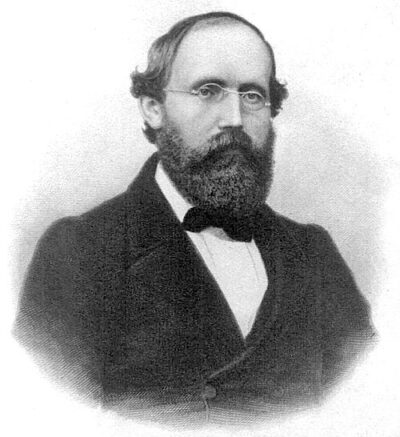
Riemannian geometry originated with the vision of Bernhard Riemann expressed in his inaugural lecture "Über die Hypothesen, welche der Geometrie zu Grunde liegen" ("On the Hypotheses on which Geometry is Based"). It is a very broad and abstract generalization of the differential geometry of surfaces in R3. Development of Riemannian geometry resulted in synthesis of diverse results concerning the geometry of surfaces and the behavior of geodesics on them, with techniques that can be applied to the study of differentiable manifolds of higher dimensions. It enabled the formulation of Einstein's general theory of relativity, made profound impact on group theory and representation theory, as well as analysis, and spurred the development of algebraic and differential topology.
From the Wikipedia article “Riemannian geometry” (en.wikipedia.org/wiki/Riemannian_geometry), by its contributors, under CC BY-SA 4.0 (creativecommons.org/licenses/by-sa/4.0/). Copied 2026-11-17; not changed.
Confirmed Two sources agree. Cited One source, and it names where it got it. One source One source, without a reference of its own. Sources disagree The sources disagree. We show the best-supported value and keep theirs below.