Schrödinger equation
Schrödinger equation is a partial differential equation describing how the quantum state of a non-relativistic physical system changes with time. It came out in 1923. It was written by Louis de Broglie.
- Came out
- 1923
- Written by
- Louis de Broglie
All 4 facts, and where they come from
Facts
4 facts · 0 confirmed by two sources · 0 cited · 4 from one source
Where this comes from
Papalocal keeps its own record. It started from these sources; what each one said is kept here as it was copied, so a change on their side never changes this page by itself. Tap one to read its version.
What Wikidata says · copied November 17, 2026 · revision 2556383333
- Described as
- partial differential equation describing how the quantum state of a non-relativistic physical system changes with time
- Other names
- Schroedinger equation, Schrodinger equation, Schrödinger wave equation
- What it is
- equation
- Written by
- Louis de Broglie
- Came out
- 1923
- Named after
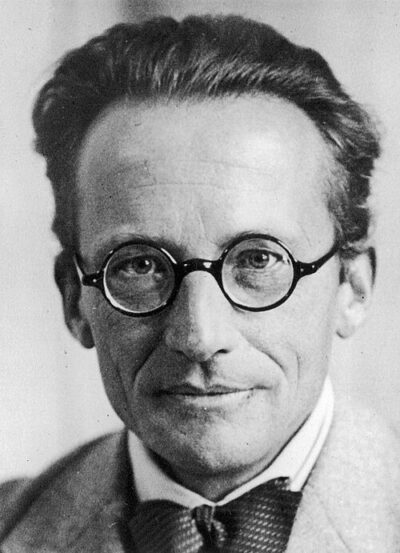
- Erwin Schrödinger
- Wikipedias with a page
- 81
Wikidata item Q165498 (wikidata.org/wiki/Q165498), public domain (CC0). Copied 2026-11-17.
What Wikipedia says · copied November 17, 2026 · revision 1383436244
The Schrödinger equation is a partial differential equation that governs the wave function of a non-relativistic quantum-mechanical system. Its discovery was a significant landmark in the development of quantum mechanics. It is named after Erwin Schrödinger, an Austrian physicist, who postulated the equation in 1925 and published it in 1926, forming the basis for the work that resulted in his Nobel Prize in Physics in 1933.
Conceptually, the Schrödinger equation is the quantum counterpart of Newton's second law in classical mechanics. Given a set of known initial conditions, Newton's second law makes a mathematical prediction as to what path a given physical system will take over time. The Schrödinger equation gives the evolution over time of the wave function, the quantum-mechanical characterization of an isolated physical system. The equation was postulated by Schrödinger based on a postulate of Louis de Broglie that all matter has an associated matter wave. The equation predicted bound states of the atom in agreement with experimental observations.
The Schrödinger equation is not the only way to study quantum mechanical systems and make predictions. Other formulations of quantum mechanics include matrix mechanics, introduced by Werner Heisenberg, and the path integral formulation, developed chiefly by Richard Feynman. When these approaches are compared, the use of the Schrödinger equation is sometimes called "wave mechanics".
The equation given by Schrödinger is non-relativistic because it contains a first derivative in time and a second derivative in space, and therefore space and time are not on equal footing. Paul Dirac incorporated special relativity and quantum mechanics into a single formulation that simplifies to the Schrödinger equation in the non-relativistic limit: the Dirac equation, which contains a single derivative in both space and time. Another partial differential equation, the Klein–Gordon equation, led to a problem with probability density even though it was a relativistic wave equation. The probability density could be negative, which is physically unviable. This was fixed by Dirac by introducing Dirac matrices. In a modern context, the Klein–Gordon equation describes spin-less particles, while the Dirac equation describes spin-1/2 particles.
From the Wikipedia article “Schrödinger equation” (en.wikipedia.org/wiki/Schrödinger_equation), by its contributors, under CC BY-SA 4.0 (creativecommons.org/licenses/by-sa/4.0/). Copied 2026-11-17; not changed.
Confirmed Two sources agree. Cited One source, and it names where it got it. One source One source, without a reference of its own. Sources disagree The sources disagree. We show the best-supported value and keep theirs below.
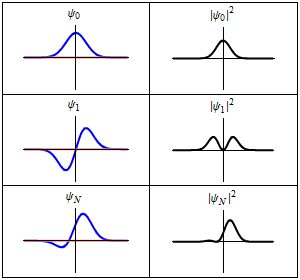
Picture: Sbyrnes321, via Wikimedia Commons · CC0