
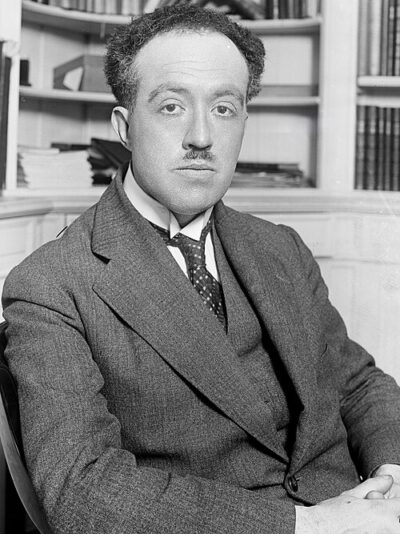
Louis de Broglie
Louis de Broglie was a Nobel laureate credited to pioneer the discovery of wave character of matter. Born August 15, 1892, in Dieppe. Died March 19, 1987, in Louveciennes. Positions held include President of the International Union of History and Philosophy of Science (1953–1956), president (1956–1972) and Member of the Académie française (1944–1987). Known for matter wave. Educated at Science Faculty of Paris and Lycée Janson-de-Sailly. Awards include Grand Cross of the Legion of Honour, Nobel Prize in Physics and Commander of the French Order of Academic Palms.
Facts
56 facts · 2 confirmed by two sources · 26 cited · 28 from one source
Where this comes from
Papalocal keeps its own record. It started from these sources; what each one said is kept here as it was copied, so a change on their side never changes this page by itself. Tap one to read its version.
What Wikidata says · copied November 16, 2026 · revision 2567934562
- Described as
- Nobel laureate credited to pioneer the discovery of wave character of matter (1892–1987)
- Other names
- Prince Louis-Victor de Broglie, Louis-Victor-Pierre-Raymond, 7th duc de Broglie, Louis Victor Pierre Raymond duc de Broglie
- Born
- August 15, 1892 · 13 references
- Died
- March 19, 1987 · 13 references
- Born in
- Dieppe · 3 references
- Died in
- Louveciennes · 2 references
- Buried in
- Neuilly-sur-Seine Old Communal Cemetery · 1 reference
- Name at birth
- Louis Victor Pierre Raymond de Broglie · 1 reference
- Citizen of
- France
- Occupation
- physicist · 2 references; mathematician; university teacher; historian; theoretical physicist; philosopher; researcher · 1 reference
- Positions held
- President of the International Union of History and Philosophy of Science (1953–1956); president (1956–1972); Member of the Académie française (1944–1987) · 1 reference; professor (1933–1962); honorary presidency; President of the Division of History of Science and Technology (1953–1956) · 1 reference
- Worked for
- Science Faculty of Paris (1932–1962) · 1 reference; Sorbonne (1925–1927) · 1 reference; Institut Henri Poincaré (1928–1962) · 1 reference
- Education
- Science Faculty of Paris (1911–1924) · 1 reference; Lycée Janson-de-Sailly (–1909) · 1 reference
- Member of
- Royal Society of London (1953–) · 1 reference; Académie Française (1944–) · 1 reference; German Academy of Sciences Leopoldina (1934–) · 1 reference; Royal Swedish Academy of Sciences; French Academy of Sciences (1933–) · 3 references; Academy of Sciences of the USSR (1958–); Vichy National Council; Pontifical Academy of Sciences (1955–) · 1 reference; International Academy of Quantum Molecular Science · 1 reference; American Academy of Arts and Sciences (1958–) · 1 reference
- Known for
- matter wave
- Awards
- Grand Cross of the Legion of Honour; Nobel Prize in Physics (1929) · 2 references; Commander of the French Order of Academic Palms; CNRS Gold medal (1955) · 2 references; Max Planck Medal (1938); Kalinga Prize (1952) · 1 reference; Helmholtz Medal (1975); honorary doctorate at the Laval University (1947) · 1 reference; honorary doctor of the University of Warsaw · 1 reference; Foreign Member of the Royal Society (1953) · 1 reference; Great Gold medal of the Société d'Encouragement au Progrès (1962); Officer of the Order of Leopold · 1 reference; honorary doctor of the University of Athens; Honorary doctor of the University of Lausanne
- Field
- theoretical physics
- Father
- Victor de Broglie
- Mother
- Pauline Célestine de La Forest d'Armaillé
- Siblings
- Pauline de Broglie; Maurice de Broglie
- Lived in
- Neuilly-sur-Seine
- Wikipedias with a page
- 101
Wikidata item Q83331 (wikidata.org/wiki/Q83331), public domain (CC0). Copied November 16, 2026.
What Wikipedia says · copied November 16, 2026 · revision 1385548273
Louis Victor Pierre Raymond, 7th Duc de Broglie (15 August 1892 – 19 March 1987) was a French theoretical physicist and aristocrat known for his contributions to quantum theory. In his 1924 Ph.D. thesis, he postulated the wave nature of electrons and suggested that all matter has wave properties. This concept is known as the de Broglie hypothesis, an example of wave–particle duality, and forms a central part of the theory of quantum mechanics. In 1929, de Broglie won the Nobel Prize in Physics, after the wave-like behaviour of matter was experimentally confirmed in 1927. This confirmation earned George Paget Thomson and Clinton Davisson the Nobel Prize in Physics in 1937.
The wave-like behaviour of particles theorized by de Broglie was used by Erwin Schrödinger in his formulation of wave mechanics.
De Broglie presented an alternative interpretation of these mechanics called the pilot-wave concept at the 1927 Solvay Conferences, but then abandoned it. In 1952, David Bohm developed a new form of the concept which became known as the de Broglie–Bohm theory. De Broglie revisited the idea in 1956, creating another version that incorporated ideas from Bohm and Jean-Pierre Vigier.
Louis de Broglie was the sixteenth member elected to occupy seat 1 of the Académie Française in 1944, and served as Perpetual Secretary of the French Academy of Sciences. De Broglie became the first high-level scientist to call for establishment of a multi-national laboratory, a proposal that led to the establishment of the European Organization for Nuclear Research (CERN). Among his publications were The Revolution in Physics and Matter and Light. He was honorary president of the French Association of Science Writers and received the inaugural Kalinga Prize from UNESCO for his efforts to popularize science.
- Born, in its opening lines
- August 15, 1892
- Died, in its opening lines
- March 19, 1987
From the Wikipedia article “Louis de Broglie” (en.wikipedia.org/wiki/Louis_de_Broglie), by its contributors, under CC BY-SA 4.0 (creativecommons.org/licenses/by-sa/4.0/). Copied November 16, 2026; not changed.
Confirmed Two sources agree. Cited One source, and it names where it got it. One source One source, without a reference of its own. Sources disagree The sources disagree. We show the best-supported value and keep theirs below.
